


Weekly insights about property in France!
Subscribe and don't miss an issue!
Sales Down, Prices Holding, Why an SCI Makes Sense…Sometimes
Volume X, Issue 30

 Paris Property Price Update:
Sales are down, but prices are holding up.
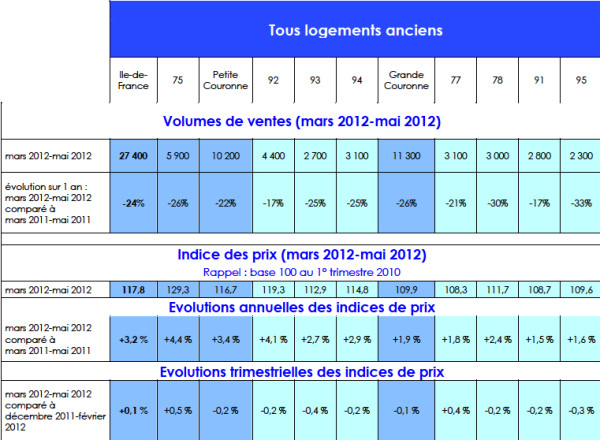
The slowdown trend during the period between February and April 2012 continued in May 2012. From March to May 2012, 27,400 existing homes were sold in the Ile-de-France, a decrease of 24% compared to 36,100 transactions during the period from March to May 2011, which had a decline of 27% compared to the same period between 1999 and 2007.
The decrease is as much for apartments than for houses. All departments in the Ile-de-France recorded a significant decline in transactions.
Yet, sale price has remained stable (0.1% between March and May 2012).
For older apartments, the price per square meter slightly declined in the inner suburbs (-0.5% in 3 months) and the Grande Couronne (-1.0%), but prices held at €5,520 per square meter through May 2012 in the entire region.
In the Capital, the selling price per square meter amounted to €8,330 in May 2012, down slightly by 0.7% in one month. Since November 2011, prices in Paris continued to fluctuate around €8,400. However, according to the latest price projections calculated by the Notaries of Paris — in the Ile de France on the presale agreements (Promesse de Vente), sales prices in Paris are predicted to increase slightly from July 2012.
For older homes, prices rose 0.5% in the Ile-de-France from March to May 2012, reaching €308,500 per house in the Ile-de-France.
 Why or Why Not to Structure Your Title in the Name of and “SCI”:
At the last Property Investors Network meeting, two young lawyers from Fidal, the largest legal firm in France, spoke about the French “Société Civile Immobilière” and handed out a very comprehensive booklet in English about the structure, it’s benefits and its liabilities.
There is one main reason to put the name of your property in the name of an SCI — to control the inheritance of it. French law will not allow you to disinherit your children, and the way property is distributed among the heirs is strictly held under French law. If you have a complicated collection of heirs over which you prefer to have some control, then an SCI may be your answer. But there are advantages and disadvantages, so don’t consider the structure without understanding it.
Here’s what they had to say:
The French “Société Civile Immobilière” by Fidal
An SCI being a civil company incorporated under French law, its organization is very flexible, as reflected in the company’s by-laws:
Its incorporation is simple and does not require a minimum capital (the acquisition of the real estate could be financed by borrowing if necessary);
The legal framework for an ordinary SCI is predefined by model contracts which will be adjusted and completed as necessary to meet the specific requirements of the partners, notably with respect to: the company management; the ownership of share capital and voting rights; the liability of partners toward third parties; the sale and transmission of company shares;
SCI also features financial advantage since it allows several people to realize real estate investments jointly, the company raising funds among the partners for a common real estate project if any.
The SCI is an excellent tool for managing and transmitting patrimony:
Generally based on family considerations, it allows to anticipate and organize the transfer of real estate, in particular vis-à-vis the concubine, the spouse (depending on the matrimonial regime chosen) or the descendants:
For example, a SCI is a good way of transferring the property to the children while retaining control over the SCI;
In this sense, this instrument can be seen as a kind of “trust à la française.”
It also avoids the dismemberment of a heritage property where the deceased leaves several heirs (preventing any hindering joint ownership);
In an international context, using a SCI grants the application of a single inheritance rule:
Indeed, SCI shares, even though the company holds real estate, are not defined as “real estate” under French civil law, but as securities, subject to the inheritance rules of the country of the deceased (whereas real estate located in France is subject to French civil inheritance rules);
Hence, using a French SCI to hold French real estate prevents the division of the deceased’s estate between the rules that would govern most of his estate and the French inheritance rules that would govern the devolution of the French real estate if it was held directly.
Schemes can also be optimized by dividing the ownership of the shares of the SCI (by separating the usufruct of the bare ownership).
Moreover, in some arrangements, it may be appropriate to place the buildings in an SCI, outside the operating company which will lease the property
In addition, the pledge of creditors is not the same as it is on SCI shares or directly on real property.
In conclusion, several types of real estate structures are possible with a French SCI, but always as a means of property management.
In any case, the SCI must have a sufficient substance in France (otherwise, the French tax authorities could consider the SCI to be fictive and disregard its existence). In this respect, it is strongly advisable for the SCI:
to keep up to date its accounting books (even though there is no legal obligations to publish accounts);
to hold at least one partners’ meeting every year in order to approve the SCI’s accounts;
to open a bank account which will be used to pay all expenses relating to the SCI and the French property.
French income tax
For income tax purposes and capital gains tax, a SCI is a “semi-transparent” entity although it has a legal and tax personality:
In this respect, the tax result is first assessed at the level of the SCI:
In a SCI where all partners are individuals not conducting a commercial activity, the tax result is determined according to the real estate income regime;
Otherwise, the computation of taxable income may be complicated if the tax status of the partners and/or their activities are not uniform.
Then, the tax is levied at the level of the partners (individuals or legal entities) in respect of their profit share. Therefore, when the SCI is held by individuals, they are taxed on any income or gains realized by the SCI as if they had received this income or realized this gain themselves.
If the SCI has a commercial activity (in particular when it gives on lease to third parties the property together with the furniture), the company would become subject to French corporate income tax (CIT).
This also applies where the SCI expressly opts for CIT:
Since SCI used for real estate investment are generally semi-transparent, our analysis would mainly focus on that kind of company (regardless SCI subject to CIT).
When the French SCI is used to rent the property, the rental income is taxable in France since it is realized by a French tax resident company.
In a SCI where all partners are individuals not conducting a commercial activity, the tax result is determined according to the real estate income regime (“Revenus fonciers”):
The taxable property income is arrived at by deducting from the rent actually received during the year, all expenses incurred during the same period for the repair, upkeep and improvement of the property. Interest on loans taken out for the acquisition and repairs and improvement are deductible. The fees and salaries paid to the property managers, guards, etc. are also deductible expenses, as are insurance premiums;
Where the annual property income does not exceed €15,000, the taxpayer simply indicates on his general income tax form the amount of property income received throughout the previous year and enjoys a notional deduction of 30% of the property income to cover expenses.
Accordingly, if the property is rented without furniture (SCI “semi-transparent”), the net rental income realized (as aforementioned) is taxable in the hands of its individual partners, in proportion to their shareholding:
The progressive income tax rates is applicable, with a 41% marginal rate applicable above €141,660 yearly net income for a married couple for fiscal year 2011;
A minimum rate of 20% is applicable to non resident individuals in principle.
For SCI subject to CIT in France (under an option or because the renting of real estate becomes a commercial activity if the accommodation is rented furnished), the standard CIT rate of 33 1/3 % would be applicable at the level of the company (or 15% on the first EUR 38,120 of profits if at least 75% of the SCI’s shares are continuously held by individuals and its annual turnover does not exceed €7,630,000).
The free use of the property by the SCI’s partners or third parties for private accommodation purposes (main residence or holiday home), is not taxable in France, both at the level of the SCI and of its partners (Article 15 II of the French Tax Code and Administrative Guidelines 5 D-2-07 dated on 23 March 2007).
As a counterpart of this non taxation, the expenses incurred by the SCI cannot be deducted for income tax purposes.
The SCI being tax transparent, its individual partners are taxed on capital gains realized by the SCI on the sale of the real estate it holds as if they had held the property directly:
The net gain is subject to tax at a fixed rate of 19% (increased by social contributions of 15.5%, making an effective rate of 34.5%);
In this respect, the taxable capital gain in France is determined by the difference between the sale price of the property and its acquisition price paid by the SCI. The acquisition price can be increased by:
Real acquisition costs (in particular registration duties and notary fees paid upon the acquisition) or by a flat percentage of the acquisition price of 7.5%;
Real renovation, refurbishing, reconstruction costs or, if the property has been held for more than 5 years, by a flat percentage of 15% based on the acquisition price.
By way of exception, the gain realized on the sale of a taxpayer’s main residence in France is exempt.
Furthermore, the taxable capital is reduced by a 2% allowance which is applicable each year as from the 6th year of ownership of the property, a 4% allowance applicable each year as from the 8th year and a 8% allowance applicable each year as from the 25th year:
As a result, the capital gain is fully tax exempt after 30 years of ownership.
In addition, a registration tax equal to 5.09% of the fair market value of the property would be due by the purchaser (which should be added the notary fee at the rate of 1% (including VAT) and the land register salary at the rate 0.1%).
Where the SCI is subject to CIT, the capital gain is taxable at is own level at the standard rate of CIT.
If the partners are EU tax residents at the time of the sale, the capital gain would be subject to a 19% withholding tax (Article 244 bis of the FTC).
If they are not EU tax residents, the withholding tax rate would be 33.1/3 % (or 50 % if the shareholder is resident of a non-cooperative State or territory).
In addition, according to the 2nd draft amended finance act (“AFA”) for 2012, dated on 4 July 2012, real estate income and (direct / indirect) real estate capital gains realized by individuals who are not French tax residents would be subject to social security charges under the standard conditions (at the overall rate of 15.5% currently). This mechanism would apply:
To real estate income received on or after 1st January 2012;
To capital gains on sales occurring as from the publication of the AFA.
The registration tax of 5.09% would also be due by the purchaser (as well as the notary fee and the land register salary).
The immovable property gains tax regime previously described also applies to the sale of shares in companies, the assets of which mainly consist of immovable property or of rights in immovable property, (to the extent that such companies are not subject to CIT in respect of their own income).
Accordingly, the taxable capital gain on the sale of the SCI shares is determined by the difference between:
The sale price of the shares; and
Their nominal value or acquisition price paid, increased by the real acquisition costs and taking into account the profits already taxed and losses already deducted by the seller if any.
The taxable capital is further reduced by the 2% allowance which is applicable each year as from the 6th year of ownership of the property, 4% as from the 8th year and 8% as from the 25th year (the capital gain being fully tax exempt when the shares have been held over 30 years).
In addition, the gain realized on the sale of a taxpayer’s main residence in France is also tax exempt.
Finally, the sale of shares in a non-quoted property company (i.e. a company, whatever its form, the assets of which mainly consist of immovable property or immovable property rights) gives rise to registration duty at a rate of 5%.
In an international context (i.e. where the partners of the French SCI are non-resident in France), the country of taxation depends on the relevant provisions of the Double Tax Treaty (DTT) concluded between France and the country of residence of the seller.
With respect to capital gains realized by an UK tax resident individual, pursuant to Article 14, 2, b of the UK-France DTT, such gain will be taxable in France:
Accordingly, the capital gain would be subject to a 19% withholding tax, the sellers being EU tax residents.
In addition, according to the 2nd draft AFA for 2012, such capital gains would be subject to social security charges under the standard conditions (at the overall rate of 15.5% currently).
If taxable in France, a tax representative needs to be designated (unless the capital gain is totally exempt by application of the above mentioned allowance).
French Wealth tax, inheritance and gift tax
French wealth tax, French inheritance tax and French gift tax are all based on the fair market value of the SCI shares. Fair market value is to be understood as the price the shares could be sold to third parties.
In general, the fair market value of a SCI share can be determined by the difference between the fair market value of its assets (i.e., of the real estate it holds, in general) and the amount of the debts owed by the SCI.
Thus, if the amount of the SCI debts exceeds or equals the fair market value of its assets, the value of the SCI share could be nil;
However, for wealth tax purposes, the SCI shares owned by non-residents are assessed without regard to debt held directly or through one or more intermediaries, by such non-residents on these companies as from 1st January 2012.
French residents are in principle subject to net wealth tax on their worldwide assets whereas non-residents are taxable only on their assets located in France:
Accordingly nonresident individuals are liable to French wealth tax based on the fair market value of their French located assets owned on January 1st after deduction of any debts related to said assets at the same date, unless provided otherwise by a DTT;
However, the SCI shares owned by non-residents are assessed without regard to debt held directly or through one or more intermediaries, by such non-residents on these companies as from 1st January 2012.
As from 1st January 2013, net wealth tax should be assessed on the following cumulative progressive scale schedule (based on the rate applicable for 2011 which should be reintroduced for 2013, further to the Financial Act for 2013):
For 2012, net wealth tax is assessed at the following fixe rate:
In addition, according to the 2nd draft AFA for 2012, a temporary surcharge would be introduced only for 2012. In practice, it would have the effect of:
Maintaining the tax threshold at €1,300,000 for 2012;
Raising the aggregate amount of wealth tax and the temporary surcharge on wealth to wealth tax level prior to the Sarkozy reform (without tax shield), i.e. a progressive rate schedule ranging from 0.55% to 1.8% (as defined previously).
French inheritance and gift tax are due on the fair market value of French located assets, when the deceased/donor was not a French tax resident at the time of his death/his gift (whereas when the deceased/donor was resident in France, all assets, including property owned by the deceased/donor are taxable in France – unless applicable tax treaties provide otherwise).
The UK/France inheritance tax treaty specifically provides that SCI shares are taxable in France even when the deceased was UK domiciled. This DTT not addressing the gift tax issue, the gift of SCI shares could be taxable both in France and in the UK. In that case, avoidance of double taxation needs to be sought in the UK by application of a tax credit.
In any case, no inheritance/ gift tax would be due if the fair market value of the SCI shares is nil or below the personal allowance (indeed, for purposes of calculating gift and inheritance taxes, a fixed deduction of €159,325 is applicable, per ten-year period on the share of each of the ascendants and on the share of the living or represented children).
However, the draft of AFA provides, for estates that go into probate and gifts that are made as from the publication of the AFA:
That the deduction will be reduced to €100,000;
That the ten-year period will be extended to fifteen years.
The rates applicable are identical as regards inheritance and gifts and vary depending on the relationship between the deceased or donor and the beneficiary of the legacy or the gift (the inheritance and gift taxes being assessed on the net share attributed to each beneficiary).
In this respect, for direct line inheritances and gifts in favor of ascendants or descendants, the tax is assessed on a cumulative progressive scale basis as follows (for 2012) :
French 3% tax
According to Article 990 D of the French Tax Code (“FTC”), French and foreign legal entities (like corporate bodies, organizations, trusts and comparable institutions) which directly or indirectly own one or more real estate assets in France may be liable to a 3% annual tax levied on the fair market value of the said asset owned as of January 1st of the year of taxation, unless it can benefit from an exemption provided for by Article 990 E of the FTC.
However, according to the French Administrative Guideline 7 Q-1-08, no 3% annual tax is due in certain circumstances, provided that the SCI filed a 2072 tax return in the year following its first financial year (to be filed by the beginning of May of each year), indicating the identity of its partners, the location of the real estate held and the fact that it is put at the free use of its partners.
It would not be necessary to file the 2072 tax return for the following years as the property is only used privately, as long as one of the following events does not occur: (i) modification of the SCI’s share capital (i.e., new partner or transfer of shares); (ii) change in the property it holds (acquisition or sale); (iii) change in the free use of the property; (iv) the company receives income (including financial income); (v) the partners receive a remuneration from the SCI, including interest from money lent to the SCI. Otherwise, the SCI would need to file another 2072 tax return to indicate the changes which occurred in the preceding calendar year.
For more information, contact:
Vincent Berger
Avocat, Fiscalité internationale
FIDAL DIRECTION INTERNATIONALE
Espace 21
32, place Ronde
F-92035 Paris La Défense Cedex
Tel +33 (0)1 55 68 15 98
Fax +33 (0)1 55 68 14 00
A bientôt,
 Adrian Leeds
Editor, French Property Insider
Email: [email protected]

 P.S. Congratulations to Interior Architect Martine di Mattéo on eight color pages devoted to her design work in two of our Parler Paris Apartments in this month’s issue of Viva Déco — Le Château de Violette and La Musique! To get your copy, visit Viva Déco. To read the article about Martine, download our pdf: Viva Deco July, 2012.

Let Us create a custom strategy for you
You can live or invest in France-now.
Property for sale

what's happening
Check out upcoming events, conferences, or webinars. Join us!
GET FINANCING
Learn about French Property Loan Information.

Read & Subscribe
Dive into more by reading the Adrian Leeds Nouvellettre®
Better yet, subscribe to both and get the updates delivered to your inbox.

Get started with your dream of owning property in Paris.
Join us on Youtube
Dive into more on how to live, invest & escape to France
Be sure to subscribe!
To read more, click the links below.