


Weekly insights about property in France!
Subscribe and don't miss an issue!
The Paris Belly Ache: What’s the Remedy?
Volume X, Issue 16

Yesterday in the Parler Paris Nouvellettre®, I reported on visiting the “Doisneau, Paris les Halles” exhibit at the Hôtel de Ville (on until April 28th). Because of the nature of the exhibit, the story touched on the “Murder of Les Halles,” the original large central wholesale market in Central Paris.
What’s important to our French Property Insider perspective, is how the evolution of this district affects the surrounding property for lifestyle and property values. It is this I’d like to explore with you in today’s issue, although we’ve written much about it over the years in following its progress.
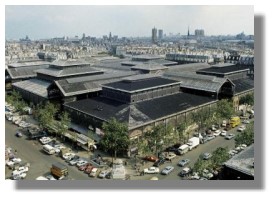 As early in the history of the city, 1183 King Philippe Auguste II enlarged the marketplace by building shelters for the merchants, who came from all over to sell their wares. Centuries later, in the 1850s, massive glass and iron buildings designed by Victor Baltard were constructed. It became known as the “Belly of Paris,” as coined by Émile Zola in his novel, “Le Ventre de Paris,” set in this busy marketplace of the 19th-century.
It thrived more than a century under the halls of Baltard, then moved outside Paris to Rungis and replaced in 1971, ‘thanks’ to President Georges Pompidou and the Préfet Diebold who wanted to build a modern shopping center and the Châtelet-les-Halles railway station. On August 2, 1971, the Baltard Pavillons were demolished while the Parisians were on vacation. (Only one Pavillon has been maintained and transferred to Nogent sur Marne where today this Pavillon has become an event center.)
 While the site was under construction in the 1970s, the enormous pit was nicknamed the “trou des halles” (hole of the halls) and was a black mark on the landscape next to one of the city’s most beautiful churches, Saint-Eustache. Doisneau’s poignant images of a once bustling, thriving market, under beautiful iron structures with Saint-Eustache as the backdrop, brought tears to my eyes to think those days are long gone.
The decision to modernize the district and construct what is the largest railway station in Europe under the shopping center (almost one million travelers per day) was a concept to improve an areas that was known for petty crime and drug trafficking. It became the largest commercial center in Paris with 160 shops, dozens of restaurants and theaters, accommodating 41 million visitors a year. It generates 3,000 jobs and 475 million euros plus it boasts of the largest bookshop in the world — FNAC.
Unfortunately, the crime and drug trafficking only escalated, with the average age of the visitors being 29, two-thirds of whom come from the suburbs. Their ‘grand plan’ has been deemed by Mayor Bertrand Delanoë (and many others) as “the worst urban planning disaster in the history of Paris” and in 2005 announced a new initiative to “revolutionize the life of the center of the city.”
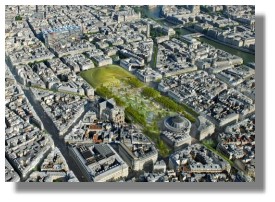
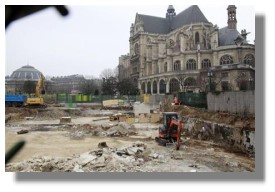 A view shows heavy construction equipment working at the destruction of the ‘Forum des Halles’ complex near Saint Eustache church in Paris March 17, 2011 – Photo: Reuters/Jacky NaegelenHere we go again. It’s undergoing a second face lift under the auspices of architect David Mangin along with architects Patrick Berger and Jacques Anziutti. The design incorporates a massive curvilinear building inspired by plant life: “La Canopée.” We are, once again faced with a new construction site, which may look less like a “trou,” but is just as unsightly. The construction will take place over the next four years with delivery to the public in 2016. Meanwhile, how is the district affected?
This past October, it was reported that the site is overrun with cats and has become a breeding ground. This may have been a blessing when it was still a market place threatened by rodents, but not in today’s environment. Benevolent groups are trying to trap them and take them to the pound, but they’re hard to catch.
And what do you think has happened to the petty crime and drug trafficking? Individuals have reported noticing how the youths have disbursed into areas surrounding Les Halles while construction is underway. Once the new construction is complete, will the district once again become a center for such lawlessness?
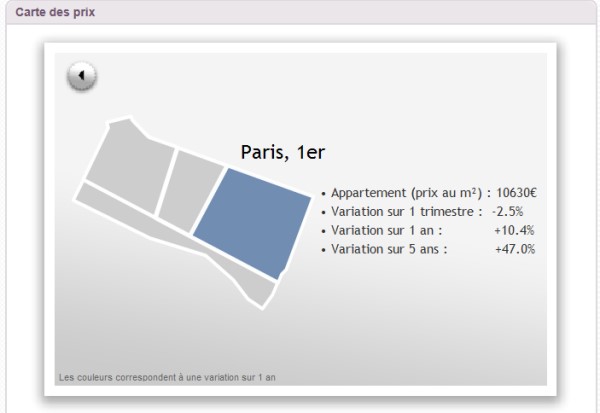
The district’s (75001) property prices are up by 10.4% over the year (2011) and up 47% over the last five years with an average per square meter price of 10,630€. Values don’t seem to be waning in spite of the uncertainty of the area.
This is Paris’ most central district. Call it “the heart” or “the belly,” it will always be important as a city center and I doubt values will ever wane. If you are considering an investment here, take caution, however, and consider the risks and uncertainty of the future. Will Mangin’s concept once again prove to be a poor excuse for the centuries-old marketplace that Doisneau so successfully captured with his Leica?
I’m afraid so.
———-
Special news from the French tax man:
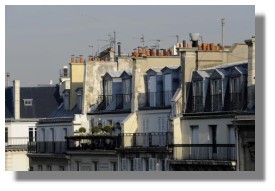 Effective in 2012, there’s a new tax on rental housing of small surfaces in Zone A — namely Paris. Surfaces of 14 square meters (150 square feet) or less rented unfurnished or furnished for a minimum of nine months with an excess rental rate of 40€ per square meter will be taxed on the difference (not including the monthly ‘charges’):
* 10% if the difference is less than 15%
* 18% if the difference is greater or equal to 15%, but less than 30%
* 25% if the difference is greater or equal to 30%, but less than 55%
* 33% if the difference is greater or equal to 55%, but less than 90%
* 40% if the difference is greater or equal to 90%.
For more information, visit Notaires de Paris.
A bientôt,
 Adrian Leeds
Editor, French Property Insider
Email: [email protected]

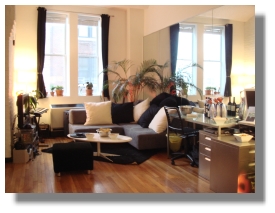 P.S. West Village New York City studio apartment (with a perfect view of the Empire State Building) is available for vacation rental May 29 to July 5 (departure required on July 5) for as little as $175/night, $1100/week (inquire for discounts on longer stays). Located in the heart of the coolest ‘hood’ in the city. “It’s super cozy, clean and comfortable.” A 50% deposit reserves your stay.
See the apartment at West Village Studio
For your reservations requests, email: [email protected]

Let Us create a custom strategy for you
You can live or invest in France-now.
Property for sale
what's happening
Check out upcoming events, conferences, or webinars. Join us!
GET FINANCING
Learn about French Property Loan Information.

Read & Subscribe
Dive into more by reading the Adrian Leeds Nouvellettre®
Better yet, subscribe to both and get the updates delivered to your inbox.

Get started with your dream of owning property in Paris.
Join us on Youtube
Dive into more on how to live, invest & escape to France
Be sure to subscribe!
To read more, click the links below.