

Adrian Leeds Nouvellettre®
Your taste of life in France!
Subscribe and don't miss an issue!
Nice Nice Neighbors (And Some Not So Nice)
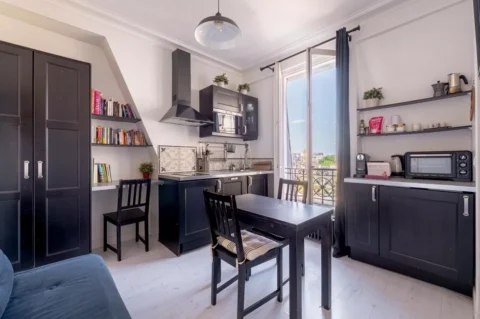
Summers are supposed to be lazy, but mine rarely are. For 12 days, my daughter and her son stayed with me in our one-bedroom apartment in Nice. It was a challenge, to say the least. As anyone who has lived with a 20-month-old knows, he is into everything, all the time, without a moment’s repose. We were constantly shooing him away from one cabinet or another, watching for new ways he might hurt himself, and struggling to get him to nap without a proper crib to contain him.
You can guess how much we are all looking forward to the new two-bedroom apartment being ready. Then they can have this smaller apartment all to themselves—if they wish—and our time together should be considerably more relaxing.
THE NEIGHBOR DOWNSTAIRS
If you have followed any of my property mishaps through these Nouvellettres®, then you know that the issue of the sanibroyeur* toilet is unresolved. For a brief recap (or Google my name and the word “toilet” to be sure to find quite a lot!):
My downstairs neighbor is suing me to remove the sanibroyeur for no obvious reason other than, as it appears to me, harassment. No one involved can see a practical point to it, including the third lawyer now handling my case, who views it as a prolonged cat-and-mouse game.
This has gone on since 2017 with no resolution—hence the third lawyer, who brings a new perspective. The bottom line is that I am legally entitled to have a toilet. There must be a resolution: either permission to install a conventional toilet or formal acceptance of the sanibroyeur by the building, which would negate the legal claim against me.
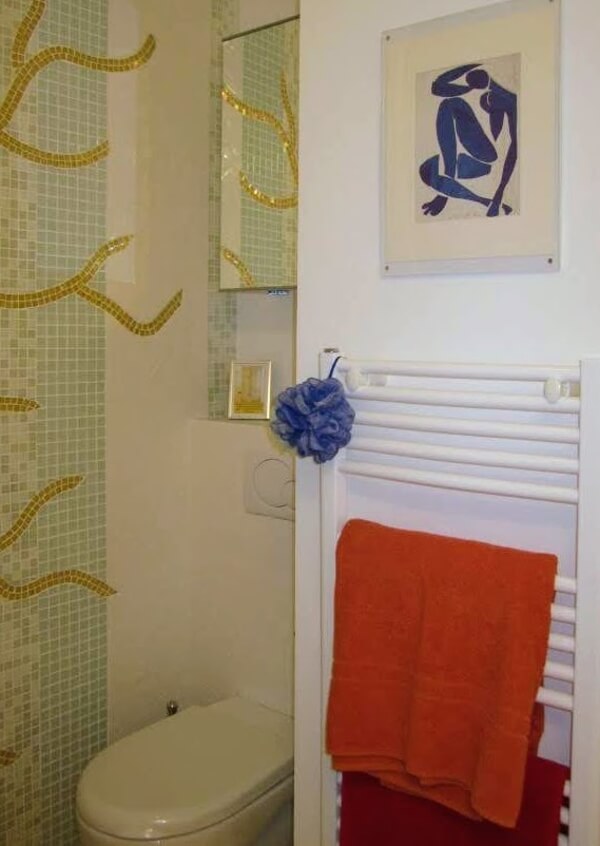
The sanibroyeur toilet in Le Matisse
My neighbor is unwilling to mediate. That leaves us in the hands of the courts, where it can take six months between hearings. Can you believe that? A warning to anyone considering litigation in France: cases can drag on for years, and finding the right lawyer is not easy.
Meanwhile, the apartment is effectively unsalable—who would buy it in the middle of a lawsuit? I’ve told him repeatedly that if he wants to get rid of me, this isn’t the way to do it! Nor did he change his thinking when I offered a six-figure contribution toward installing an elevator, during which the toilet plumbing could be added so that the pipes would never be visible in the stairwell.
His wife simply said the sum was pas suffisant—not enough! I was dumbfounded and thought, “They are never getting their elevator!” How foolish was that?
This week, a specialist visited to assess the situation and estimate the cost of a formal study outlining exactly what would be required to install a conventional toilet—evidence we could present to the court. It’s not cheap. None of it is. But if the sanibroyeur failed, I’d be left with a large closet and no usable abode!
Meanwhile, my contractor inspected the sanibroyeur to make sure it was functioning properly. We couldn’t risk having nothing but a big closet while the kids were visiting, now could we?
The saga continues. Stay tuned.
*A sanibroyeur is a compact toilet system with a built-in electric macerator. It grinds waste and toilet paper into a fine slurry, then pumps it through a narrow pipe to the main drain. It’s useful where installing a conventional large waste pipe would be difficult—such as a basement, attic, or converted room. In English, it’s usually called a macerating toilet or upflush toilet.
ANOTHER DOWNSTAIRS NEIGHBOR
The new two-bedroom apartment has been under renovation for two years because of a dispute with the syndic (building management) over a terrace that leaks into the apartment below and floods my enclosed veranda, making the apartment impossible to finish—or inhabit. Although I own the terrace, its underlying structure is part of the building and is therefore a common area; only the surface belongs to me. Confusing, but true. The delays have cost me time, use of the apartment, and money. The syndic has clearly failed to meet its responsibilities, so claims against it are warranted.
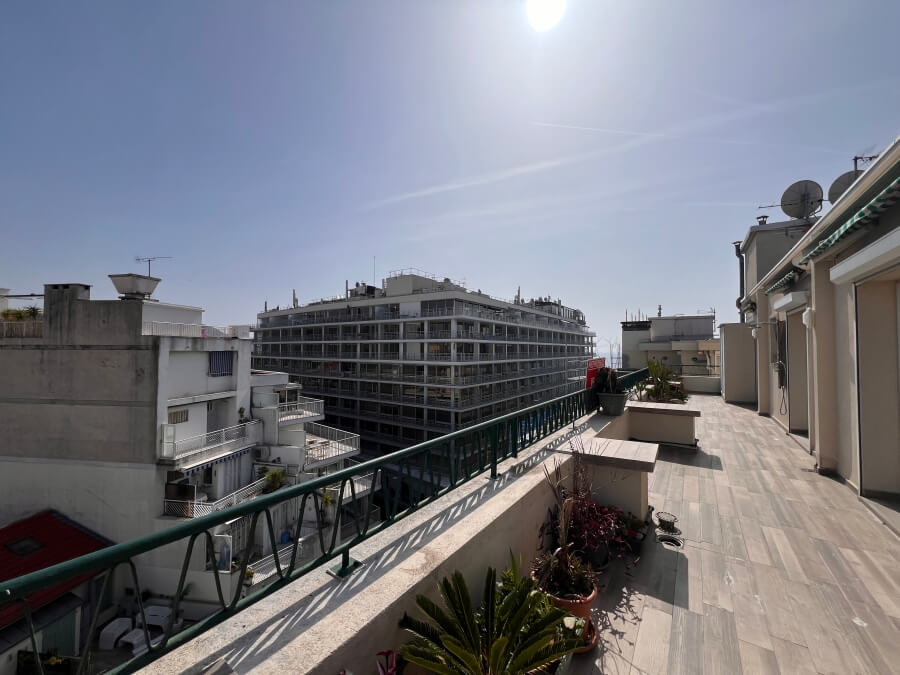
The apartment’s terrace
Finally, after much ado—numerous repairs, tests, and bailiff’s reports—we have reached the point where the interior work can be completed. We are now projecting a move-in date at the end of the year. The terrace will be finished in a way that preserves access should further repairs become necessary.
Fingers crossed that I’ll soon be able to move into the larger apartment. Then, when Erica visits with her son, they can have Le Matisse—the name of the smaller apartment—all to themselves.
THE NEIGHBORING TOWNS
On Thursday, we still had the rental car, so we decided to explore neighboring Antibes and find a sandy beach. If you have never driven west from Nice along the sea to Antibes and around the Cap, it’s a treat not to be missed.
Follow the Promenade des Anglais past the airport, cross the mouth of the River Var near the CAP3000 shopping center, and continue through Cros-de-Cagnes, an old fishing quarter with a small harbor and beachfront restaurants. From there, the route skirts Cagnes-sur-Mer’s long pebble beach and the Hippodrome de la Côte d’Azur before reaching Villeneuve-Loubet-Plage and the distinctive pyramids of Marina Baie des Anges—which first caught my eye on the Riviera in 1979. After the mouth of the River Loup and another stretch of beaches, you arrive at Port Vauban, filled with big, beautiful yachts.
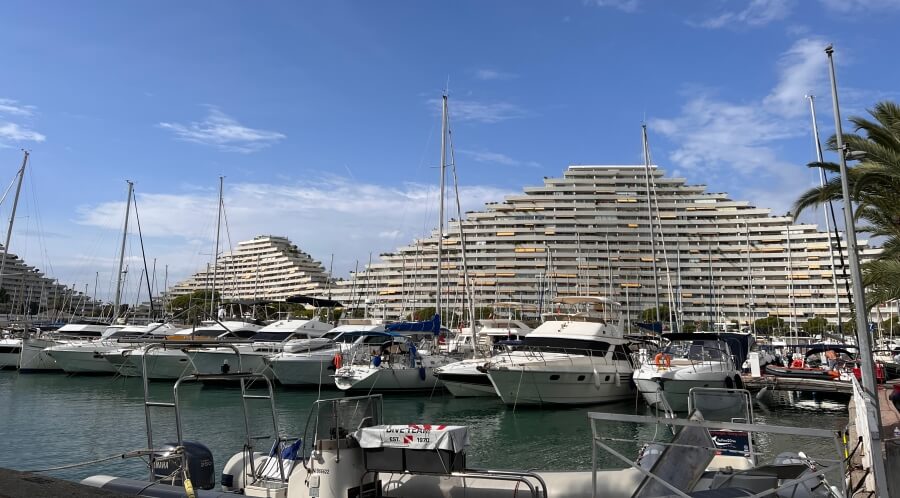
Villeneuve-Loubet’s distinctive pyramids of Marina Baie des Anges
It is an urban Mediterranean drive rather than an isolated cliff road, but with its sea views, palms, beaches, and marinas, it is gorgeous—even with the apartment buildings and traffic lights. We parked at the port and walked into the Old Town, our first stop.
No one would argue that Antibes’ Old Town is beautiful. Everything about it feels polished. The shops are filled with lovely things rather than cheesy souvenirs, and the streets are impeccably paved. Place Nationale was bustling with a brocante (flea market), its treasures beautifully arranged across the tables. At the covered market, the produce displays were equally artful and the quality exemplary.
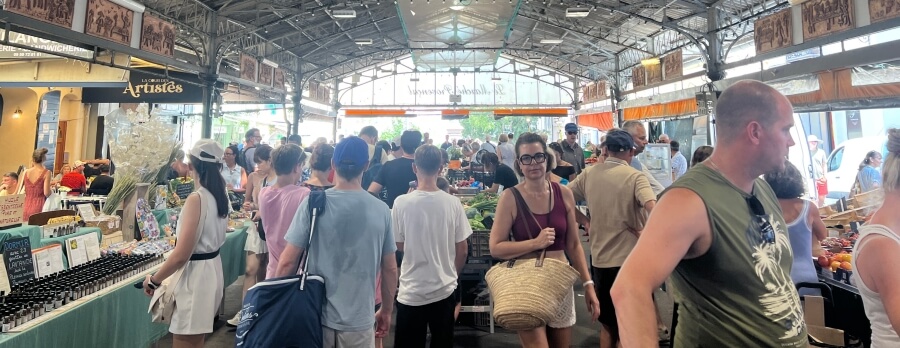
Antibes feels more refined than Nice, which is more middle-class and far more urban—the hub of the entire Riviera—but that doesn’t necessarily make Antibes a better place to live.
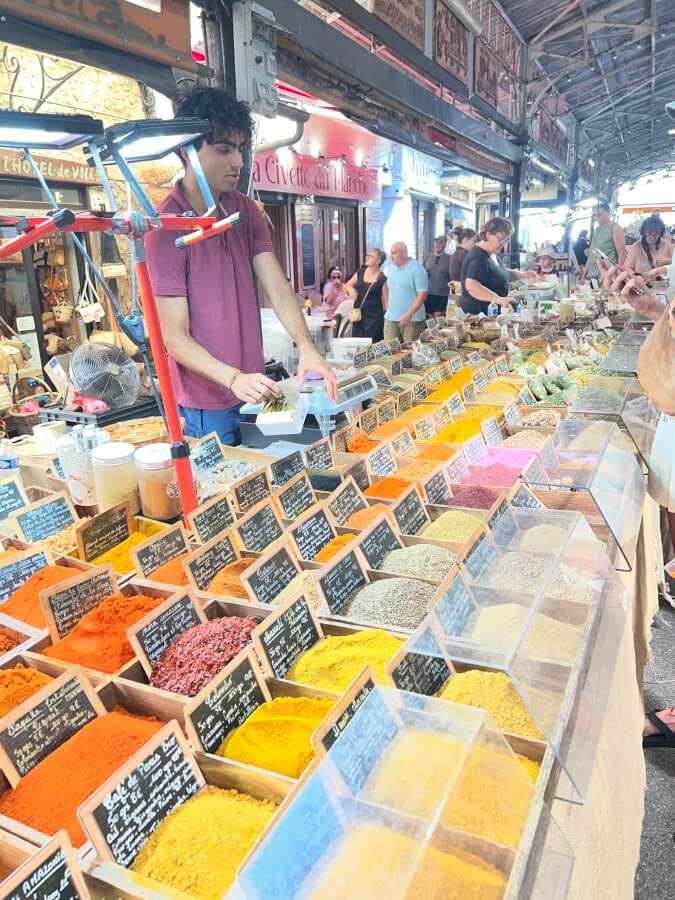
The spice stands in the Antibes market
At the height of summer, Antibes is as busy as a beehive. Its substantial permanent population swells dramatically with tourists and seasonal residents drawn to its beaches. If you lived in Antibes, you would probably want a car—and might often find yourself in Nice for everything the larger city offers—but there is no denying Antibes’ beauty and appeal.
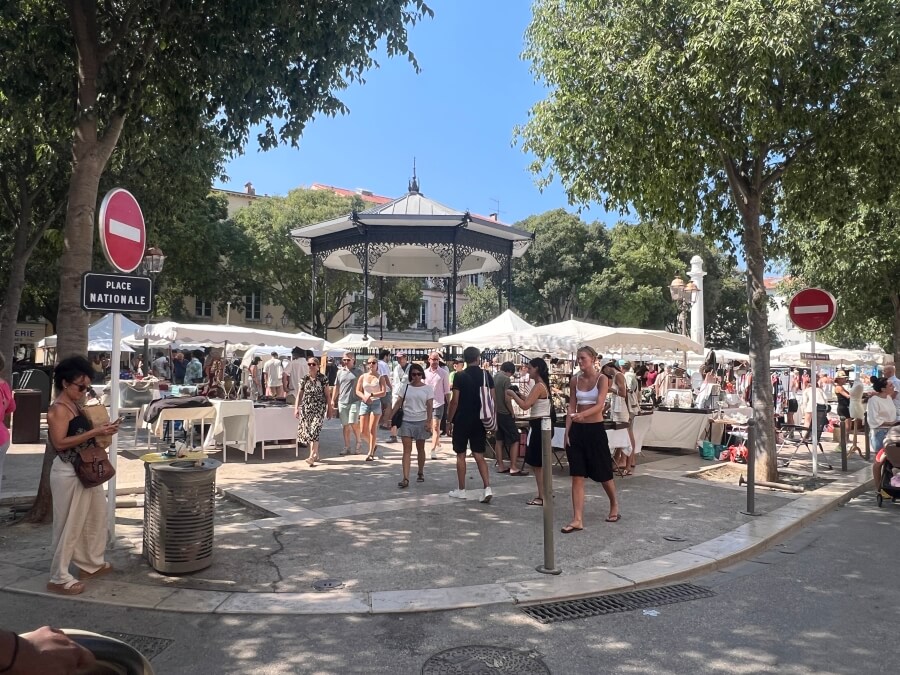
Antibes central square
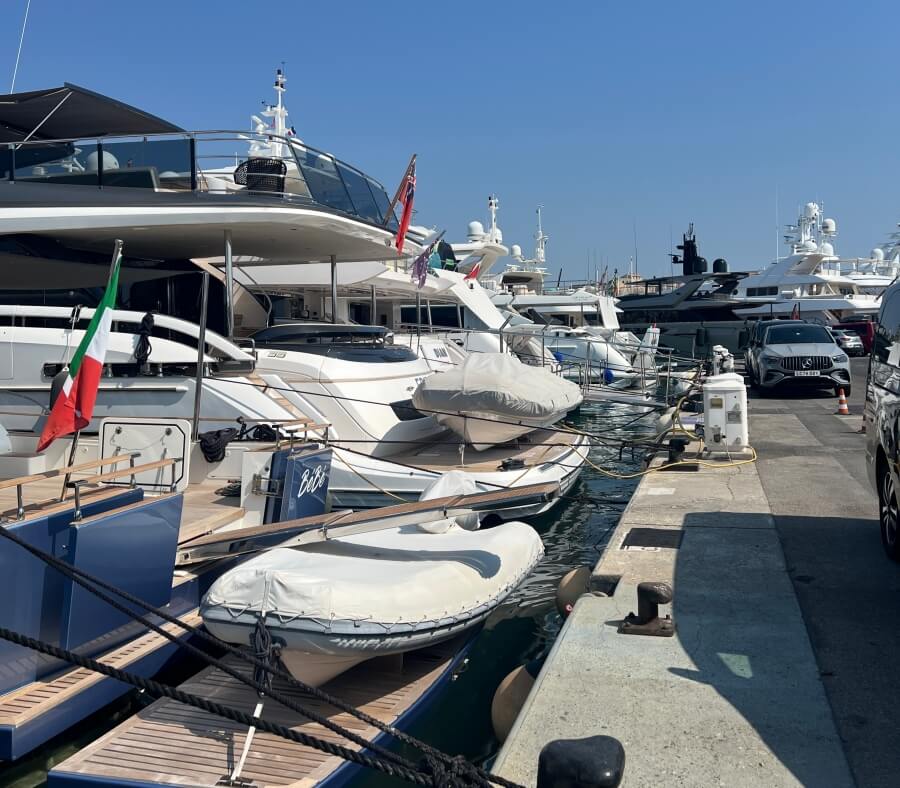
Yachts in the marina in Antibes
We planned to lunch at La Petite Garoupe, a restaurant directly on the sand at Plage de la Garoupe. Tucked along the eastern side of the Cap d’Antibes peninsula, a few kilometers south of the town center, it is one of the Côte d’Azur’s most storied beaches. The sheltered crescent of pale, soft sand has exceptionally clear, gently sloping water—ideal for swimming and families with children. Facing east within the protected curve of the Cap, it is calmer than many Riviera beaches. My grandson called it “a big bathtub”—and this from a 20-month-old!
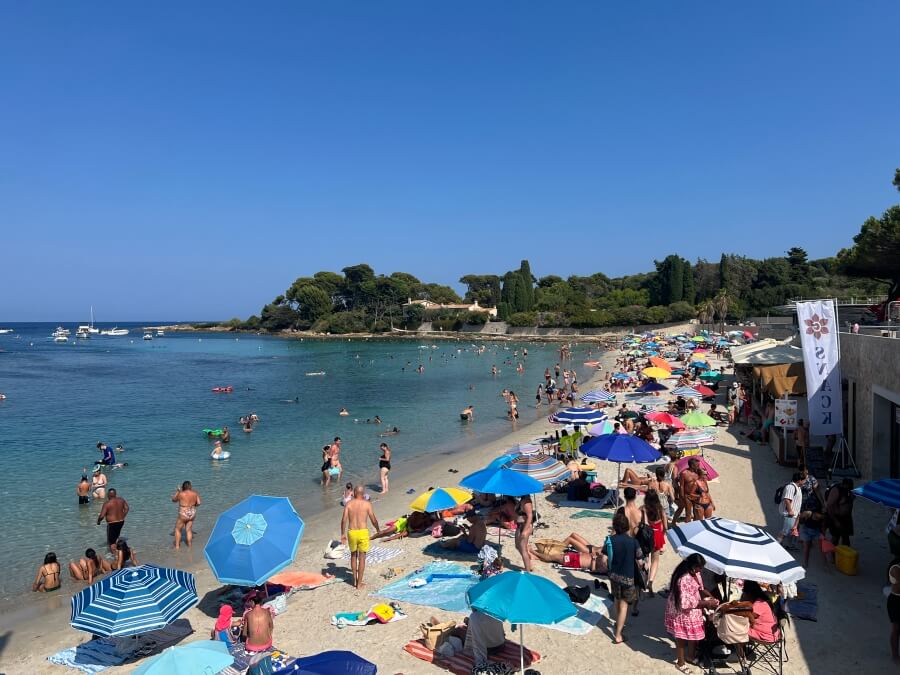
Plage de la Garoupe
In the 1920s, expatriates including Cole Porter and American artist Gerald Murphy helped turn this stretch of coast into a fashionable summer destination. Murphy and his wife, Sara, hosted figures such as F. Scott Fitzgerald, Ernest Hemingway, and Picasso in the area. Fitzgerald later drew on the Riviera setting in Tender Is the Night.
Parking was free but scarce, and there were no parasols or loungers to rent. Like idiots, we had left the apartment without our parasol or beach mats, so we stayed at our table, lingered over lunch, and took turns cooling off in the water. For Little Leeds, it was perfect: he could stand and splash for hours. We loved it just as much—except for the sand, which stuck like glue. (This is precisely why I am a fan of Nice’s galets: no sand, and you go home clean!)
DISTURBING THE NEIGHBORS
On Sunday, the “kids” flew to Copenhagen for a week in a cooler climate. I’m jealous, I’ve never visited Scandinavia. Every summer I vow to go, yet somehow I have trouble giving up my beach time. As the climate warms, however, the idea looks increasingly appealing.
It didn’t take long to restore the apartment for little ol’ me—except for the mountains of laundry. If you know French washer-dryer combinations, you know that a load of towels can take six hours to wash and dry (in my Indesit, at least). Fortunately, it works well enough that I could run it overnight and wake up to clean, dry towels ready to put away.
France has no nationwide rule specifically prohibiting washing machines during fixed hours, so running one at midnight is not automatically illegal. It can, however, become a nuisance if the noise or vibration disturbs the neighbors. The building’s règlement de copropriété (co-ownership rules) may also impose stricter quiet hours.
The truth is, I don’t know whether ours do. But since the neighbors downstairs are already suing me over the sanibroyeur…do I care? Perhaps the spin cycle will inspire their next lawsuit!
A FEW DOORS DOWN TO OUR CANNES NEIGHBORS
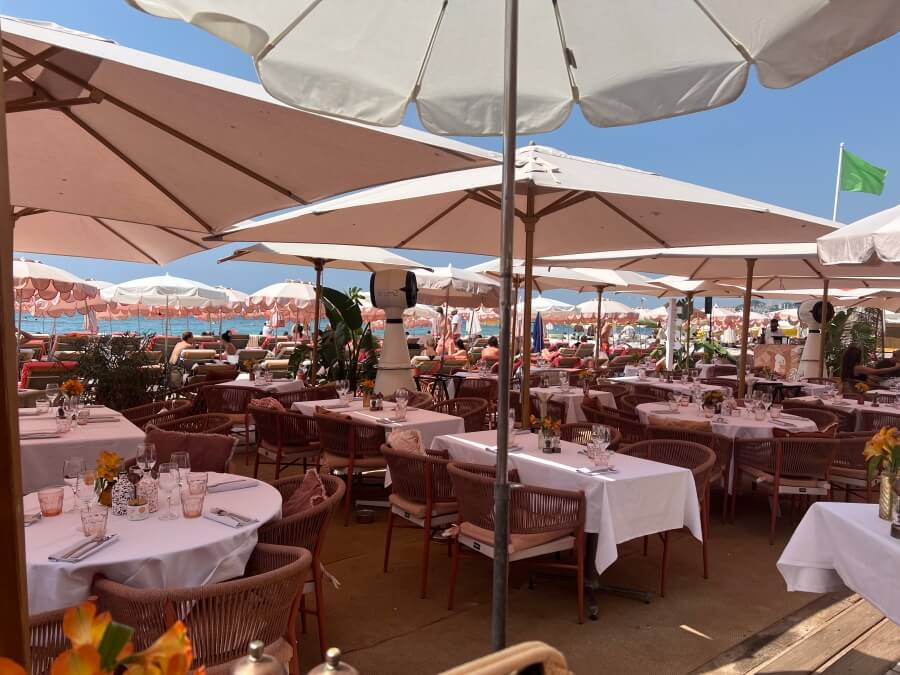
On Sunday morning, an L.A. friend and I hopped on the train to Cannes for a day of indulgence. She is currently taking classes at the Institut de Français in its new Nice branch. The beach clubs lining the Croisette offer transats (beach beds), parasols, and dining either at your chair or in the restaurant.
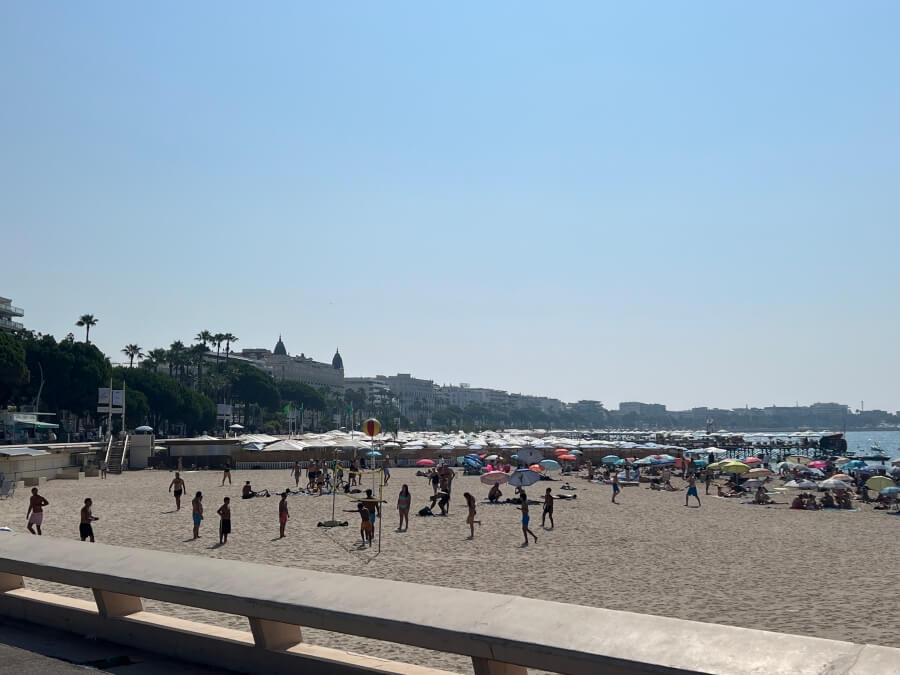
The beach in Cannes
We chose La Mandala Plage for its good reviews, proximity to the famous Carlton, and “lower” lounger prices. Lower meant €65 each, compared with prime spots at other Croisette clubs that can approach or exceed €100. We are not talking about a hotel room—we are talking about renting a beach bed for a few hours! It’s all about real estate.
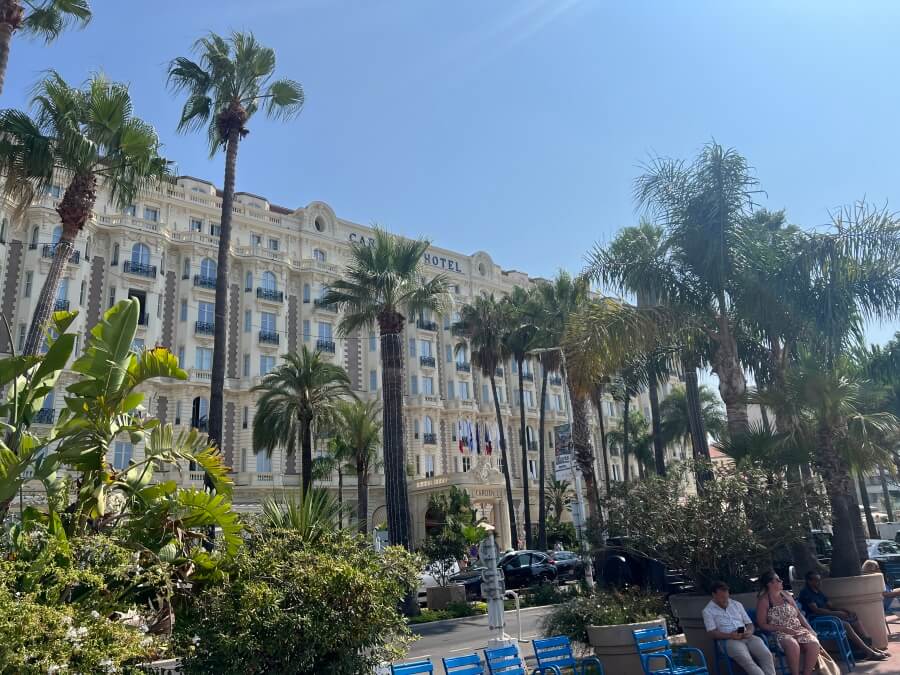
The Carlton Hotel in Cannes
Of course, you can enjoy Cannes’ sandy shore for free on a public beach with your own gear. This, however, was a deliberately decadent treat—complete with a delicious lunch in a beautiful setting. Their salade niçoise was a work of art and one of the best I’ve had. Sampling it everywhere I go has become a pastime, and this one gets a thumbs-up. At €28, it should!
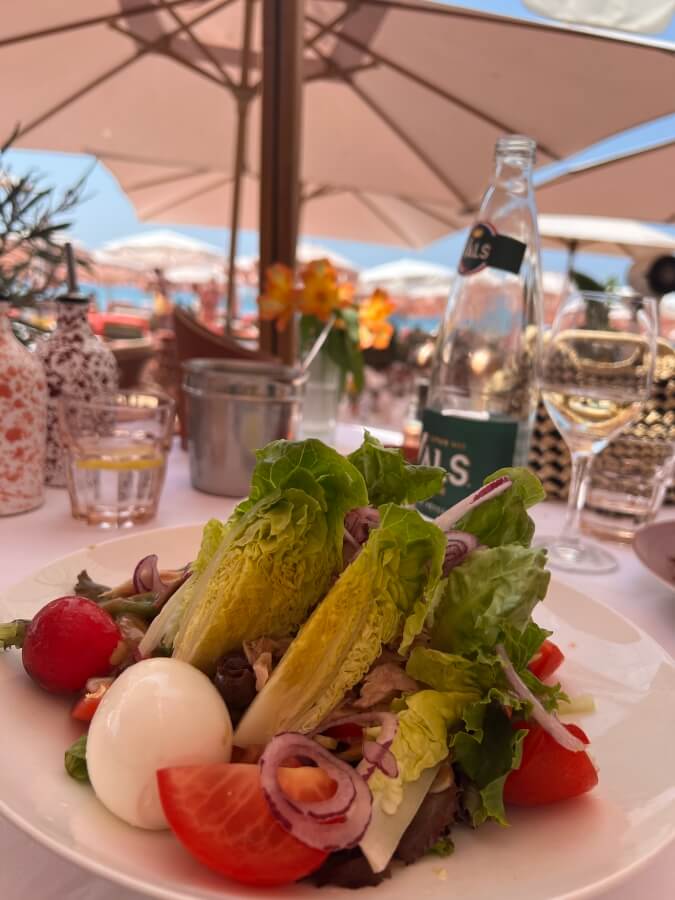
For me, Cannes is like Hollywood. It is as much about glamour as reality. Its official permanent population is only 74,350, but during major events and the height of summer, the number of people in town can approach 200,000—nearly three times the resident population.
Whether the rich really go there—or merely people who want you to think they are rich—is the question. My guess is both. We went for the sheer glamour ourselves and, I must admit, everything was perfect. The water was calm, shallow, and warm. We floated for hours and loved every minute, although the sea was not the same beautiful aqua blue as in Nice. It was greener and less clear; the sandy bottom, rather than the rocky floor of the Baie des Anges, seems to change the water’s color. In my opinion, nowhere else on the Riviera compares with the blue of Nice.
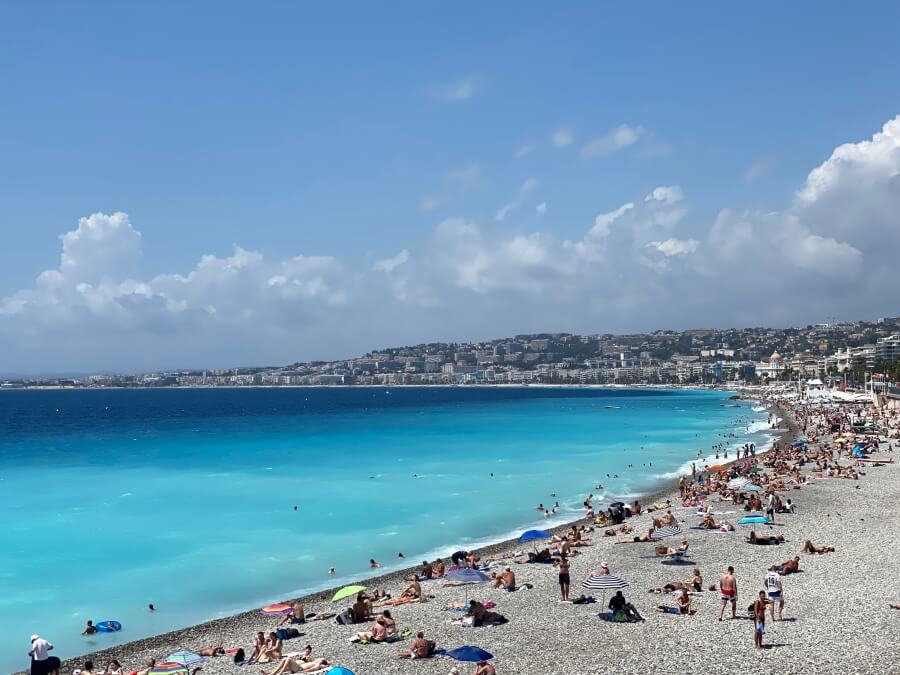
The blue waters of the Bais des Anges
Next weekend won’t be beach time—I’m headed to Provence. Stay tuned for more summer adventures in the South of France.
À la prochaine…
 Adrian Leeds
The Adrian Leeds Group
P.S. We are not just about property services, we also focus on living in France on a practical level—like shopping, dining, meeting other expats, getting around, exploring the country, etc. Our website is the perfect place to begin your education into everyday life in France. Visit us today!
P.P.S. Don’t miss your chance to be part of our Small Group Consultation in Nice. We only have 1 spot left…Make it yours today!

Let Us create a custom strategy for you
You can live or invest in France-now.
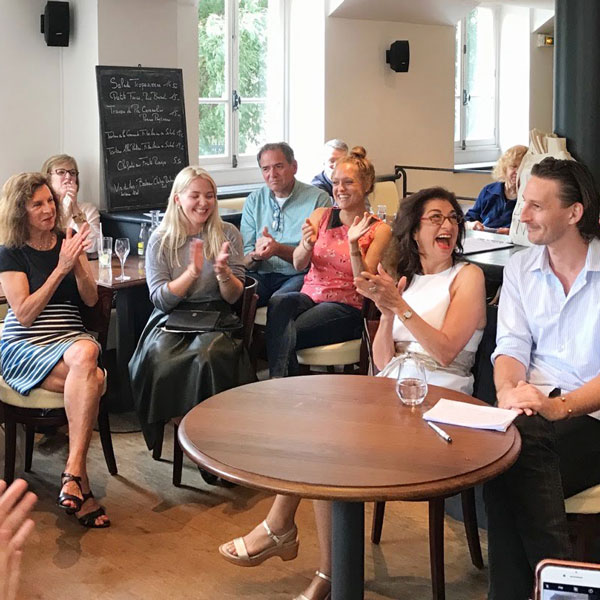
Join us at our monthly Après-Midi.
Become a part of the Paris community.
Property for sale
Read & Subscribe
Dive into more by reading the French Property Insider
Better yet, subscribe to both and get the updates delivered to your inbox.
Global Money Services
Our contacts will help you invest in France.


See Adrian on HHI

Join us on Youtube
Dive into more on how to live, invest & escape to France
Be sure to subscribe!
To read more, click the links below.