


Weekly insights about property in France!
Subscribe and don't miss an issue!
Weather or Not: Finding Your Perfect French Climate
Volume XXIV, Issue 25

By Jay Corless, Edited by Adrian Leeds
One of the great pleasures of choosing where to live in France is that you are not choosing from one weather pattern. You are choosing among many.
France may look compact on a map, especially to North Americans accustomed to crossing entire time zones by car, but its climate is wonderfully varied. In the space of a single country, you can have the bracing sea air of Brittany, the golden summers of Provence, the snowy winters of the Alps, the softer Atlantic rhythm of the southwest, and the crisp continental seasons of Alsace.
That matters. Weather is not just what you pack in your suitcase. It affects how you live, how you heat and cool your home, how much time you spend outdoors, and whether you crave shutters, air conditioning, a terrace, a fireplace, thick stone walls, double glazing, or simply a good dehumidifier. It can even affect what kind of property makes sense.
So, before falling in love with the shutters, the village square, the sea view, or the wine cellar, it is worth asking: What kind of French weather do you really want to live with?
FRANCE’S MAIN CLIMATE FAMILIES
Météo-France generally describes mainland France in terms of five broad climate types: oceanic, altered oceanic, semi-continental, mountain, and Mediterranean. But administrative regions do not fit neatly into climate boxes. Many regions contain two or three climates, and the difference between the coast, the plains, the mountains, and the interior can be dramatic.
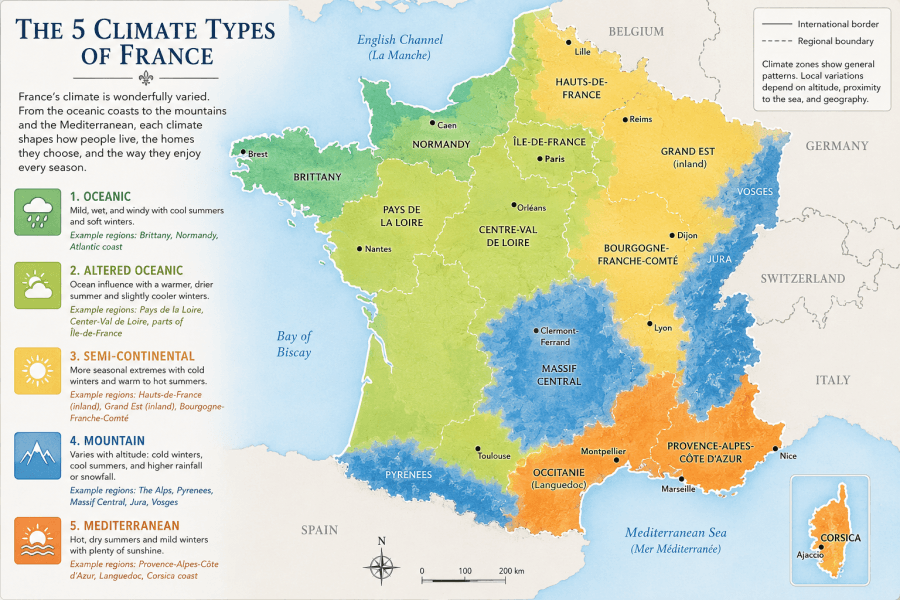
HERE IS A REGIONAL TOUR
Brittany: Oceanic, Green, and Changeable
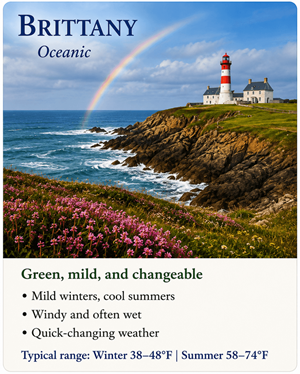 Typical temperature range: winter often runs from the upper 30s to the upper 40s°F, while summer usually runs from the upper 50s to the low or mid-70s°F.
Brittany is the classic Atlantic region: maritime, mild, windy, and green. Winters are generally softer than in inland France, summers are often cooler, and rain can arrive in passing bands rather than long theatrical downpours. The weather changes quickly, which is part of the Breton charm. You may start the day under a pewter sky, eat lunch in bright sunshine, and finish with a glowing pink sunset over the sea.
For property buyers, Brittany’s climate rewards homes with good roofs, sound shutters, proper ventilation, and a tolerance for salt air near the coast. It is ideal for those who dislike extreme heat and love dramatic skies.
Normandy: Mild, Moist, and Beautifully Temperate
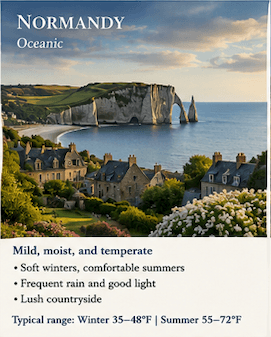 Typical temperature range: winter generally runs from the mid-30s to upper 40s°F, while summer tends to stay between the mid-50s and low 70s°F, warmer inland than along the Channel.
Normandy shares much of Brittany’s oceanic softness, with the Channel bringing moderation, wind, and generous rain. The result is lush countryside, apple orchards, green pastures, and stone villages that seem made for misty mornings.
Summers are usually comfortable rather than scorching, while winters are damp rather than severely cold. It is a region for people who appreciate atmosphere over guaranteed sunshine. A good heating system, solid insulation, and moisture control are important in older properties.
Hauts-de-France: Northern Light and Brisk Seasons
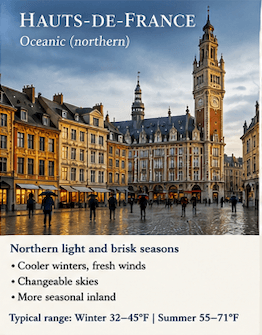 Typical temperature range: winter often runs from the low-to-mid 30s to mid-40s°F, while summer usually ranges from the mid-50s to low 70s°F.
Hauts-de-France is influenced by the Channel and the North Sea, as well as by its more northerly position. Expect cooler winters, fresh winds, and skies that shift quickly. Lille and the inland areas can feel more seasonal than the coast, while the Opal Coast offers magnificent light, wide beaches, and bracing air.
This is not the France of lavender fields and cicadas. It is the France of hearty food, brick architecture, big skies, and practical coats. For buyers, it can offer relative value, strong urban centers, and a climate that remains manageable in summer.
Île-de-France: Four Seasons, Urban Heat
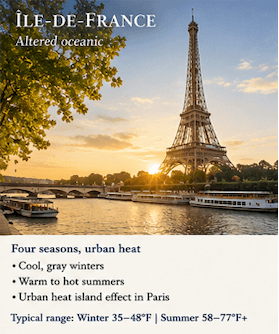 Typical temperature range: winter generally runs from the mid-30s to upper 40s°F, while summer often ranges from the upper 50s to upper 70s°F, with heat waves pushing much higher.
Paris and the Île-de-France sit in an altered oceanic climate. The Atlantic influence is still there, but the distance from the sea brings greater seasonal contrast. Winters are cool and gray, springs can be glorious, summers are increasingly hot, and autumn is often elegant.
The special issue in Paris is urban heat. Top-floor apartments can be challenging during heat waves, especially without cross-ventilation, shutters, or air conditioning. When apartment hunting, orientation, floor level, window quality, insulation, and ventilation matter more than many newcomers realize.
Center-Val de Loire: Gentle, Inland, and Seasonal
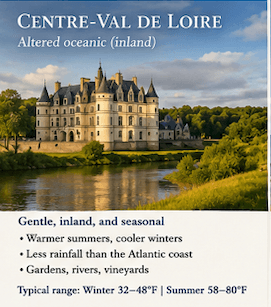 Typical temperature range: winter often runs from the low-to-mid 30s to upper 40s°F, while summer usually ranges from the upper 50s to upper 70s or low 80s°F.
The Loire Valley offers a softer inland climate: warmer summers, cooler winters, and less rainfall than the Atlantic edge. It is a region of gardens, châteaux, rivers, vineyards, and long summer evenings.
For those who want more sunshine than Normandy or Brittany but less intensity than the Mediterranean, the Center-Val de Loire can be a lovely compromise. Older stone houses can be wonderfully cool in summer, but must be checked carefully for damp, insulation, and heating efficiency.
Pays de la Loire: Atlantic Moderation with a Warmer Touch
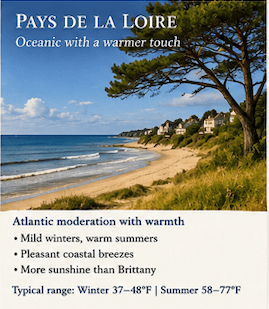 Typical temperature range: winter generally runs from the upper 30s to the upper 40s°F, while summer usually ranges from the upper 50s to the mid- to upper 70s°F.
Pays de la Loire sits between the open Atlantic and the interior. Nantes, Angers, and the Vendée each have their own feel, but overall, the region offers a moderate climate with mild winters and pleasant summers. The coast can be breezy and bright, while inland areas are warmer and drier.
It is an appealing region for those who want access to the sea without the full ruggedness of Brittany and who like the idea of a balanced rather than extreme climate.
Nouvelle-Aquitaine: A Country Within a Country
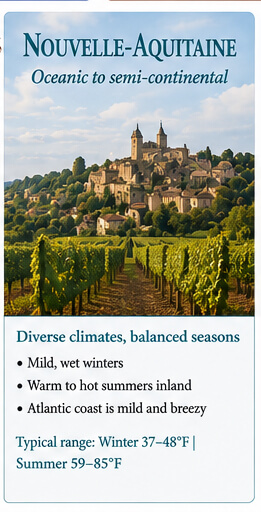 Typical temperature range: along the Atlantic coast, winter often runs from the upper 30s to low 50s°F and summer from the upper 50s to upper 70s°F; inland areas can see colder winter mornings and summer highs in the low-to-mid 80s°F.
Nouvelle-Aquitaine is so large that it contains several weather personalities. The Atlantic coast brings oceanic influence, surf, wind, and winter rain. Bordeaux and the Gironde are warmer and sunnier, with a growing southern feel. The Dordogne and Lot-et-Garonne can bring hotter summers and cooler winter mornings. Limousin is greener, hillier, and more humid. The Basque Country is famously lush because it is also famously rainy, especially near the mountains.
In short: do not judge Nouvelle-Aquitaine by one city. Biarritz, Bordeaux, La Rochelle, Limoges, and Périgueux do not live under the same sky. Property priorities vary accordingly: storm protection near the coast, shade and cooling inland, and careful damp checks in greener rural zones.
Occitanie: From Toulouse to the Mediterranean
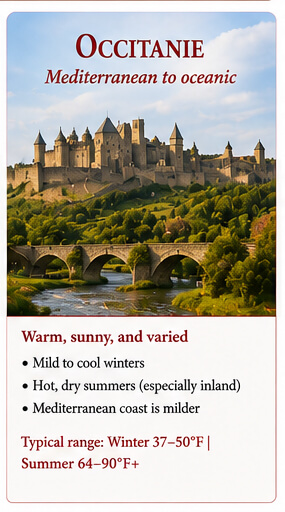 Typical temperature range: around Toulouse, winter often runs from the mid-30s to the low 50s°F and summer from the low 60s to the mid-80s°F; along the Mediterranean coast, winters are milder, and summers can reach the upper 80s°F or beyond.
Occitanie may be one of the most climatically varied regions in France. Around Toulouse, the weather has an inland southwestern character, with warm summers, occasional storms, and the influence of both Atlantic and Mediterranean systems. Along the Languedoc coast, the climate becomes Mediterranean: hot, dry summers, mild winters, and intense rainfall events in autumn or spring. In the Pyrenees, altitude changes everything, bringing mountain weather, snow, and rapid shifts.
For buyers, Occitanie is seductive but demands local knowledge. A village near the Cévennes, a beach town near Montpellier, a farmhouse in the Gers, and a chalet in the Pyrenees are entirely different propositions.
Provence-Alpes-Côte d’Azur: Sun, Mistral, Sea, and Mountains
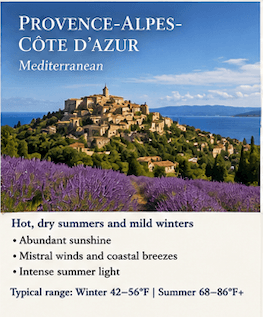 Typical temperature range: coastal areas often range from the low-to-mid 40s to mid-50s°F in winter and from the mid-60s to low- to mid-80s°F in summer; inland Provence can be hotter, while Alpine areas are much colder.
Provence-Alpes-Côte d’Azur is the France that many foreigners dream about: sun-drenched Provence, the Côte d’Azur, olive trees, rosé, lavender, and luminous stone villages. Its Mediterranean areas have hot, dry summers and mild winters, while the Alps bring snow, altitude, and a completely different way of life.
The region’s weather is not just sunshine. The mistral can be fierce. Summer heat can be intense. Drought and fire risk are real considerations. Homes here need shade, shutters, outdoor living spaces, good ventilation, and increasingly, some strategy for cooling. On the coast, humidity and summer crowds are part of the package; in the hills, access and water management matter.
One special case deserves mention: Nice and the Baie des Anges enjoy what many consider a distinct microclimate within the Mediterranean zone. Sheltered by the Maritime Alps and moderated by the sea, Nice tends to experience milder winters, fewer temperature extremes, and more sunshine than many other parts of France. Cold northern winds are often blocked by the mountains, while sea breezes help temper the summer heat.
This unique combination has attracted visitors for centuries and helped establish Nice as one of Europe’s premier winter resorts. It is not uncommon to find residents enjoying lunch on a sunny terrace in January or flowers blooming weeks earlier than in much of the rest of the country. For property owners, this translates into a longer outdoor-living season, lower heating needs, and a lifestyle centered around balconies, terraces, gardens, and the sea. While occasional Mediterranean storms can bring intense rainfall, the overall climate remains one of the most moderate and desirable in France.
If your dream of France includes morning coffee on a terrace in February, dining outdoors in October, and rarely needing to scrape ice from your windshield, Nice may have one of the most appealing climates in the country.
Auvergne-Rhône-Alpes: Alpine Drama and Valley Heat
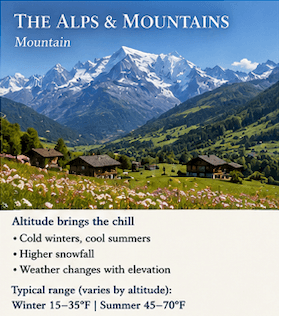 Typical temperature range: Lyon and the Rhône Valley often range from the low-to-mid 30s to the upper 40s°F in winter and from the low 60s to the low or mid-80s°F in summer; mountain areas are colder year-round and can see deep winter freezes.
This region is a climate mosaic. Lyon can have hot summers, cold winter spells, foggy periods, and strong seasonal contrasts. The Alps bring snow, mountain storms, and altitude-driven weather. Auvergne offers volcanic landscapes, cooler uplands, and a more rural, elevated climate. The Rhône Valley can be windy and hot.
It is one of the great regions for those who love seasons. But property choices should be made with precision: valley, slope, altitude, exposure, and winter access all matter. A south-facing chalet and a shaded apartment in Lyon do not face the same weather challenges.
Bourgogne-Franche-Comté: Continental Seasons and Vineyard Weather
Typical temperature range: winter often runs from the upper 20s to the low 30s°F to the mid-40s°F, while summer usually ranges from the upper 50s to the upper 70s°F or low 80s°F.
Bourgogne-Franche-Comté leans more toward a semi-continental climate, with warmer summers, colder winters, frost, and greater seasonal contrast than western France. The vineyards of Burgundy live by these seasonal rhythms, while the Jura adds altitude, snow, and mountain influence.
This is a region for people who like a true winter, a real autumn, and the feeling of seasons changing. Buyers should look carefully at heating systems, insulation, frost exposure, roof condition, and access in snowy or icy areas.
Grand Est: The Most Continental Feel
Typical temperature range: winter commonly runs from the upper 20s or low 30s to low or mid-40s°F, while summer often ranges from the upper 50s to upper 70s or low 80s°F.
Grand Est includes Alsace, Lorraine, and Champagne-Ardenne, and is among the most continental of France’s regions. Winters can be cold, summers can be warm and stormy, and the seasonal contrast is stronger than in the west. Alsace is a special case: protected in part by the Vosges, it can be relatively dry compared with nearby areas.
For North Americans who miss proper seasons, Grand Est can feel familiar. Think Christmas markets, vineyards, timbered houses, frosty mornings, hot summer afternoons, and excellent food for cold weather.
THE REAL-ESTATE TAKEAWAY
The weather is a lifestyle. It is also infrastructure.
In the western ocean, look for roofs, drainage, ventilation, and moisture management. In Paris and other cities, think about summer heat, floor level, exposure, and cross-breezes. In the Mediterranean south, prioritize shade, shutters, cooling, water, and fire-risk awareness. In mountain and semi-continental regions, heating, insulation, snow access, and freeze protection matter.
France gives you an extraordinary choice of climates. The question is not whether one is better than another. The question is which one matches the life you want to build.
Because in France, choosing a region is not only choosing a landscape, a market, or a way of eating. It is choosing a sky.
If you’d like to know more about how to choose the right French region for you, watch the replay of our webinar, Get to Know the Rest of France: The Best Places to Live and Why.
A bientôt,
 Adrian Leeds
The Adrian Leeds Group®
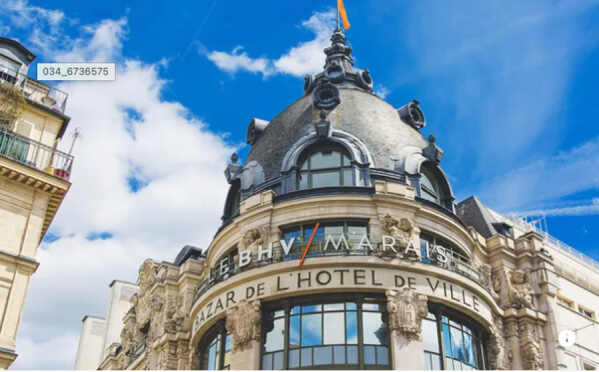 P.S. BHV Marais gets a fresh start! One of the Marais’ most iconic institutions is changing hands again. BHV Marais, the beloved department store overlooking Paris City Hall, is being acquired by a group led by its own management team, less than three years after its sale by Galeries Lafayette. The move comes after a period of controversy and uncertainty, including criticism over the store’s partnership with fast-fashion retailer Shein. The new owners have announced plans to end that partnership and refocus BHV on its historic strengths: home furnishings, decoration, DIY, and quality lifestyle products. For Parisians and lovers of the Marais, the news signals a return to the store’s roots and a renewed commitment to preserving one of the neighborhood’s most important retail landmarks.
This is good news for the owners of our newest Fractional Ownership property, Le Bijou de l’Hôtel de Ville, that overlooks the famous and iconic building!

Let Us create a custom strategy for you
You can live or invest in France-now.
Property for sale
what's happening
Check out upcoming events, conferences, or webinars. Join us!
GET FINANCING
Learn about French Property Loan Information.

Read & Subscribe
Dive into more by reading the Adrian Leeds Nouvellettre®
Better yet, subscribe to both and get the updates delivered to your inbox.

Get started with your dream of owning property in Paris.
Join us on Youtube
Dive into more on how to live, invest & escape to France
Be sure to subscribe!
To read more, click the links below.