


Weekly insights about property in France!
Subscribe and don't miss an issue!
France’s 2025 Property “Reset”: More Sales, Flatter Prices, a Clear Message on Energy Ratings and a Look Ahead to 2026
Volume XXIII, Issue 50
By Jay Corless, edited by Adrian Leeds
Every December, notaries provide one of the clearest snapshots of French real estate. Their reports rely on recorded transactions and the Notaires–INSEE indexes, so they focus on evidence rather than opinion. In their December 8, 2025 briefing, the message is simple and reassuring: after the sharp correction of 2023–2024, the market is working again. Activity is picking up, prices have mostly stopped falling, and buyers are coming back, though they are more careful than before.
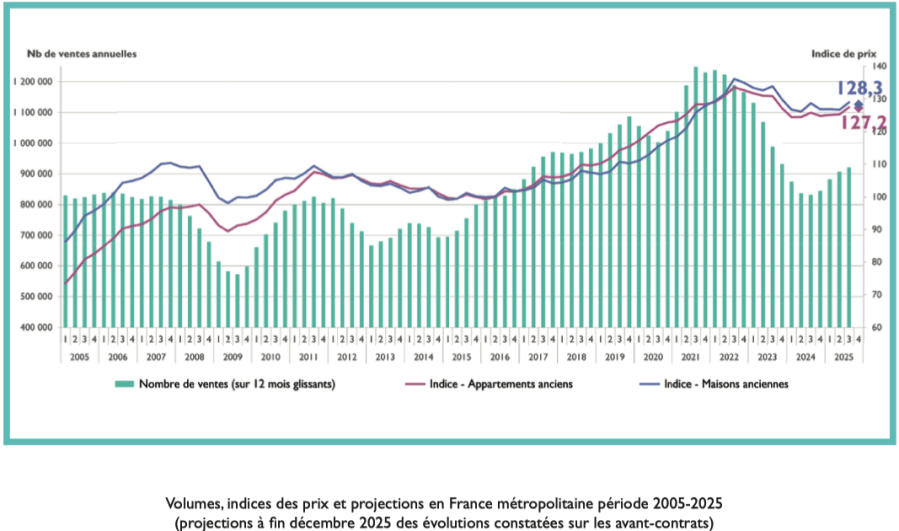
What does it mean for the market to be working again? Sales volumes are rising from last year’s low point. Notaries estimate about 921,000 transactions in the past twelve months (up to the end of September 2025), and early signs suggest this number could increase as autumn data is added. This is important because in France, confidence is often linked to liquidity. When people start buying again, more homes are listed, sellers adjust their expectations, and negotiations become more balanced for everyone.
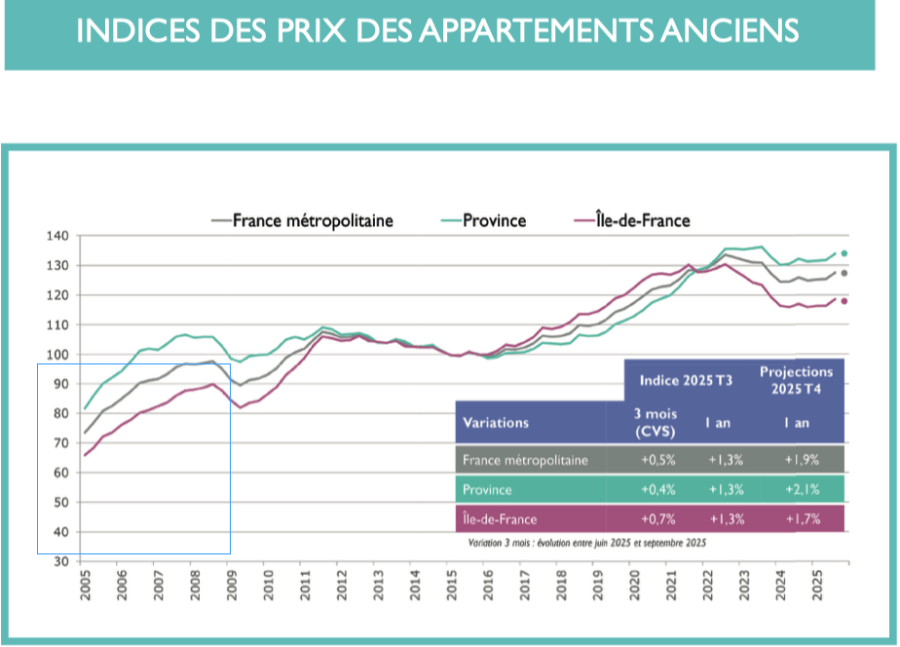
The report shows that prices are steady, which matches what many people are seeing. Nationally, in Third Quarter 2025, apartment prices are slightly higher than a year ago, while house prices are mostly unchanged. This isn’t a boom, but rather a period of stability with a small upward trend, especially for apartments. The report also points out that the difference between Île-de-France and the rest of France has narrowed for apartments in 2025, with both areas showing similar growth rates in the Third Quarter. For houses, the recovery is slower, and house prices in Île-de-France are still down a bit compared to last year, though the worst seems to be over.
A helpful part of the notaries’ briefing is their outlook based on “avant-contrats,” or pre-sale agreements, which help them predict price trends a few months ahead. Their forecasts through January 2026 suggest a gentle increase, not a big jump: apartments are expected to see low single-digit annual growth into late 2025 and early 2026, and houses should also improve a bit. Both the provinces and Île-de-France are likely to recover from the slow market of the past two years. The message is clear: the market is getting better, but it is not overheating.
To understand why the market is improving, look at purchasing power. The notaries report that housing purchasing power got better during the first nine months of 2025, with the ‘financeable surface’ returning to 2022 levels. In simple terms, this means a typical household can now borrow enough to buy a bigger home than they could at the market’s low point. The report credits this to easier credit conditions compared to 2024, higher disposable income (in constant euros), and the fact that prices have stopped falling as they did in 2023–2024. In my work helping expats in France, this is the kind of sign that shows when buyers are ready to move forward.
The dossier’s city comparisons help put Paris and the Riviera in context. Notaries show a wide range of apartment prices across major cities, from affordable places like Saint-Étienne to Paris at the top. Nice is also among the most expensive cities, along with other large, high-demand areas. More importantly, only a few cities are still seeing real annual price drops in 2025, while most are stable or slightly up. The report highlights that Nice, which was already pricey, did not have the same correction as other cities and is still at record price levels. Over the past five years, the difference is clear: Paris prices are down, while many coastal and southern cities, including Nice, have seen strong growth. For expats choosing between Paris and Nice, the data confirms what many already feel: Paris now offers more selective opportunities after its correction, while Nice has stayed strong, so the best homes there require quick decisions rather than expecting bargains.
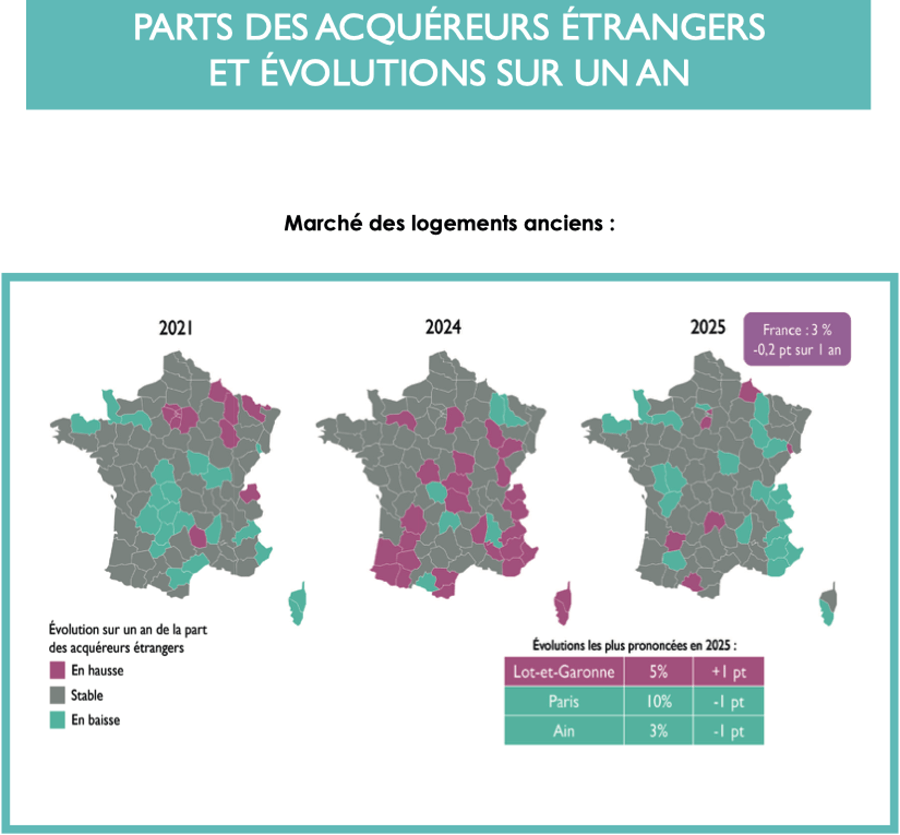
Foreign buyers still make up a small part of the national market, about three percent of existing home purchases, which is a bit lower than in 2024. However, anyone who spends time in central Paris or the Côte d’Azur knows that national numbers can hide what’s happening locally. International demand is still strong in certain neighborhoods and for the ‘turnkey’ properties that expats often look for.
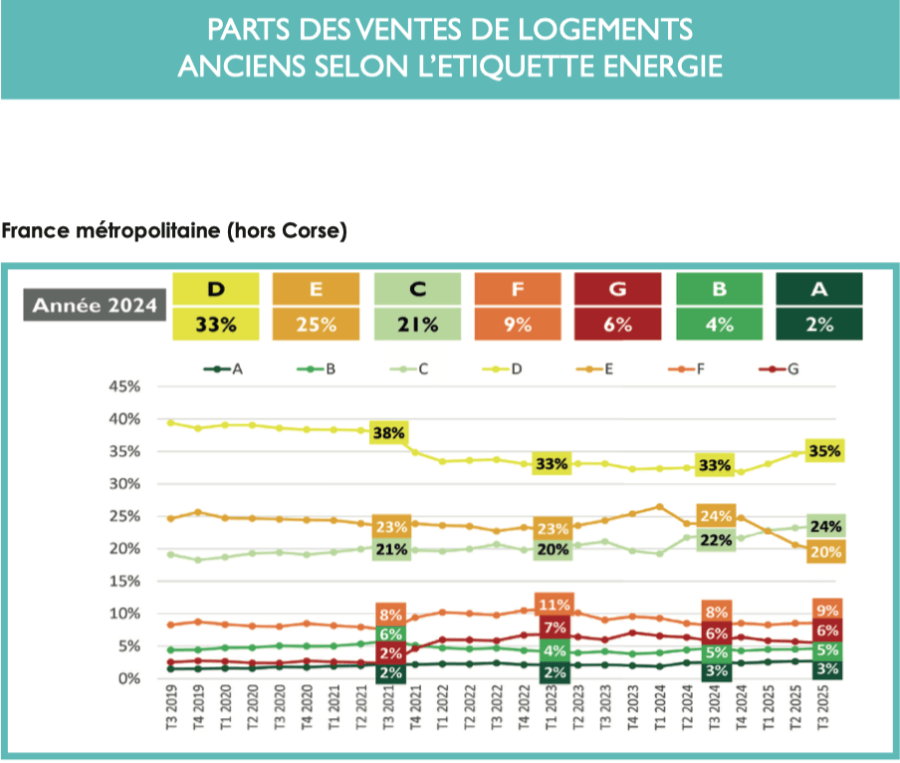
This leads to the most practical part of the report: energy performance. Notaries show that energy labels now play a key role in pricing. They point out that many transactions still involve energy-inefficient homes (E, F, or G ratings), with Paris having a particularly high share. More importantly, they measure the price differences: top-rated apartments (A) sell for much more than mid-rated ones (D), while G-rated apartments sell for less. For houses, the penalty for a G rating is even bigger. This matches what we see in negotiations now: buyers don’t just ask if a home is charming—they want to know what it will cost to upgrade and whether it’s possible in that building. If the work is clear and manageable, the discount can be an opportunity. If not, buyers either walk away or push for a lower price.
Finally, the dossier serves as a reminder of the pipeline. While the existing market is recovering, new-build volumes remain depressed compared with a couple of years ago, and construction land is also well below prior levels—even if the rate of decline has eased. In plain language, future supply is constrained, which over time tends to support prices in high-demand areas, especially for housing that already meets modern expectations for comfort and energy performance.
If you’re planning for 2026 as an expat, the notaries’ advice isn’t to rush or to wait—it’s to be precise. The market has found its rhythm again, and buyers who are prepared, well-informed, and clear about their priorities have the advantage. In Paris, this often means using factors like energy ratings, building rules, and renovation needs to make a smart purchase in a corrected market. In Nice and other strong coastal markets, it’s about focusing on quality and moving quickly when the right property comes up, since the best homes still sell fast even in a calmer market.
So long to 2025 and hello 2026…looking ahead!
Happy Holidays to all.
A bientôt,
 Adrian Leeds
The Adrian Leeds Group®
P.S. This is the last issue for the year of French Property Insider, our 23rd year! We’ll be back on January 1st, 2026 with Issue #1 of our 24th year publishing information about property in France. Pass it on and tell your friends…it’s easy to subscribe.
 P.P.S. Special thanks to Jay Corless for doing such a wonderful job bringing you this valuable news all this year long!
1 Comment
Leave a Comment

Let Us create a custom strategy for you
You can live or invest in France-now.
Property for sale
what's happening
Check out upcoming events, conferences, or webinars. Join us!
GET FINANCING
Learn about French Property Loan Information.

Read & Subscribe
Dive into more by reading the Adrian Leeds Nouvellettre®
Better yet, subscribe to both and get the updates delivered to your inbox.

Get started with your dream of owning property in Paris.
Join us on Youtube
Dive into more on how to live, invest & escape to France
Be sure to subscribe!
To read more, click the links below.
Just wanted to wish you a wonderful holiday season! Thank you for sharing your enthusiasm for life in France, your joy with your daughter and grandson, your travels and appreciation of good people, art, food, architecture – LIFE!