


Weekly insights about property in France!
Subscribe and don't miss an issue!
Going, Going, Gone…"Le Dernier Feu"
Volume XI, Issue 18

Paris photographer, Meredith Mullins, recently blogged about “A Paris Cultural Experience: Auctions by Candle” inspiring one of our Property Consultants and I to visit an upcoming property auction. It had been years since having witnessed an auction and thought it time to refresh our memories.
 The bugie manMeredith wrote of her experience:
The ‘vente à la bougie’ (sale by the candle) dates from the 15th century, where waiting for the candle to burn out after each bid was meant to give everyone a fair chance at thoughtful buying.
Today, it remains a charming tradition . . . and adds a certain elegant (and humorous!) quality to the auction.
The auction room is modern, with a huge flat screen that projects photos and details of the buildings, houses, and apartments that are up for sale. Then, on the platform, amongst the computers, microphones, and wires, is a silver candle holder and candelabra.
For the ‘sale by the candle,’ a candle is lit at the beginning of the auction. When the bidding seems to be coming to an end for a particular item (that is, when all is quiet), another candle is lit and placed in the candelabra to indicate a call for last bids.
Lighting the first candle at the auction by the candle, a cultural experience that mixes old and new.
The beginning of the waiting period before the last fire and
the bidding is closed.
If no one bids, a final candle is lit and the auctioneer announces ‘le dernier feu’ or ‘the last fire.’ When this candle goes out, the auctioneer announces ‘éteint’ or ‘extinguished,’ which signals that the bidding is closed for that item.
During this process, the potential landowners and apartment magnates have plenty of time to reflect. Impulse buying is controlled, and buyers remorse is almost nonexistent.
Of course, if someone bids again before the last candle goes out, a new candle must be lit. And, if someone bids before that candle goes out, another new candle must be lit. And so on and so on.
The room of anxious bidders learns the true meaning of patience. Drama builds, flames flicker, time passes. And, for those few timeless moments, the room lives in the 15th century.
How long will a cultural experience like this be part of our everyday life? How long can we hold on to these charming vestiges of the past?
Time will tell.
But, sadly, I imagine they will soon be going, going…gone.
What remnant from the past will make you sad when its gone?
Meredith Mullins (meredithmullins.artspan.com)
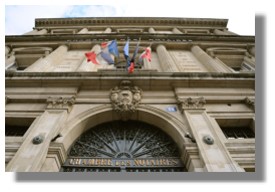 Chambre de Notaires – photo by Meredith MullinsNormally the property auctions take place at the Chambre de Notaires at 12, de l’Avenue Victoria at place du Châtelet. The auction we attended last week was a public auction at the “Tribunal de Grande Instance de Paris” at 4, boulevard du Palais on the Ile de la Cité, but the system was the same.
We attended simply as observers, with wonder about most of the ‘players.’ The game was fascinating as the bids inched up, the candles were lit and extinguished and buyers won their property prizes. The candle-lighter himself seemed bored, although he must remain very alert and I wondered how often he got burned. The presiding judges weren’t working very hard, except for one who enjoyed reprimanding the audience for one thing or another — their cell phones ringing or talking too loud. There was a group of students who had come to observe, too — as anyone can attend. Most of the active bidders were the notaries themselves, in their traditional black robes, seemingly on behalf of their clients who were the real buyers. It was a cast of characters, to say the least.
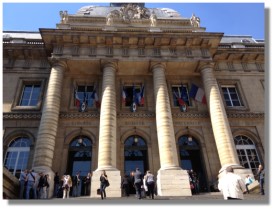 Palais de Justice – site of our auctionIf you think you might be interested in such a venture, here’s how to purchase property at auction (from the Chambre des Notaires Web site) :
Before the auction, find out about the properties on offer, visit those that interest you, study the specification sheet, and prepare your financing.
The day of the auction, leave a deposit check with the notary in charge of the sale and collect your bidding authorization and a badge. During the auction, you will be allowed to place bids yourself. The auction proceeds according to the candle method.
If you are the final and highest bidder, then you are declared to be the winning bidder.
After the auction, you have 45 days within which to pay the purchase price as well as the costs and fees of the property transfer. However, an overbid may be made on the property within ten days of the auction.
The property transfer can only take place, therefore, when the sale is declared to be final.
The auctions are open to the public and anyone can attend. Purchasing by auction is ‘tricky business’ and we wouldn’t recommend it to someone lacking experience, but a visit to an auction is fun, nonetheless. And if you’re lucky, you might land a real bargain.
A bientôt,
 Adrian Leeds
Editor, French Property Insider & Director of The Adrian Leeds Group, LLC
Email: [email protected]

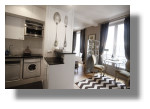 P.S. Last Minute Cancellation – take advantage of a 25% discount! We’ve just had a one month booking cancelled at the last minute at Le Bonaparte, so most of May is available. We are offering a discount of 25% off the usual rate for May so book now!
 P.P.S If you’re thinking about attending the Living and Investing in France Conference in Nice September 27-29, don’t miss the opportunity to book your hotel room at the special reduced conference rate. To receive the lowest rate possible, be sure to book your stay by May 31, 2013. Visit Living and Investing in France Conference Accommodations

Let Us create a custom strategy for you
You can live or invest in France-now.
Property for sale
what's happening
Check out upcoming events, conferences, or webinars. Join us!
GET FINANCING
Learn about French Property Loan Information.

Read & Subscribe
Dive into more by reading the Adrian Leeds Nouvellettre®
Better yet, subscribe to both and get the updates delivered to your inbox.

Get started with your dream of owning property in Paris.
Join us on Youtube
Dive into more on how to live, invest & escape to France
Be sure to subscribe!
To read more, click the links below.