


Weekly insights about property in France!
Subscribe and don't miss an issue!
How Does the City of Paris Have the Right to Violate Our Rights in Their Effort to 'Crack Down' on Short-Term Rentals?
Volume XII, Issue 40

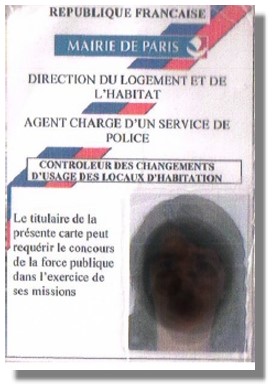 Agent’s badge Agent’s badge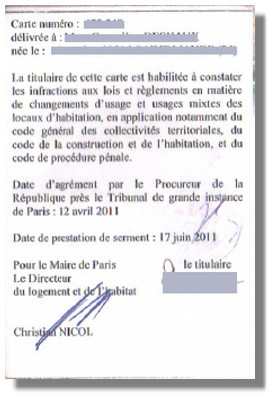 Back of Agent’s badge Back of Agent’s badge Spying on tourists (yes, that’s Paris Hilton) Spying on tourists (yes, that’s Paris Hilton) Ordre de Mission, Front Ordre de Mission, Front Ordre de Mission, Back Ordre de Mission, Back |
This past week there was a knock on my door, rather than the usual buzz from downstairs at the entry. The woman entered the building without authority and I did not open the door before she explained who she was. She was an agent from the city her credentials shown to me in a plasticized form. (Click on the document photos for a larger view. They are in French.(
She asked if I owned two apartments in building A of my complex and named them, that they were both advertised on VRBO.com, and that she had witnessed renters (or at least people with suitcases) coming into the building. In addition, she saw the rental calendar online. She said she knew that we manage a group of short-term rental apartments.
I told her that yes, I do own a small apartment in building A that my daughter uses when she comes home…that she was due to arrive in a couple of days and that I have lived in my apartment 17 years. She asked three times if I work here…for some reason. I would not allow her to take photos of the apartment, although she asked if she could. She was polite, at least, and the only reason I let her in was to learn more from her, feeling safe enough that I am a resident of the apartment and the building.
This is not to frighten you as owners or as renters. It is clear that I am personally highly visible and easy to track via our own Web site and others. Other owners of short-term rentals are not. The owners are the only ones responsible for compliance with the current short-term rental laws in Paris. The agencies bear no burden, nor do you, as a renter of a vacation apartment in Paris, are to be held liable in any way.
Clearly, the city has a big team that is ferreting out violators of the city regulations determined to reduce the number of short-term rental apartments and increase housing for residents — affordable housing. One city official noted that City Hall has ONE person in charge of tourism — the 32 million people who visit Paris, but a team of 20 chasing after them to find where they are staying!
According to the “Ordre de Mission,” the agent has the right to enter the property and either the occupant or the “guardien” must allow him entry between 8 a.m. and 7 p.m. In the case where the occupant or guardian is not present, they have the right to enter the property in the presence of the Mayor or the police commissioner! And they are following tourists to their accommodations, spying on tourists and residents!
When the law became apparent in the fall of 2009, we consulted an attorney to explain the regulations clearly. The following is an English interpretation by legal counsel:
———-
1- French law evolved in an unfavorable way for foreign investors, especially in Paris.
The basic law is the article L 631-7 of the French construction and housing Act which sets the change of use of dwelling-house is submitted to prior permission.
Before the law of the 4th of August 2008, the change of use was organized by a national administrative authority, the Préfet de Police, representing the French state. Nowadays, the law transferred the skill for the change of use to the Mayor of Paris.
In parallel, the city of Paris has voted a local legislation concerning seasonal or tourist rents.
Hence, in appliance of the local law, the change of use is submitted to both personal authorization and compensation.
According to the head of the city hall, there is a difference between furnished rent and tourist furnished rent.
In case of a furnished rent, the rent has to fulfill two conditions:
– The furnished tenement has to be the main tenants residence.
– The furnished tenement has to be rented for a one year renewable contract (reduced to 9 months for students).
If both conditions are fulfilled, the rent is mere furnished and not tourist. A tourist rent requires the conditions developed by article L 632-1 of the construction and housing Act.
In that case, these rents require a prior authorization for the change of use of a dwelling.
The authorization is granted but subject to the rule of compensation.
2 – The rule of compensation respects the article 2 of the local legislation which follows the law of the 4th August 2008 transferring the skills to the mayor of Paris.
The compensation consists in the transformation another tenement used for living in. That is why the compensation is expensive.
The tenement offered for compensation have to be high-standard and have the same surface space as the first tenement.
However, in the central sectors, in which the Marais is located, dwellings offered have to represent two tenements or twice the surface space as the initial tenement.
In some cases, if the tourist furnished rental is used for living in, the occupation with an other use will infringe the article L 631-7 of the construction and housing Act. The infringement leads to imprisonment planned by the criminal Act.
The only way to regularize is to carry out a compensation.
3 – There is no way to get around the current legislation except to object the refusal adopted by the mayor or the local law which enforces a compensation.
The legality of the local rule seems to be problematic. Indeed, it globally limits the trade around some districts, and especially in the Marais. In other words, the French law forbids the rent of tourist furnished rent in some districts in Paris.
In the present state of affairs, the situation can be disputed and could lead to litigation based on freedom of trade and industry.
However, the dispute is a long one and uncertain, and wont find an outcome for months.
4 – Anyway, investors must be informed by the risk involved by this kind of trade.
The article L 651-2 of the construction and housing Act punishes it with a fine up to 25,000, and, the return of the dwelling to its first use.
The financial fine is a high one and can frighten foreign investors.
5 – The core issue is to know, as the city council of Paris is supporting it, if the tourist furnished rents are considered or not as residence within the meaning of the article L 631-7 of the construction and housing Act.
According to us, it seems that tourist rented rents are not a part of the article 632-1 of the construction and housing Act (furnished rent which lasts 1 year…).
Nevertheless, the law only distinguishes between residence and non-residence.
The main resolution would be to consider that it is not a tourist furnished rent but a guest room (bed and breakfast) as in the law of the 14 of April 2006. The law defines the guest room as a furnished room located in occupants house and furnished in order to welcome tourists for one or more nights with service. The rent must be paid.
The law enforces a prior declaration at city council and the articles D 324-12 to D 324-15 of the tourism Act impose some norm:
– each room must have a bathroom and restroom;
– the linen must be provided;
– the occupant must welcome the tourist;
– the breakfast must be provided.
In other words, the only solution, and in the case of the Parisian legislation wouldnt change, w
ould be to adapt the service provided to make it conform to guest house French law.
The first step would be to query the city council in order to know if it considers the guest house as a change of use. It can be criticized because the dwelling is still allocated to living.
6 – In brief, two solutions can be proposed:
– A owner can decide to rent his flat under the tourist furnished rental law and accept full responsibility to be objected a refusal for the change of use by the Mayor of Paris, and then, is in a uncertain situation;
– The flat stands in the guest house legislation and, consequently, should avoid mayor decision for change of use. The carefulness invites us to query the city council on that issue. Of course, guest house concept is quite different from tourist furnished rent and assume to fill conditions imposed by the tourist Act. We can – as you wish – query the city council of Paris in order to obtain an official decision from the administration.
———-
Special notes:
* Ground level apartments are considered commercial and therefore do not require a change of usage. They fully comply with the law for short-term rental.
* The law applies to cities of 200,000 population or more. Only the city of Paris is currently enforcing the law.
Let’s take a closer look at the law. If a lease can contract for no less than one year, then doesn’t that mean anyone needing accommodations for less that than period doesn’t have the right to housing? If you come for an extended stay, legally up to 90 days, then do you not have the right to find accommodations for you and your family? If you are a resident and need temporary housing — while doing renovation, between permanent homes while one is sold and the other is purchased, or in the case of divorce or separation, then what would you do without the right to find housing of less than one year?
And of course, if you own property that you use part of the year and need to cover your expenses in order to maintain the ownership via rental income, you are not entitled to do that. Our counsel is correct: “In the present state of affairs, the situation can be disputed and could lead to litigation based on freedom of trade and industry.”
Another problem is that even if the city were to grant the change of usage from residential to commercial, your “copropriéte” is not likely to grant it. A residence in an apartment building, even with occasional rentals does not qualify as a commercial enterprise — it’s still for use of habitation, and the other residents may not agree. In the case of today’s ALUR laws, the decision has been removed from the rights of the copropriétes and that means that one owner in a building can denounce all the other owners to the city officials, even if a majority in the building were in agreement with the rentals.
Denouncement has become rampant among neighbors, something reminiscent of the occupation during WWII when Jewish neighbors were being turned into the authorities. How is this acceptable in a civilized world?
On another note, the city is losing valuable tax revenue as owners who rent less than one year are forced to not declare their rental earnings for fear of exposure. If the city were to realize their folly, they could make is easy to rent, as long as certain conditions were met:
* A required standard for the properties so that tourists and all renters have the best experience in Paris possible
* A control so that taxation is fully paid and the city would benefit from additional revenues
* Tax incentives to owners to make their property available for long term rental (without turning the estimated 40,000 property owners of short term rentals into criminals!)
* Etc., etc., etc.
I am launching a personal campaign to get media coverage. I believe that the only way the city is going to pay attention to our outcries is by realizing how this affects the little man not those who profit from it financially (although we capitalists don’t see anything wrong with this as it fuels the economy!), but those who suffer by not being able to find accommodations for less than one year: students, temporary workers, newly divorced individuals, those in transit between homes sold and purchased or those whose property is under renovation, etc., etc. One can be here 90 days legally, but not entitled to housing under the current laws. In addition, the laws negatively affect tourism and definitely hurt the economy and tax assessment. The city needs to wake up to their one-sided view which benefits no one and the only way to do that (in my opinion) is via negative media. I am hoping to achieve it by soliciting the help of you and all those who agree with our point of view to expose it.
Meanwhile, now is the time to think about how as an owner you would like to proceed. The options are these:
1. Do nothing.
2. Remove your apartment from Web sites which will reduce your rentals.
3. Move to a long term scheme so that rentals are not taken for less than one month, a one-year lease is signed (which carries a 30-day cancellation), but the renter cancels prior to the end of the lease, which also reduces your rental revenue.
4. Cease from renting your apartment completely.
5. Sell your apartment.
When this question was posed to our apartment owners, overwhelmingly they wanted to continue doing what they are doing and take the chance. We all agree that we must make all renters aware of the situation and if they want to continue to have access to Paris apartments, they must be wary of city inspectors — they must be told not to answer their questions, do not allow them entry, and do not show any contracts! It is best that a renter be greeted as circumspectly as possible so that there is no cause for concern by the neighbors or exposure to city inspectors.
At some point we all believe that City Hall will wake up to the position in which they are placing everyone — both the tenants and the landlords — ‘a rock and a hard place.’
As an investor, one can still make a smart purchase that will protect the property from the city ordinances. Remember, ground level apartments need no special authority and leases of one year with a stay of no less than one month fully comply.
Whatever you choose, just know that regardless of the laws, there will always be those with property who need to rent to cover their expenses and those who need to rent the property for accommodations. The city will not be able to stop it and we will do what we can to fight it until this is righted. Someone is going to endure or win - and I do hope its all of us!
A bientôt ,
 Adrian Leeds
The Adrian Leeds Group
Respond to Adrian: [email protected]

P.S. As a result of the unexpected guest, we have one of our best Marais studio apartments now offered for long term rental or for sale. If you want to learn more, write me at [email protected].
P.P.S. Fall has arrived in Paris, but the weather is still warm and sunny in Nice! Plan your getaway for a few days of warmth and sunshine in the south of France and you can now rent any of our Parler Nice Apartments for a minimum of just 3
nights. Plus, when you rent Le Matisse and Le Cote du Paradis together, receive a reduced rate. For more information visit Parler Nice Apartments or email [email protected].

Let Us create a custom strategy for you
You can live or invest in France-now.
Property for sale

what's happening
Check out upcoming events, conferences, or webinars. Join us!
GET FINANCING
Learn about French Property Loan Information.

Read & Subscribe
Dive into more by reading the Adrian Leeds Nouvellettre®
Better yet, subscribe to both and get the updates delivered to your inbox.

Get started with your dream of owning property in Paris.
Join us on Youtube
Dive into more on how to live, invest & escape to France
Be sure to subscribe!
To read more, click the links below.