


Weekly insights about property in France!
Subscribe and don't miss an issue!
Is There Really a Bubble Brewing in Today’s French Property Market?
Volume X, Issue 10

When the change in the capital gains tax laws was announced this past year, there was a sudden flood of properties on the French market at fire sale prices. When February 1st rolled around and the laws were in effect, the unsold properties were either taken off the market or their prices increased dramatically. Agents say that the little they have left to sell are the result of divorce or succession.
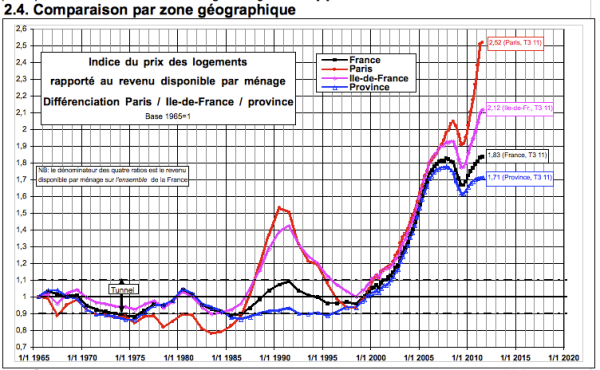 Chart courtesy of Bulle-Immobiliere.org
I doubt the lawmakers fully understood the ramifications of their actions — thinking that increasing the declining tax formula from 15 to 30 years would simply increase tax revenues, when it’s actually had the opposite affect. The new tax rate on secondary properties is as follows:
The seller must pay tax on the gross added value at a rate of 32.5%. The amount is reduced by:
* 2% for each year of ownership beyond the fifth (between 6 and 17 years of ownership)
* 4% for each year of ownership beyond the seventeenth (18 to 24 years of ownership)
* 8% for each year of ownership beyond the twenty-fourth (25 to 30 years of ownership)
* After 30 years of ownership of the property, the gain will be totally exempt.
Let’s take one small example.
Before February 1st, 2012, a property owned for 17 years selling for 250,000€ would reap no capital gain, but would be taxed 5.09% in transfer taxes — 12,725€. For 17 years of ownership, the amortized taxation rate would be 748.53€ per year.
That same property after February 1st, originally purchased for 100,000€ with improvements of 20,000€, sold at the same price of 250,000€, would pay 32,110€ in capital gains tax:
Purchase price of 100,000€ + 20,000€ = 120,000€
Price: €250,000€
Amount of the gain: 250,000€ – 120,000€ = 130,000€
24% allowance 31,200€
Amount of the gain after deduction: 130,000€ to 31,200€ = 98,800€
Tax calculation: 98,800€ x 32.5% = 32,110€
This coupled with the transfer taxes would increase the annual tax rate to 2,637.35€ per year and the government would be laughing all the way to the proverbial bank.
A clever seller realizes that to make up the difference in tax, he must sell the property for a higher price or take the property off the market until less tax is paid. If he increases the price, it would be no less than by the estimated tax — so let’s say he adds 45,000€ to the selling price. Let’s look at this scenario:
Purchase price of 100,000€ + 20,000€ = 120,000€
Price: €295,000€
Amount of the gain: 295,000 – 120,000€ = 175,000€
24% allowance 42,000€
Amount of the gain after deduction: 175,000€ – 42,000€ = 133,000€
Tax calculation: 133,000€ x 32.5% = 43,225€
Transfer taxes of 5.09% on the sale of 295,000€ = 22,152€, therefore the tax base has now increased to 4,324€ per year over the course of the 17 years.
The seller will pay a higher fee to the agency — 14,750€ instead of 12,500€ (5% of the selling price — a difference of 2,250€), but that added to the capital gains tax is only a cost to the seller of 475€:
Agency fee: 14,750€
Capital gains tax: 43,225€
Total fees: 45,475€
Price increase compensation: 45,000€
Net cost to seller: 475€
Everyone wins — the seller nets about the same, the agent earns more, the Notaire earns more fees and the French government has now multiplied its revenue by 5.8 times on an annual basis.
On paper this looks great and the politicians must think they have been very clever indeed. But, that’s not whats happening.
Properties have been taken off the market and because of the basic laws of supply and demand, prices have gone up. Transactions are down, therefore the rewards are not being realized and their efforts to provide affordable housing are being thwarted. Here lies even more air to inflate the property bubble.
From 2000 to 2008, property in France rose 120%, with a brief dip in 2009 of 5.6%. According to some analysts, property is already strongly overvalued, currently at 135% of their historic price-to-income ratio and 150% of their historic price-to-rent ratio. Paris drives the entire French market, with prices having risen more than 40% since 2005. Some areas of the city were up as much as 27% in 2011 alone. Part of the increase was a result of tax incentives for buyers in 2009 and plunging mortgage rates (from 6.5% in 2008 to 3.5% in 2011). Demand was high, supply low, prices naturally increased…and now we’re faced with even fewer properties on the market.
Is there really a bubble? If there wasn’t one before the change in capital gains tax, there is one now on the rise. You will see lenders becoming more cautious making it even more difficult to purchase and perhaps prices will plummet.
Then, where will the French government be when they realize they’ve ‘cut off their noses to spite their faces’ — and it becomes a money-losing proposition for everyone and their tax coffers are emptier than ever?
A bientôt,
 Adrian Leeds
Editor, French Property Insider
Email: [email protected]

P.S. If you would like to consider having your own pied-à-terre for your pleasure and profit, guests of any one of our luxurious Parler Paris Apartments can take advantage of a FREE one-hour consultation with me while you’re enjoying the apartment in the City of Light. It’s our way of saying “thank you” to our community! Visit: Parler Paris Apartments to book your stay and for more information email me at: [email protected].

Let Us create a custom strategy for you
You can live or invest in France-now.
Property for sale
what's happening
Check out upcoming events, conferences, or webinars. Join us!
GET FINANCING
Learn about French Property Loan Information.

Read & Subscribe
Dive into more by reading the Adrian Leeds Nouvellettre®
Better yet, subscribe to both and get the updates delivered to your inbox.

Get started with your dream of owning property in Paris.
Join us on Youtube
Dive into more on how to live, invest & escape to France
Be sure to subscribe!
To read more, click the links below.