


Weekly insights about property in France!
Subscribe and don't miss an issue!
Money Makes the World Go Round
Volume XI, Issue 12

Money’s been a big topic lately — particularly here in France thanks to the dismissal of Jérôme Cahuzac, the French Budget Minister in charge of fighting tax evasion. Turns out he’s under criminal investigation into his tax-evading Swiss bank account — funds he allegedly garnered during his previous career as a plastic surgeon.
In yesterday’s Parler Paris Nouvellettre®, on line with the same subject of foreign bank accounts, outlined the newForeign Account Tax Compliance Act (FATCA), Subtitle A of Title V of the Hiring Incentives to Restore Employment Act (HIRE), of the Internal Revenue Code. The U.S. government is working hard, too, to ‘crack down’ on tax evasion, evidenced by these new regulations…which shock me. FATCA regulations mean that the U.S. government will require foreign banks and financial entities to disclose the balances, receipts, and withdrawals of any American account holders to the IRS, or be subject to a 30% withholding tax on income from those U.S. financial assets held by the banks or financial entities.
How can the U.S. think it can actually legislate over foreign banks or other foreign financial institutions! What’s already happening as a result is that those foreign financial institutions don’t want to take on the burden or expense of managing American customers and are simply blackballing us from doing business with them. Some of our French lenders have done just that — we’re becoming Pariahs on the international financial scene.
If you purchase a property in France, or own one and need to make regular mortgage payments, pay your property taxes and your utility bills, then you likely make regular transfers to your French bank account — a foreign account by U.S. standards. And you may very well be transferring U.S. dollars to your euro account to accomplish this. That means that not only does the rate of exchange affect your costs of ownership, but what it costs to make that transfer does, too!
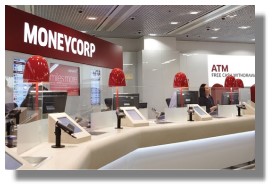  |
We are affiliated with two currency specialists (or brokers) which both offer lower rates and commissions for currency transfers than your average commercial bank: Moneycorp and World First. The system of transfer works very much the same except that when you instruct your bank to transfer the funds, the wire will be in dollars (or other currency you hold) to the currency specialist who in turn forwards the funds in another currency to your foreign bank account. It’s all very simple to set up an account and it can save you about 1% of the value of the transfer.
For example, if you wish to transfer $10,000 into your French euro bank account, your commercial bank may take 2% in the transfer — or $200, whereas a currency broker will take about 1% — $100. With transfers of larger sums, the savings can be quite significant.
The currency brokers are also under strict regulations by the U.S. Because they are trying to make it difficult to move money from one currency to another for foreign or ‘off shore’ traders, all brokers based outside the U.S. are forced to acquire licenses on a state-by-state basis in order to service U.S. clients.
At present, Moneycorp is able to make all trades from residents of the following states (incoming and outgoing): · Florida · Indiana · New Mexico · Wisconsin · South Carolina
In addition to this, they are now accepting funds from a U.S. resident’s non-U.S. located account (such as your French bank account) and return counter currency to the same U.S. resident’s U.S. based account. To be clear, in this scenario funds must not originate either from a third party or from the client’s U.S. based account and funds must only be paid to the client’s U.S. based account.
Therefore, subject to the above restrictions, they are now able to allow trades for residents of the following States (incoming from France to U.S.):
· California · Colorado · Connecticut · Georgia · Louisiana · Maryland · Massachusetts · Michigan · New Jersey · New York · North Carolina · Oregon · Rhode Island · Tennessee · Washington DC
World First can currently make currency transfers to and from those resident in the following states:
· Florida · Indiana · Montana · New Mexico· New York · Rhode Island · South Carolina · Texas · Wisconsin
World First can also make currency transfers between a client’s own accounts (or to and from a Notaire’s escrow account) for another two dozen states.
News from Moneycorp — an update on currency trends:
EUR: The euro lost two cents to the pound, most of it this Monday morning after EU leaders announced a bailout plan for Cyprus that would involve the country itself contributing €5.7 billion to the pot. The money will be raised by taxing bank deposits at rates of 6.75% or 9.9%, depending on their size. Investors hate the idea and fear its implications for future euro zone bailouts.
USD: Sterling strengthened by a cent and a half over the week. The entire gain came on Thursday and was the result of unexpectedly positive comments during a TV interview by the normally gloomy Bank of England governor. He said “recovery is in sight” and went on to say “we are moving to a properly valued exchange rate. I think we’re probably there.”
CAD: Sterling made back entirely its losses of the previous week with a gain of one cent. The bulk of the move took place on Thursday and was the result of unexpectedly positive comments during a TV interview by the normally gloomy Bank of England governor. He said “recovery is in sight” and went on to say “we are moving to a properly valued exchange rate. I think we’re probably there.”
AUD: The Australian dollar fared better than sterling but the difference was just a quarter of a cent. Helping the Aussie were figures showing a 71.5k increase in the number of people in employment, eight times as many as forecast. Sterling’s leg up came from the Bank of England governor, who was uncharacteristically upbeat during a TV interview. He said “recovery is in sight” and implied that the pound had fallen far enough.
NZD: The NZ dollar fell behind sterling, losing a cent on the week. Holding it back was the Reserve Bank of New Zealand, which noted in its Monetary Policy Statement an “uneven” recovery, a “weak” labour market and an “overvalued New Zealand dollar”. Sterling’s leg up came from the Bank of England governor, who was uncharacteristically upbeat during a TV interview. He said “recovery is in sight” and implied that the pound had fallen far enough.
You may also check Moneycorp’s Daily Brief.
For more information about currency exchange and how to minimize your risk, visit our Web site.
A bientôt,
 Adrian Leeds
Editor, French Property Insider & Director of The Adrian Leeds Group, LLC
Email: [email protected]

 P.S. If you’re looking for a great investment property in the heart of Paris, we have the inside scoop on a two-bedroom apartment next to Notre Dame that is an ongoing legal rental property for sale including all the furnishings along with future booked rentals to the tune of many thousands of euros. This one is a non-risk, sure-to-make-you-happy property for years to come as a great place in which to grow your investment and a truly enjoyable home to call your own at “Kilometer Zero” in the City of Light. For more information, email [email protected].

Let Us create a custom strategy for you
You can live or invest in France-now.
Property for sale

what's happening
Check out upcoming events, conferences, or webinars. Join us!
GET FINANCING
Learn about French Property Loan Information.

Read & Subscribe
Dive into more by reading the Adrian Leeds Nouvellettre®
Better yet, subscribe to both and get the updates delivered to your inbox.

Get started with your dream of owning property in Paris.
Join us on Youtube
Dive into more on how to live, invest & escape to France
Be sure to subscribe!
To read more, click the links below.