


Weekly insights about property in France!
Subscribe and don't miss an issue!
Playing the Currency Game to Save “Beaucoup Bucks”
Volume XII, Issue 23

|
|


Playing the currency game can be risky, especially when you’re transferring “beaucoup bucks” from whatever currency to euros to make a healthy property purchase…but if you don’t ‘play the currency game,’ you could foolishly lose too much to bad timing or a bad broker.
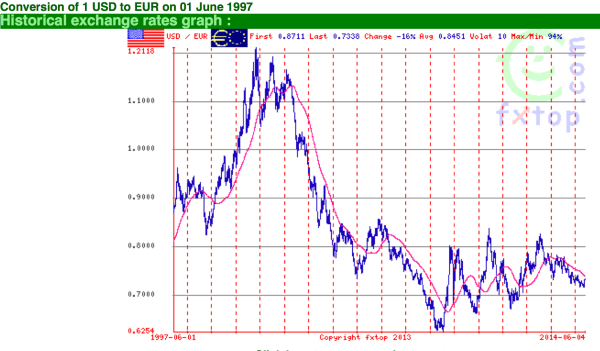
Once you venture outside the comfort of the dollar zone into the realm of the euro (or any other currency), you will find the rate of exchange varies minute to minute, Web site to Web site, buy rate to sell rate to the interbank rate. It’s confusing to say the least. What affects the rate of exchange is even more daunting. Even the most sophisticated of currency specialists will tell you that making predictions is just intelligent guesswork, even if based on very profound knowledge of how rates of exchange are affected. What they believe will happen in the future is all in their minds and not reality…they might as well have a crystal ball and then ‘pray like hell.’ (See finance.yahoo.com/ for an in-depth explanation of what affects currency values.)
On a daily basis, I stopped playing the currency game long ago — as long ago as when the dollar was stronger than the euro (2003). I vowed then to transfer “beaucoup bucks” while the rate was good and then just by being a bit ‘lazy’ I missed the opportunity. While waiting for the rate to improve, it just got worse and life in Paris living on dollars started costing more and more.
When making a big purchase as important as a piece of property that costs well into the hundreds of thousands of dollars or euros, even 1% can make a huge difference in cost. Here’s where, regardless of the current rate of exchange, you can save yourself “beaucoup bucks” simply by transferring the money in a smart way — by using a currency broker.
Currency brokers generally buy and sell currency at a lower profit margin than the banks. This means that the “spread” or difference between the buy and the sell price is their margin of profit, and because this is their business, and not just an ‘add-on’ like a commercial bank, they can afford to count on volume by discounting their service.
The brokers operate as an intermediary and provide additional services that help take the risk out of currency transfer. Instead of transferring the money from your bank account directly to the end recipient, you simply transfer the money to the broker who then forwards it on to the end recipient. It costs you nothing more to add this extra step, but it can save you “beaucoup bucks.”
For example, let’s say you are purchasing a property in Paris for 500,000€. The total cost will be about 550,000€ when adding the closing costs. First a deposit of 10% is placed with the Notaire at the time of the signing of the “Promesse” or “Compromis de Vente” (pre-sale agreement), then the remaining balance is transferred at the time of the signing of the final deed (about two to three months later). The rate can vary greatly between those two periods and you could gain or lose several points…depending on how you play the game.
First of all, the currency brokers normally add about 1% between the buy and sell rate, therefore the cost of the transfer for you is about 1%. The banks normally charge between 2% and sometimes as much as 3%. If you transferred the entire 550,000€ at one time, the difference between a broker and a bank could be as much as a 10,000€ savings! With that, you could furnish the apartment! This is what I call “beaucoup bucks.”
Other than the “one-off payments,” the brokers services also include making regular payments abroad (such as transferring money to pay your mortgage monthly), “buy forward” contracts that lock in a rate for a period of up to two years and “market orders” that enable you to trade at the moment the rate suits your fancy. Most of the brokers also offer the ability to make your transactions online from anywhere in the world.

Thanks to U.S. “FATCA” regulations, currency brokers must adhere to strict rules and acquire special licenses in each state in order to be able to handle your money. Acquiring the licenses is a long and expensive process for the brokers.
Discussion of the negative ramifications the FATCA regulations have created is a case for another discussion. The arm of the law reaches long and has hindered the fluidity of finance across borders, as well as placing Americans on the ‘black list’ of bad customers with foreign banks. For the moment, we have no choice but to manage the obstacles as best as we can.
We work with three of the world’s best currency brokers who are doing just that. Each has stealthily acquired the necessary licenses in U.S. states to service as many American clients as possible. World First, has generously provided the following predictions for our readers:
EURO SLIPS GOOD NEWS FOR THOSE LOOKING TO BUY IN EUROPE
June 2014
Written by Simon Hilton, Senior Foreign Exchange Consultant at World First:
For a while now, pound strength has provided British expats looking to move abroad real encouragement that they will get more for their money, and this is still the case.
In the last couple of weeks, the pound versus euro (GBPEUR) exchange rate has been as high as 1.235, with £200,000 getting you around €309,000. At the start of the year, it was down below 1.20, with the same amount of money getting you €300,000 – that’s €9,000 less in the space of a few months. Beware short term dips, though. For a couple of weeks in March, we saw the rate dip to below 1.20 – after that, it returned to the highs the likes of which sterling is currently enjoying.
So good news for Brits buying in Europe though there are signs that other currencies are starting to catch up.
For example, in the U.S., decent employment figures have given the dollar a lift, slightly allaying fears that the U.S. economy was in some form of weather fueled tailspin; exceptionally bad weather there had slowed – and in some cases halted – the workforce. The 288k increase in payroll jobs was much higher than the 215k expectation, but this allied with non-existent wage growth, this is why overall dollar strength through the last month has been good but not exceptional. At the start of June, the dollars vs pounds exchange rate (USDGBP) was 0.597, when it had been at 0.589 just three weeks earlier. On a $200,000 transfer, that’s £1,600 more in a relatively short space of time. However, in the longer term, USD is still well down on the highs it enjoyed at the start on February – USDGBP at 0.613; $200,000 worth £122,600, over £3,000 more than it’s worth today.
The Australian dollar’s recent strength continued through the last month, and like in the U.S., this is courtesy of an improvement in the jobs market. The overall unemployment rate moved to 5.8% following a recent foray towards 6.0%, with particular improvements seen in full-time jobs. Australian performance is linked with that of China, and a pickup in sentiment there has increased support for AUD. AUDGBP is currently hovering around the 0.555 mark, which is some way short of the 0.61/0.62 of a year ago, but represents one of the highest points in the last six months. Back at the end of January, the rate was down at 0.525, with AU$200,000 worth £105,000. Now, the same amount is worth around AU$111,000. Against the euro, AUD is close to six-month highs.
The Canadian dollar was the best performing G10 currency over the month of May. Increases in oil prices are always CAD positive as the marginal benefit of refining sour oil sands rises; crude was up around 2.6% on the month, and this has indeed has a positive effect on the Canadian dollar. At the start of June, CADEUR was at 0.676 against 0.660 at the start of May. On a CAD $200,000 transfer that’s worth €3,000 more. Against GBP, CAD has recently hit three and a half month highs.
Currently at the 0.072 mark, JPYEUR is roughly where it was at the start of the year, though month-on-month, there’s quite a change as to how far your money goes. At the start of May, JPY 50 million would have got you around €353,000. At the start of June, that’s gone up to over €360,000, showing how exchange rates can fluctuate in no time at all.
The euro has slipped recently against many of the major currencies, including those mentioned above – good news if you’re looking to purchase a property in Europe, or looking to make any other type of currency transfer.
And if friends of family want to send you any funds in your new country, their money will go further with the current pound strength in their favor.
 Notes: World First specializes in assisting private and corporate clients with foreign exchange transactions. World First transacted circa £6 billion for their clients in 2013 and have a 3A1 credit rating from Dun & Bradstreet – the highest possible rating for a company their size. As well as a best-in-class online platform, regular transfer service and tailored hedging solutions designed to protect you from adverse market movements, they also offer excellent customer service. Winner of the Client Focus Award at the 2012 National Business Awards, each customer gets a dedicated consultant and all phone calls are answered within three rings.
To learn more about World First and the other brokers (Moneycorp and Forex) with which we work, visit our currency exchange page, and be sure you mention that you are a reader of Adrian Leeds Group publications.
A bientôt ,
 Adrian Leeds
Director of The Adrian Leeds Group, LLC
Respond to Adrian: [email protected]

P.S. If you’re buying a holiday home or investment property overseas, the cost of moving your money can be greatly reduced by working with currency specialists instead of relying on your bank to make the transfer. We work with currency specialists to help you make the most of your U.S., Canadian or Australian Dollor, or Sterling — Moneycorp, World First, and USForex. Find out how you can make your money go further — visit our Currency Exchange page.

Let Us create a custom strategy for you
You can live or invest in France-now.
Property for sale

what's happening
Check out upcoming events, conferences, or webinars. Join us!
GET FINANCING
Learn about French Property Loan Information.

Read & Subscribe
Dive into more by reading the Adrian Leeds Nouvellettre®
Better yet, subscribe to both and get the updates delivered to your inbox.

Get started with your dream of owning property in Paris.
Join us on Youtube
Dive into more on how to live, invest & escape to France
Be sure to subscribe!
To read more, click the links below.