


Weekly insights about property in France!
Subscribe and don't miss an issue!
Sales Up, Prices Down, Rate Favorable…Now’s a Good Time to Invest
Volume X, Issue 22

The first quarter 2012 market report has just been issued by the Chambre de Notaires de Paris…today, hot off the press. They’re calling it an “atypical period” because the beginning of 2012 has seen a burst of activity that had no impact on the predicted slowing down of prices, now confirmed, but still gradual and general.
The volume of sales on the Ile-de-France first quarter 2012 was up 14% compared to the same period in 2011 and up 4% compared to 1999-2007, the boom years. Yet, the dynamics have changed. Sales of resale homes fell 16% between February 2011 and February 2012 and 21% between March 2011 and March 2012. Prices have eroded only slightly — in all geographic areas of the Ile-de-France and all types of habitats, prices have been stable or lower in the first three months of 2012.
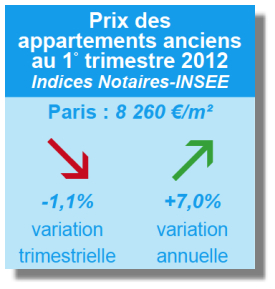
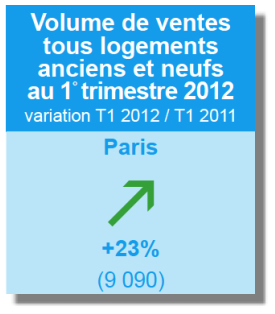 The price of an apartment in Ile-de-France decreased by -0.5% between January and March 2012, reaching 5,510€/m2. In Paris the price per square meter amounts to 8,260€ at the end of March 2012, down by -1.1% compared to the 4th quarter of 2011. Only five districts still show rising prices as they recede in the other 15 districts. However, the annual change still amounts to 7%. According to the leading indications in late July 2012, the average price per square meter for an apartment in Paris is expected to lower to 8,200€ (a decline of 2% compared to July 2011).
House prices in Ile-de-France have stabilized at 1st quarter 2012 (the unit price of a home to 309,500€). This trend concerns all the suburbs of Paris and the outer areas.
To download the report (in French) in its entirety, click here: Chambre de Notaires de Paris.
With the rate of exchange weakening the euro and prices coming down (a bit — about $1.24 = €1 today), this is a good time to consider an investment. Mid May, Moneycorp.com issued their report and currency predictions:
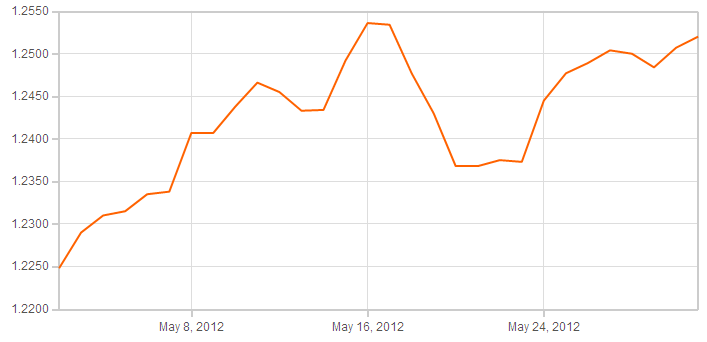
The last two weeks have seen another volatile period for the Pound. Although UK GDP was revised down to 0.3% retraction the real driver was again concerns over the Eurozone with the focus firmly on Madrid and Athens. This combined with another retraction of Chinese manufacturing, and alarm bells have been ringing that the global economy could quite quickly fall back into dangerous territory.
Spain’s fourth largest bank, the improbably-named Bankia, was formed a year and a half ago from the broken remnants of half a dozen regional “caja” savings banks. In those 18 months its losses are such that it needs a €19 billion injection of capital, more than four times its market value. And Bankia’s solution? It made severance payments of €14m and €6m to two of its discredited management team and promised a Spiderman towel to young savers brave enough to leave €300 in their account until the end of the month. Investors looked on and wept.
Bankia needs more and there are others behind it in the queue. The Spanish government would dearly love to provide the money itself but it cannot raise funding from the bond market at any sensible rate of interest. One way or another Spain is going to need a bailout from the EU. The only argument is about where it comes from and what it is called. Unfortunately that argument has been going on for longer than investors would like. Specifically, Germany must sign up for whatever scheme emerges and so far Chancellor Merkel has not found one to her taste.
Meanwhile in Greece, citizens have been agonizing about whether or not to stick to their austerity medicine. In essence they want to dump the austerity measures which are a condition of the EU bailouts that keep them going. Were they to do so the payments would probably be cut off and the country would go bust, forcing it out of the single European currency. A re-run of May’s indecisive general election in mid-June might clarify the situation.
Failure of the Spanish banking system or Greece’s departure from the euro would be enormous individually. For the two to happen at the same time would be catastrophic (probably – nobody really has a clue). It is therefore probable that EU leaders will put their differences behind them and cobble together last minute solutions.
Whatever the short-term outcome, it looks increasingly likely that it will be unhelpful to the euro. An unruly dissolution would be expensive and messy: To preserve the currency’s integrity at any price would involve printing a great deal of money and would leave dangling the possibility of a repeat of the current pantomime.
EU politicians are growing reluctantly accustomed to the idea that without fiscal union there is bound to be a repeat. Whether they can sell it to their voters is a different matter.
A risky time indeed for any Euro sellers.
Jordan Tilley
Senior Key Account Manager
Visit Moneycorp for more information and to set up your Moneycorp account.
A bientôt,
 Adrian Leeds
Editor, French Property Insider
Email: [email protected]

P.S. You can now buy currency and make overseas transfers 24 hours a day, 7 days a week using Moneycorp Online. The same great service you receive over the phone is now online and simple to use, whenever it suits you. Right now, if you make a currency transfer, you have the opportunity to win an iPad! It’s easy to register for Moneycorp Online — just click on the link, enter your mobile number in the form, and activate your account. That’s it – you’ll be entered in our prize draw to win one of three iPads.

Let Us create a custom strategy for you
You can live or invest in France-now.
Property for sale

what's happening
Check out upcoming events, conferences, or webinars. Join us!
GET FINANCING
Learn about French Property Loan Information.

Read & Subscribe
Dive into more by reading the Adrian Leeds Nouvellettre®
Better yet, subscribe to both and get the updates delivered to your inbox.

Get started with your dream of owning property in Paris.
Join us on Youtube
Dive into more on how to live, invest & escape to France
Be sure to subscribe!
To read more, click the links below.