


Weekly insights about property in France!
Subscribe and don't miss an issue!
The French Property Market Report
Volume XI, Issue 6

The Market for Older Properties
In Volumes: According to estimates from the CGEDD (Conseil Général de l’Environnement et du Développement Durable), sales of older properties stood at 730,000 in late September 2012, i.e. a fall of 12% over a year. Since March 2012, the number of sales calculated over the last 12 months has fallen by an average of 2% each month compared to the previous 12 months. Over the third quarter of 2012, our estimate for the French provinces reveals a fall of 20% over a year, compared to 16% the previous quarter. In the greater Paris region, a similar pattern can be observed: during the third quarter, 37,700 homes were sold, i.e. 21% fewer than in the third quarter of 2011. The slide continued over the three months from August to October, with 31,600 sales.
Prices: According to the NOTAIRES-INSEE index, apartment prices fell by 0.5% and those of houses by 1.5% (year-on-year) in the third quarter of 2012 for the whole of Mainland France. Taking just the French provinces together, the prices of older apartments and older houses have suffered a similar fall (1.3% and 1.5% respectively) over a year. Only apartments in the greater Paris region have seen their prices increase (by +0.3%) while the prices of houses have fallen back by 1.2%.
Between the second and third quarters of 2012, prices increased to a degree slightly below that generally witnessed at this time of year: the index figures corrected for seasonal variations published by the Insee – which are designed to reduce the impact of these effects – are down overall by 0.1% (with apartments falling by 0.2% and houses remaining stable).
In the greater Paris region, prices continued to hold up in October, with the quarterly price development of older homes (all types) being +0.1% (+0.4% for apartments and -0.4% for houses). On the same date, the annual development was -0.5% (0% for apartments and -1.7% for houses). In Paris, the price of apartments rose by 0.4% in a year, while house prices fell in all the départements comprising the region (between -1% in Seine et Marne and in Val dOise, and -2.9% in Seine-Saint-Denis).
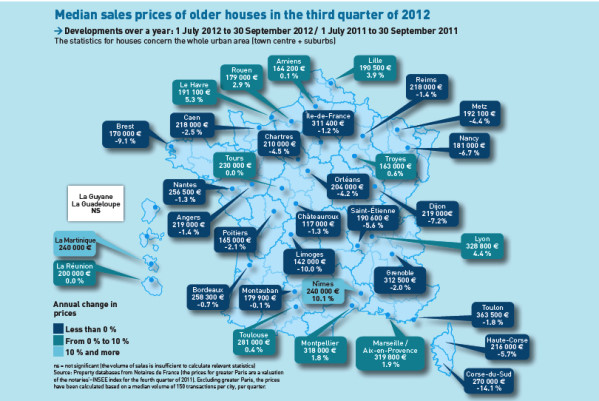
In the French provinces, in the third quarter of 2012 two départements out of three were showing developments of between -5% and +5%. Increases in excess of 5% were rare. These concerned five départements for houses (Charente maritime, Haute-Loire, Vosges, Deux-S
èvres and Haute-Marne) and five others for apartments (Haute-Vienne, Haute-Corse, Hautes-Pyrénées, Lot-et-Garonne and Gard). For the same département, apartments and houses are not necessarily going in the same direction. As an example, Aude, Drôme and Eure-et-Loire are all posting price rises for apartments and falls for houses. The opposite phenomenon is also observed, for example in the Bouches-de-Rhône, Charente Maritime and Alpes-Maritimes.
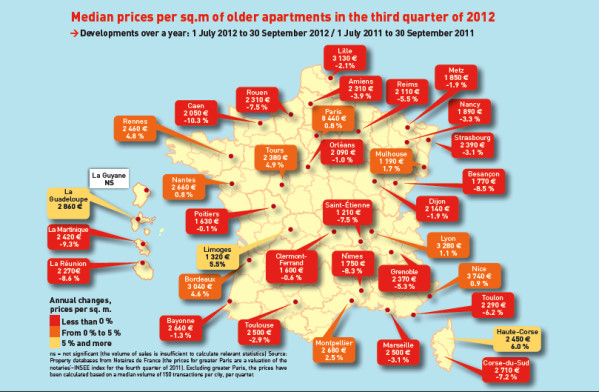
For the main towns (districts) and urban areas in the French provinces, the developments are also mostly situated between -5% and +5%. Sharper falls are nevertheless noted, for apartments in certain towns such as Caen (-10%), Besançon (-8%) or Nîmes (-8%) and for houses in the urban areas of Limoges (-10%), Brest (-9%) and Dijon (-7%).
The advance indicator derived from option agreements is showing a downward trend for the prices of apartments and houses in the French provinces and a stabilization in prices in inner Paris for 2012 and early 2013.
The new housing market
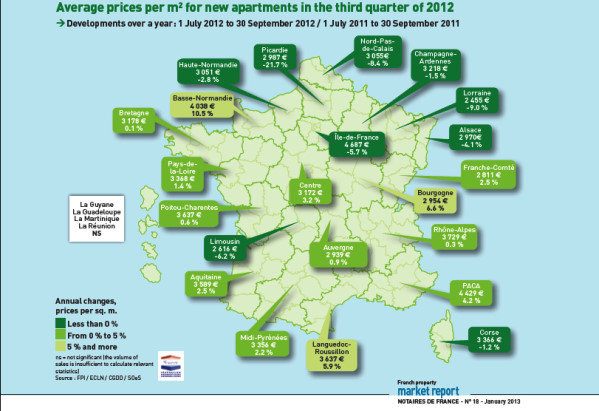
According to the ECLN survey (Enquête Commercialisation des Lodgements Neuf New Homes Marketing Survey), for the third quarter of 2012, the volume of sales of new homes is 25% lower than that of the third quarter of 2011. One quarter ago, the fall over a year was only 14%. The stock of apartments proposed for sale is slightly up and is equivalent to 4.3 quarters of sales. On the other hand, the proportion of stock actually completed remains at a very low level, equivalent to 4.3% of the total stock. According to the Fédération des Promoteurs Immobiliers, prices have increased only slightly over a year (+1.2%).
According to the Markemétron newsletter (a market report examining sales of non-project houses) the number of transactions concerning non-project houses up to October 2012 was down by 17% over a year.
As for the construction of new properties, the number of authorisations fell by 5.5% quarter on quarter up to late October and that of new housing starts by 19.3%. Over a year, the development of authorisations was up (2.1%) but that for housing starts was down overall (-5.7%). Houses are sharply down, both for non-project (-11%) and project houses (-13.1%) while the apartment sector is holding up (+1%).
The availability of credit According to the Observatoire Crédit Logement (housing loan monitoring group) CSA, the distribution of housing loans to domestic clients in 2012 is sharply down on the previous year. The fall totaled 32.6% year-on-year over the first 11 months of the year.
Interest rates have however continued to fall. The average level in November was 3.31%, (i.e. 3.35% for new properties and 3.26% for older ones). Since March 2012, their decline has totaled 64 base points for an identical period of 208 months.
For older properties
Volumes in the market for older properties, which usually stand at an average of around 800,000 transactions per year, should see 2012 ending somewhere between 650,000 and 700,000 sales. The risk of a year-end figure of fewer than 650,000 seems to have receded. In a number of very specific cases, the reduced taxation of real estate capital gains will have no impact as it is limited to building land. The only cause for concern is that the fiscal instability which generated something of a frenzy in 2012 and the various ideas which have been put forward during the budgetary debates may have put some buyers off.
For 2013, three additional factors will contribute to a further fall in the number of transactions: the economic outlook, with low growth bringing about an unavoidable rise in unemployment, a wait-and-see attitude on the part of potential buyers in markets in which a downturn is not yet fully underway and the absence of any state aid for the acquisition of older properties, with the exception of sensitive urban areas. In such circumstances, we can be certain that the volume of sales will not reach 600,000 and that it may well not even get above 550,000. It will be even lower if vendors fail to lower their pricing expectations or if they choose to postpone the sale of their properties. A new loss of tax revenue for the départements and districts is therefore a very real risk. Overall this should be of a lower scale than in 2012, but the number of local authorities suffering both a decline in volumes and prices could be higher in 2013.
The scenario of a simultaneous rapid fall in prices and volumes occurred in 2009 but this was an exception. On the contrary, as a general rule, falls in prices are not only usually “out of sync” with those in volumes but furthermore they tend to be spread over several years. This is what happened in the 1990s. This is also the conclusion reached by the OECD based on their observation of several dozen property cycles in all member countries: the prices (in real terms) increased on average by 20% over six years before falling back by 26% over five and a half years.
For new properties
The volume of sales by property developers in 2012 should be closer to 70,000 than 75,000. The “tax incentive” effect due to the looming end of the Scellier scheme will not occur, due to a postponement of its demise until late March 2013. Whats more, it would not have been particularly significant in scale. There is no reason for the perspectives for new homes in 2013 to be any better than that for older properties. Sales prices will suffer the effects of the introduction of the RT2012 standard. To this should be added that of a realignment vis-à-vis sales to social housing bodies, whose relative size will increase due to the “scissor effect” underway between social accommodation and the private sector. The first is supported by governmental production targets and the increasing of the threshold in the major urban areas. The second is hampered by the economic climate and the real estate situation described above. As for sales to investors, these should be fewer in number than in 2012, so it remains difficult to establish the level of attractiveness of the Duflot scheme.
As for the construction of private houses, this tends to be less sensitive to the fiscal environment but more so to the economic environment and property support schemes. The full details of the revised zero rated loan are still not yet all known. It is therefore difficult to issue any opinion concerning its impact and to estimate whether the improved repayment terms for less well-off families will offset the lowering of the revenue ceiling (36,000 instead of 43,500 in zone A).
Housing indicators
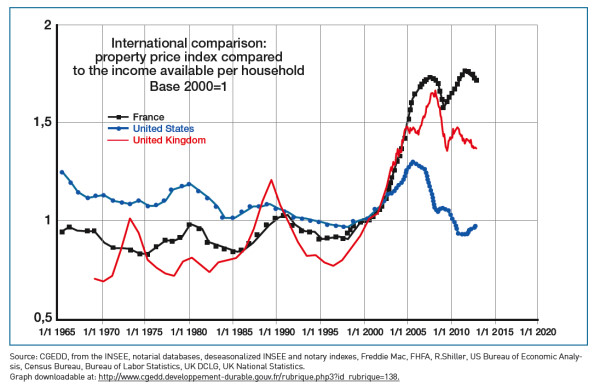
France: The all-France price index for older housing is calculated by Notaires de France (French notaries) in partnership with the INSEE (French National Statistics & Economic Studies Institute). This index is published on a quarterly basis and uses the hedonic pricing method. Data are derived from deeds of sale submitted by the notaries.
United States: The FHFA index is drawn up by the Federal Housing Finance Agency, an organization affiliated to the US government, which measures the development of prices for houses based on a sample of mortgages. It uses the repeat-sale method.
United Kingdom: The DCLG is the official price index for housing published by the British government based on a sample of mortgages. It uses the hedonic pricing method.
The real estate market as a whole has not escaped the economic crisis as demonstrated by a fall in the number of transactions, whic
h began several months ago. However, we are seeing neither a brutal downturn nor a major slide in prices. Youll find the complete press kit for the mountain real estate market at notaires.fr.
In an economic crisis and a climate of fiscal instability, how can a market as large as that of the real estate sector escape the general downturn?
However, the market for mountain properties seems to have stood up quite well, seemingly proving that second homes, which by their very nature are less essential than first homes, continue to exercise an attraction for buyers, bringing with it increasing numbers of foreign buyers and a drift towards the top of the range, upon which the main resorts and not only Courchevel or Val dIsère now appear to be focusing with their future plans. This is the main factor explaining this economic paradox.
The winter sports clientele is often a wealthy one and people are now increasingly looking not only to Europe but to the rest of the world to capture new markets even if the lack of snow sometimes limits the number of tourists, as was the case in the winter of 2006/2007.
It must be acknowledged that over the years the quality of new buildings and better space usage have led to the construction of apartment buildings and chalets which are environmentally friendlier and more in keeping with the traditional feel of Savoyard villages. The renovation of older properties, the conversion of barns or mountain farms in areas where real estate is in short supply, combined with the construction of luxury chalets are all good reasons to live in the mountains, for easy access to the activities on offer. More than just snow and skiing, the attraction is actually the mountain as a whole, its living environment and its traditions which are the main attractions for an ever more demanding clientele.
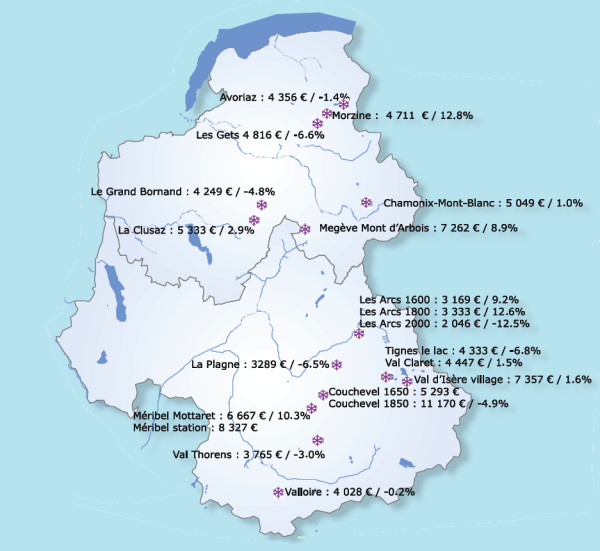
Will the market for rental properties provide a boost for the Alps?
Although Haute-Savoie, which is situated within easy reach of Switzerland and Geneva, has retained a significant industrial base alongside its mountain resorts, Savoie is proud to vaunt the sheer prestige of its resorts and ski areas to the whole world, all factors which have made it deservedly famous. The expenditure of skiers and those accompanying them has been assessed for all resorts in the Rhône Alps region at more than 6 billion and more than 85% of this is spent in the départements of Savoie and Haute-Savoie.
Without a doubt, Savoie benefits first and foremost from the mountain and winter sports market.
You can download the PDF document for further explanation of this information.
The Chambre de Notaires de France App
 Download the Chambre de Notaires de France app for your iPhone (or iAnything) for the latest in property prices in more than 36,000 French towns. Data is updated monthly and faithfully recreates the reality of the market. There is a quarterly, annual and 5-year evolution and housing prices index. The calculation tool Notaires’ costs allows you to estimate the amount of taxes and other fees, that you must consider in addition to the sale price. The distribution of those costs is suggested. This data is provided for guidance and does not represent a contractual commitment. You can easily save your searches and your market price simulations and fees to your favorites. Before any real estate project, consult your Notaire. More than 9,000 Notaires are available throughout the country.
More information, visit notaires.fr and download the app.
Buying or selling a home — get informed about legal and fiscal aspects of real estate transactions in France. A publication by the Chambre de Notaires de France. Please make note that this document was published in 2010 and therefore some of the information (particularly regarding tax issues) is out of date. Download the PDF.
A bientôt,
 Adrian Leeds
Editor, French Property Insider & Director of The Adrian Leeds Group, LLC
Email: [email protected]

P.S. Did you know that the Adrian Leeds Group offers everything you need for your visit or move to Paris or France?…from luxurious vacation rentals at Parler Paris and Parler Nice Apartments to customized concierge services at Parler Paris Plus, long-term apartment rentals searches, property finding services for purchase of property, currency transfers, loans and more. For more information, visit our site at AdrianLeeds.com

Let Us create a custom strategy for you
You can live or invest in France-now.
Property for sale

what's happening
Check out upcoming events, conferences, or webinars. Join us!
GET FINANCING
Learn about French Property Loan Information.

Read & Subscribe
Dive into more by reading the Adrian Leeds Nouvellettre®
Better yet, subscribe to both and get the updates delivered to your inbox.

Get started with your dream of owning property in Paris.
Join us on Youtube
Dive into more on how to live, invest & escape to France
Be sure to subscribe!
To read more, click the links below.