


Weekly insights about property in France!
Subscribe and don't miss an issue!
The Role of the Notaire
Volume X, Issue 34

 The Notaire’s office has been quiet all this month with most employees on vacation and few transactions to manage. Anyone thinking they can make a property purchase, sign documents or manage any legal transaction during the month of August in France is dreaming!
We managed to accomplish one such transaction — the signing of an “Acte de Vente,” but only at the end of the month and with a clerk, not the Notaire himself who is still enjoying the summer off.
No complaints — our Notaire with whom we have worked exclusively since the year 2000 is well worth the wait. We have a lot of faith in his capabilities to perform his function for our clients as diligently and efficiently as possible. He speaks English and has always ensured that his clerks working with us have a good command of the language. We depend on them to oversee every letter of the law on behalf of our clients and we would hold them responsible for mistakes, but we would never recommend blindly trusting your Notaire to catch it all. This means that it is insurance to have another set of professional eyes on the process of the transaction and the letters of the law.
Keep in mind that the Notaires are not actually familiar with the property. They might have a thick dossier of documents that describe it in excruciating detail, but they are unlikely to have ever stepped foot in the door and really seen the physical property for themselves. This is where the mistakes really happen.
For example, we have a friend who purchased an apartment with a mezzanine, only to discover many years later that it was not noted in his deed and therefore did not own it, even though it is very much physically part of the apartment! The culpable Notaire, by coincidence, represented both our friend as well as the actual owner of the mezzanine, who owns an apartment in the same building. The mezzanine was once a “débarras” (storeroom) on an upper floor that was obviously ‘stolen’ by our friend’s apartment’s previous owner. The real owner of the stolen storeroom never even noticed.
One can only imagine what ensued after the discovery. It became a legal mess tied to big expense. If the owner had not given the Notaire total authority to manage the sales transaction, they might have caught the costly mistake in the beginning saving everyone a lot of time, aggravation and money.
It is both customary and smart to have your own Notaire representing you, as both the seller’s and buyer’s Notaire will share commissions. Over the years, I’ve been in hundreds of transactions and met as many Notaires. They come in all sexes, shapes and sizes and of course, competences. They are your insurance — like having title insurance on a U.S. transaction, so choose wisely.
The Chambre de Notaires provides a good explanation of their role
(http://www.notaires.fr/):
———-
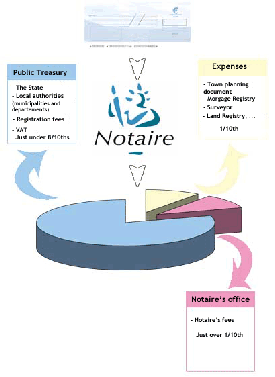 A Notaire is a legal specialist with a public authority mission who draws up authenticated contracts on behalf of his clients. He is self-employed.
A Notaire is a public officer who operates in every area of law including family, property, inheritance, asset, company law, countryside law, local authorities, etc. He acts on behalf of the State and is appointed by the Minister of Justice, and the fact that an instrument is drawn up by a Notaire is a guarantee of its legality and authenticity. All this means that the Notaires are vested with prerogatives of official authority which they receive from the State. Under the terms of Article 1 of the Order dated 2 November 1945 regarding the status of Notaires, “Notaires are public officers authorized to record any instrument or contract the parties to which are obliged, or may wish, to invest with the type of authenticity associated with public authority instruments.”
The Notaire is empowered to authenticate instruments by affixing his seal and signature. By so doing he officially witnesses the wishes expressed by the signatories and gives his personal guarantee regarding the content and date of the instrument. Such instruments then have the legal status of a final judgment. As such, the Notaire is an amicable judge and dispensers of out-of-court justice.
Although he has a public authority, the Notaire operates on a self-employed basis and is responsible for his own office, thereby providing a modern type of public service that costs nothing to the State. He is a self-employed professional who is paid by his clients (and not the taxpayers) on the basis of a rate fixed by the State for the services he provides.
The Notaire is present throughout the country according to a zoning system worked out by the Minister of Justice to best serve the needs of the population. The Notaire is therefore able to provide a locally-accessible public service focused on legal matters. His office is not subject to “numerus clausus” restrictions which would limit the number of Notaires operating at any one time. Instead they are subject to a zoning system which ensures in order to cater to the needs of the population in any given area.
The location of Civil Law Notary offices is reviewed on an ongoing basis under the supervision of the Central Administration of the Ministry of Justice, known as the “chancellerie.”
This location review has three objectives:
– to maintain a locally-accessible public service focused on legal matters,
– to take account of geographical and population change,
– to oversee the financial conditions under which the profession is carried out with a view to ensuring quality of service.
The sum paid to Notaires, which is commonly and mistakenly referred to as Notaires costs, actually comprises:
– taxes that go to the State and local authorities (approximately 8/10ths of the costs): these are sums that the Notaire must collect and pay to the State on behalf of their clients. They vary according to the type of instrument and property.
– expenses (1/10th): sums that the Notaire disburses on behalf of their clients to pay the various parties in the transaction and/or the cost of the various documents, and to settle one-off expenses incurred at the clients request (e.g. certain travel costs).
– The Notaire’s actual remuneration (1/10th).
Since the Notaire acts in public interest, his remuneration is strictly controlled and is governed by regulated fees.
The fees was set by the decree dated 8 March 1978 and has since been modified twice: decree dated 16 May 2006 and decree dated 21 March 2007.
In this respect, it is worth noting that 71% of French people consider that fixing of Notaires’ fees by the State is a good thing because it ensures equality between citizens (CSA — Notaires de France survey, January 2007).
It is also worth noting that the monies that the clients leave with the Notaire for the completion of their file, and which more often than not constitute provisions, are deposited at the Caisse des Dépôts (Deposit and Consignment Office) and are inspected on a regular basis.
It should also be pointed out that these funds do not earn interest and that the Notaire is paid only when all the formalities are completed.
It is therefore not in the Notaire’s interest to let a matter drag on.
Strictly speaking, the fees therefore comprise of:
– proportional and fixed emoluments (fixed by decree) for all the instruments and formalities to which the public authorities have decided it applies (e.g. marriage contracts, gifts, etc.),
– fees for all instruments for which the decree provides that payment is freely agreed between the Notaire and his client (e.g. commercial leases, articles of association, etc.).
Fixed emoluments are charged for instruments for which no proportional fee is payable and are calculated using an accounting unit called a unit of value (U.V.). (Since the decree of 16 May 2006, the U.V. is 3.65 excluding VAT). This fee is set by decree and varies according to the type of instrument.
Examples:
– Gifts between spouses (during the marriage): 30 U.V. i.e. 109.50 (excl. VAT).
– Drawing up a posthumous power-of-attorney: 30 U.V. i.e. 109.50 (excl. VAT)
– Initial or amended PACS (Pacte Civil de Solidarité âà civil union) document: 50 U.V. i.e. 182.50 (excl. VAT).
The formality emoluments often charged for the completion of an instrument are also evaluated in U.V.’s depending on the type of instrument.
Examples:
– authenticated copy : 0.3 U.V. i.e. 1.09 (excl. VAT)
– plain-paper copy : 0.1 U.V. i.e. 0.36 (excl. VAT)
Proportional emoluments are calculated by applying a percentage (rate) to the value specified in the instrument. The rate is on a sliding scale and applies to a coefficient depending on the legal nature of the instrument. These instruments are categorized in the decree.
Emoluments for specific instruments:
– Negotiating fees for Notaire acting as negotiator.
– These are in proportion to the value of the property: 5% up to 45,735 and 2.5% thereafter.
– Settlement fees for “contracts ending a dispute or preventing a future dispute”: the emolument payable is doubled for the agreement to which it leads.
Fees paid directly to the Notaire apply to instruments of which article 4 of the decree stipulates that the payment is agreed freely between the Notaire and his client.
Example of instruments: sale of businesses, legal advice.
Clients must be notified beforehand in writing of the sum to be paid or the method used to calculate it, and give their approval to the Notaire.
———-
Download a pdf brochure by the Chambre de Notaire.
A bientôt,
Adrian Leeds
Editor, French Property Insider
Email: [email protected]

 P.S. We have the inside scoop on a drop-dead-gorgeous thr
ee-bedroom, two-bath newly renovated apartment with all the finest amenities in an amazing location next to Notre Dame for sale at the right price. If you are SERIOUSLY interested and can afford to spend about 1.5 million euros to have the dream apartment in Paris (we can get you an 80% LTV mortgage), then contact me immediately at [email protected]

Let Us create a custom strategy for you
You can live or invest in France-now.
Property for sale

what's happening
Check out upcoming events, conferences, or webinars. Join us!
GET FINANCING
Learn about French Property Loan Information.

Read & Subscribe
Dive into more by reading the Adrian Leeds Nouvellettre®
Better yet, subscribe to both and get the updates delivered to your inbox.

Get started with your dream of owning property in Paris.
Join us on Youtube
Dive into more on how to live, invest & escape to France
Be sure to subscribe!
To read more, click the links below.