

Adrian Leeds Nouvellettre®
Your taste of life in France!
Subscribe and don't miss an issue!
Happy New Year from Jerusalem of Gold

The return to Paris from Tel Aviv was January 1st because the air fares were more of a bargain on the holiday. New Year’s Eve isn’t that important in Tel Aviv because the Jewish year ends and begins with Rosh Hashana, which was the evening of Monday, September 22, 2025. It’s the year 5786 for Jews who observe the Hebrew (Jewish) calendar.
The Hebrew calendar counts years from what Judaism defines as the Creation of the World—specifically the creation of Adam and Eve, understood as the beginning of human time. The date is calculated from the biblical genealogies and lifespans in the Book of Genesis and later texts, as systematized by early rabbinic scholars—most notably in a second-century text. The traditional Jewish calculation places Creation in the autumn of 3761 BCE. Personally, I don’t care, as long as I know what date most of you will understand! For all intents and purposes, I’ll stick with January 2026.
After the excursion to the Golan Heights on Saturday, the weather turned cold and rainy. Bundled up, we headed out by public bus riding along the water’s edge past the high-rise four- and five-star hotels to first visit the Leibling Haus, a historic modernist building. It’s now a cultural center located at 29 Idelson Street, designed in 1936 by architect Dov Karmi and the engineer Zvi Barak, originally built by Tony and Max Liebling as a residential building. The structure exemplifies the modernist architecture that gave Tel Aviv its distinctive “White City” character.
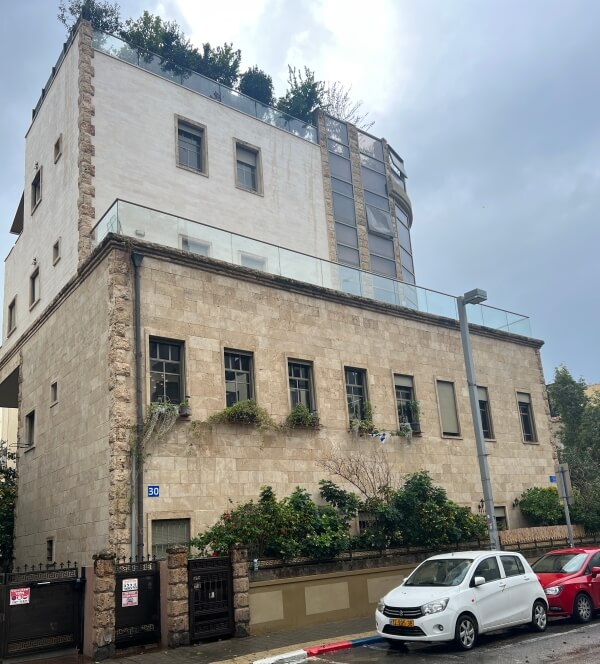
Leibling Haus in Tel Aviv
This cultural and educational hub focuses on architecture, urban conservation, and the history of Tel Aviv’s modernist heritage, hosting exhibitions, lectures, workshops, research labs, guided tours, a café, and other public programs. The café was jammed with young people on laptops, slowly sipping java. Its exhibition explains how Tel Aviv developed and the story of how modern architecture shaped its unique urban character.
Tel Aviv is famous worldwide for its extraordinary concentration of Bauhaus-influenced architecture, often called the “White City.” It’s so significant that UNESCO declared it a World Heritage Site in 2003 for its outstanding modernist urban ensemble. The “White City” is the central area of Tel Aviv, roughly from Rothschild Boulevard and surrounding streets with around 4,000 modernist buildings built mainly in the 1930s and 1940s. About 2,000 of these buildings are now protected heritage sites. Their clean lines, white façades, flat roofs, balconies, and functional designs give the city a distinctive look. If you’re a fan of Bauhaus, then you won’t want to miss a special excursion to Tel Aviv.
A walking tour took us to what was the first City Hall of Tel Aviv—Beit Ha’ir on Bialik Square—which now serves as a museum for Tel Aviv urban culture. Just down the street is Beit Bialik, the house of the national poet, Haim Nahman Bialik, one of Tel Aviv’s most authentic and beautiful houses.
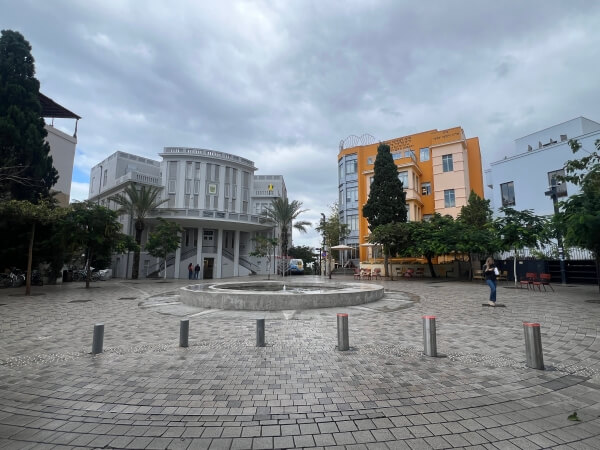
Beit Ha’ir on Bialik Square
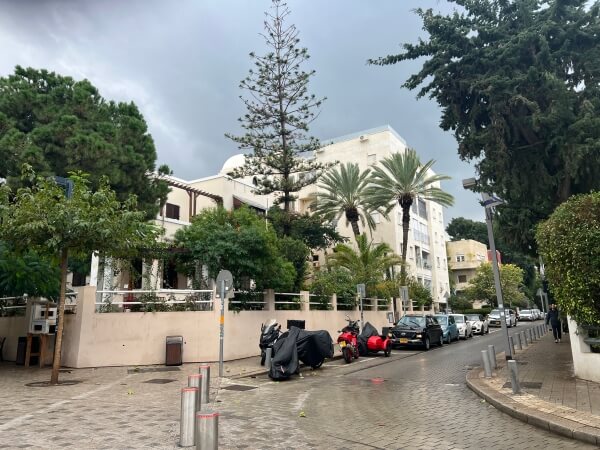
The Beit Bialik house
The goal was to land eventually that day at the Shuk HaCarmel, the city’s largest and one of the oldest markets bordered by Allenby Street and Magen David Square. It’s open every day of the week, except Shabbat (Saturday), and sells mostly food but also a variety of items, such as home accessories and flowers. In the market are lots of little restaurants, one of which we did a B-line for: Mifgash Rambam, famous for its shawarma.
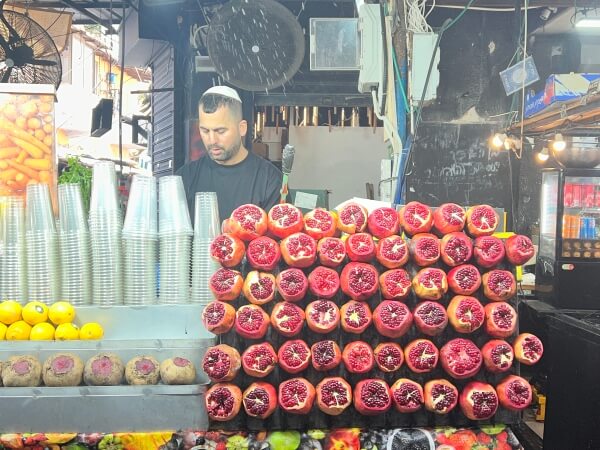
Shuk HaCarmel
Mifgash Rambam is one of the city’s most talked-about shawarma spots—started as an idea by the team behind the acclaimed restaurant HaBasta, a well-known name in Tel Aviv’s restaurant world. During the Covid lockdowns, the chefs turned a joke about opening a shawarma stand into reality, bringing their culinary expertise to a humble street-food staple. What makes it stand out is its blend of lamb and beef that’s seasoned and sliced with care. Some diners even call it among the best shawarma in Tel Aviv and the surrounding region because of the flavor balance. (In Paris, on rue des Rosiers, we have L’As du Fallafel which is known to be the best in Paris.)
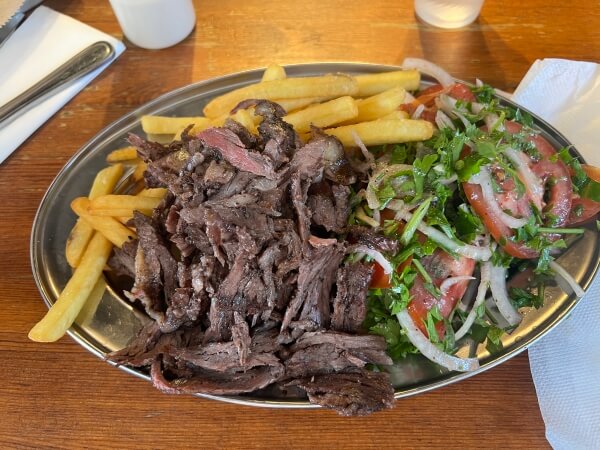
Shawarma at Mifgash Rambam
With seats at the counter, this is where everyone came to place their orders. They were eyeing my very mountainous plate of shawarma, salad and fries, ending up ordering one like it for themselves. I ate almost every bite. Yes, it ranks way up there in shawarma land. I even joked with the young woman taking the orders. “You know how good this is, don’t you?” Yep, she knew!
As we sat there scarfing it down, I watched cute guy after cute guy walk up to place their orders. I said to Kathy, “This is cute guy land.”
Her response was, “Yeah, there’s no such thing as a bad cucumber in Israel!”
I laughed so hard that I nearly peed in my pants, and could barely get the words out of my mouth, “Kathy, what do you think I said???”
The even funnier part to all this was the joke we got when just before in the market, we saw a huge bin of cucumbers standing erect!
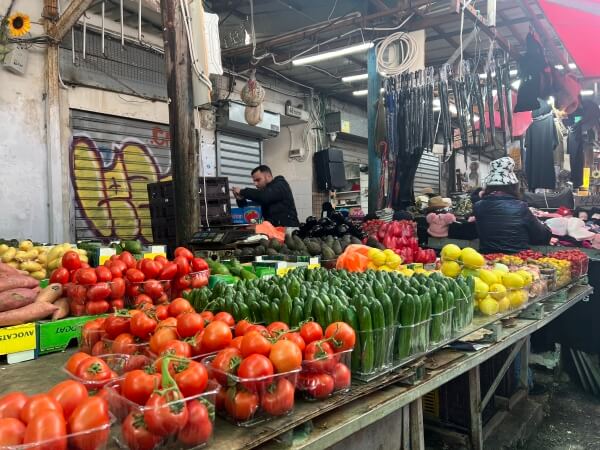
So, from now on, we have a code. If one of us says “This is cucumber land,” we’ll know exactly what the other means!
This all led to a hankering for a Turkish coffee to wash it all down—what they call “café shachor”—or “black coffee.” It’s made with finely ground coffee boiled in water, often in a small pot. We used to call it “café bots,” meaning “mud coffee” because of the grounds that settle to the bottom before it’s drinkable, turning to mud. One small very specialized coffee house had a bevy of the little pots simmering on a bed of heated salt. It was thick, rich, delicious…plus muddy!
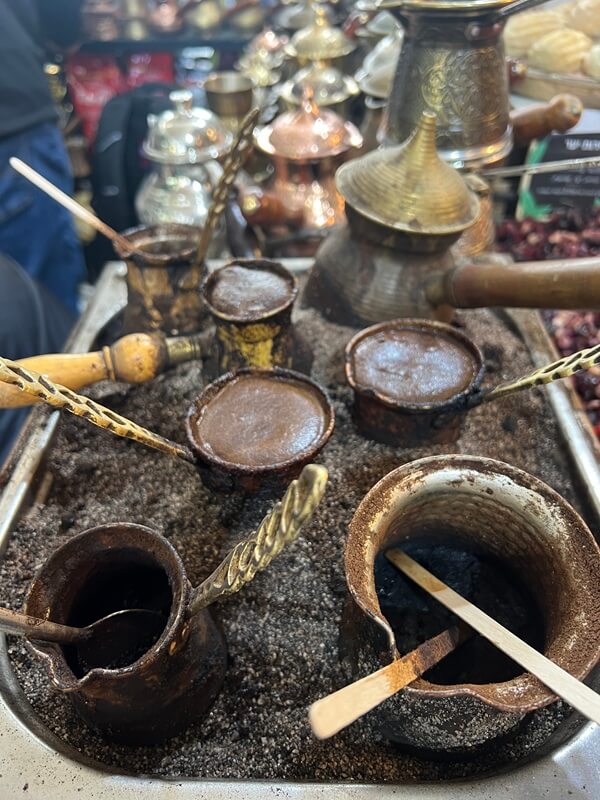
Café shachor
Big plans to go down to Jaffa (Yafo) after that were thwarted thanks to the strong winds. My favorite Kangol brand beret went flying and rolled half-way down the block till it landed under a truck, relatively unscathed. I had to chase it down and climb under the truck to retrieve it. So, instead of spending the afternoon in Jaffa, we grabbed a taxi and headed home to a calmer, warmer haven.
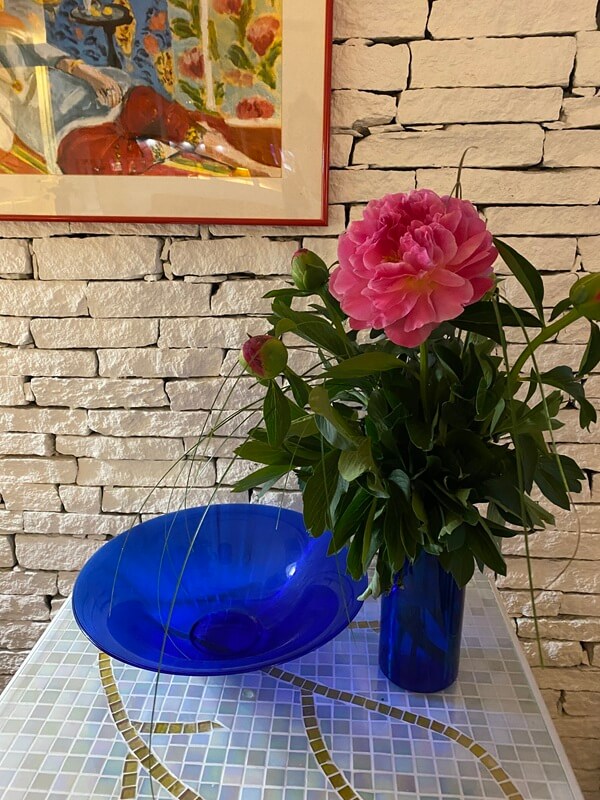
Jaffa (Yafo) is the ancient port city at the southern edge of Tel Aviv, where history, culture, and daily life intertwine. With its biblical roots, winding stone alleys, art galleries, flea market, and blend of Jewish and Arab traditions, it feels both timeless and alive. Once one of the world’s great ports and the historic gateway to the Land of Israel, Jaffa has merged with modern Tel Aviv while beautifully preserving its soul. It’s one of my favorite parts of the city and always remember purchasing a big blue glass bowl in its flea market…for pennies. I schlepped it all over Israel during the 2011 visit, then brought it back to Paris, then brought it to Nice, where it sits on my dining room table unscathed.
Kathy and Kobi have one car—a Smart electric model that is truly Smart, but it’s smarter to avoid taking the car into town at any price. Monday night we taxied to the Nachalat Binyamin neighborhood, the heart of Tel Aviv that is partially pedestrian, where lots of new bistrots are making their mark. We arrived early enough to get a bar seat watching the kitchen at work at the Barbur Grill & Bar (number 26 on Rechov Nachalat Binyamin). A 23 year-old cute Australian cucumber took our order and made our dishes right there in front of us.
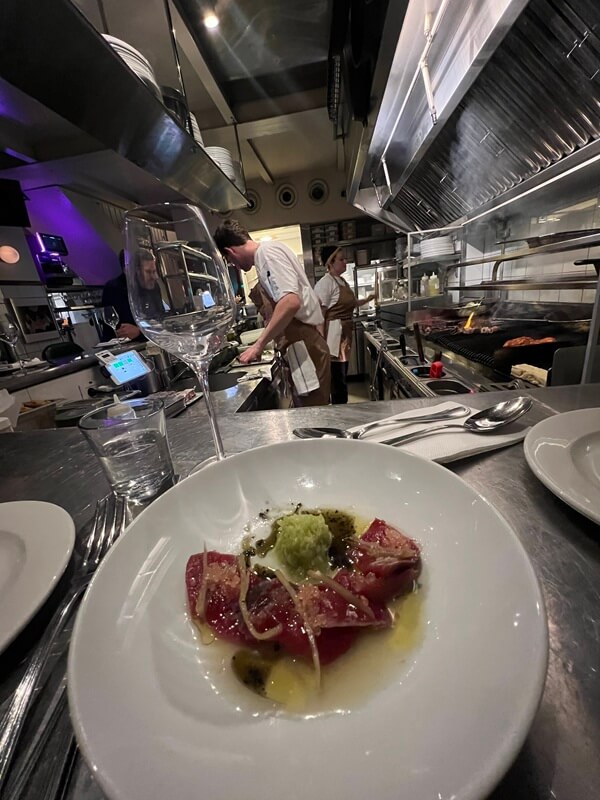
A delectable appetizer served at Barbur Bar and Grill
This was one of those mmm-mmm meals you write home about. After the disappointing experience we’d had at the beginning of the trip, this was welcome compensation. If you’re ever in Tel Aviv, mark this one as a definitive yes!
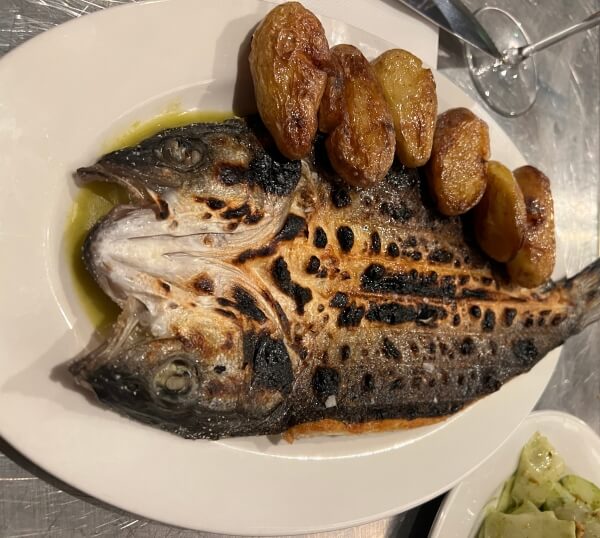
Barbur Bar and Grill whole butterflied fish
The Food Scene in Israel is impressive. It’s culture, history, and daily life served together, shaped by waves of immigration from Europe, North Africa, and the Middle East. From the lively “shuks” (markets) piled high with spices, olives, breads, and fruit, to street food counters serving hummus, falafel, shawarma, and “sabich,”* eating here is social, informal, and joyful. At the same time, a new generation of chefs is reimagining local flavors with modern technique, creating a food scene that is both deeply rooted and internationally sophisticated. In Israel, meals are meant to be shared, lingered over, and talked about—and that may be the most essential ingredient of all. My friends from New Orleans understand this fully—as we talk about the next meal we have planned while dining on the present one…and are forever seeking that “party in your mouth” you can get in New Orleans.
From Barbur, Kathy led me all the way down Rothschild Boulevard—an iconic, tree-lined street famous for its beautiful Bauhaus architecture (part of the White City), trendy restaurants, cafes, nightlife, and status as a central hub connecting business and culture, also home to the historic Rothschild Hotel. It’s one of the principal streets in the center of Tel Aviv, beginning in Neve Tzedek at its southeastern edge and running north to Habima Theatre and is one of the most expensive streets in the city…for good reason. The buildings are some of the city’s most beautiful.
Rothschild Boulevard doesn’t end at just another intersection—it culminates in one of Tel Aviv’s most culturally and historically significant public spaces: Habima Square—and that’s why its “end” matters. Habima Square is home to the Habima National Theatre, public gardens, and other cultural institutions. It’s also a central gathering place. Since the war began the square has shifted from being mainly a cultural meeting place to one of Tel Aviv’s key arenas for public expression, protest, and civic engagement tied to the war, politics, and national debates.
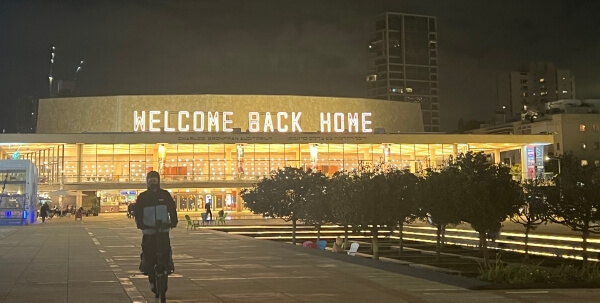
Habina Square at night
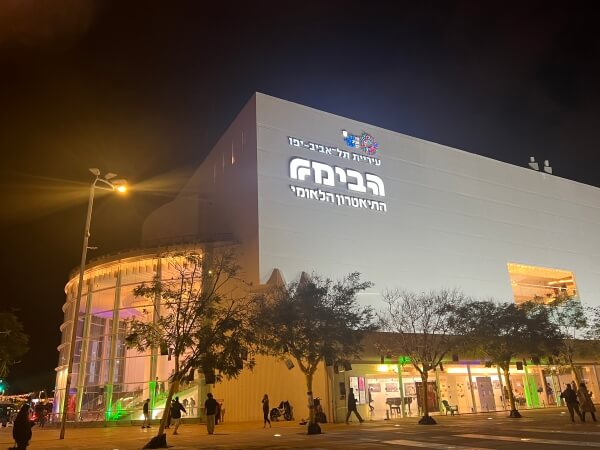
The Habina National Theater
Monday I took a private Pilates class with the daughter of an old friend who is an expert instructor, Shira Oren. It was the first of a series of exercises I intend to begin as part of my New Year’s Resolutions, to include Gyrotonics and anything else I can do to strengthen my spine.

I did better than I imagined, perhaps due to the daily Qigong I do, about 15 minutes every morning. Pilates was right on target and I can see that continuing a regimen is what should happen if I want to get back on the saddle. Shira was an excellent teacher.
Shira’s mother, Pam, is part of our high school friendship group who all moved to Israel except for me. Seeing her was as if no time had passed at all. We just took off from where we last left off about eight years ago, the last time I was in Tel Aviv.
The rain came pouring down just after the three of us entered Café Zorik, a short walk from Shira’s apartment. Our timing was perfect to find a cozy spot in this casual, neighborhood café/restaurant. We watched the street flood as the heavens opened up. The café is where celebrities are known to come, including Quentin Tarantino, acclaimed American film director of Pulp Fiction, Kill Bill and Inglourious Basterds. He lives in Tel Aviv with his Israeli wife, singer/actress Daniella Pick, and their two children, where it is likely easier for him to live a more normal life than in the U.S. During the October 2023 conflict, Tarantino made a surprise visit to Israeli army bases in the south to meet with soldiers and show support—a moment that circulated widely on social media.
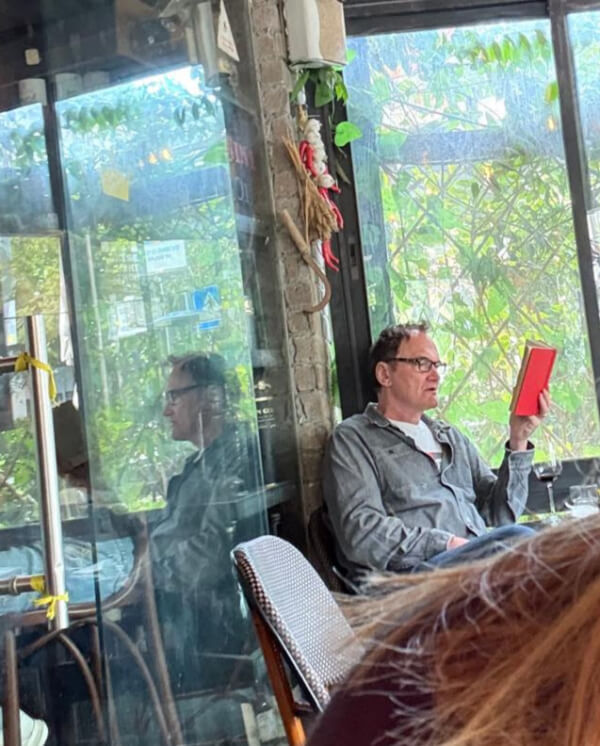
Quentin Tarantino sighted at Café Zorik
Pam couldn’t join us, but Kathy wanted to show me the new Design Museum Holon, so we headed there by car. This is one of Israel’s most striking cultural institutions, opened in 2010 and housed in a sinuous, steel-ribboned building by renowned architect Ron Arad. The museum was the first in Israel dedicated entirely to design—from furniture and fashion to everyday objects and cutting-edge contemporary works. It has become a must-visit destination for anyone curious about how design intersects with life, culture, and innovation. It doesn’t hold a permanent exhibit; instead, it presents three rotating, deeply curated exhibitions each year, inviting visitors to see design as something that shapes our world, our habits, and our imagination.
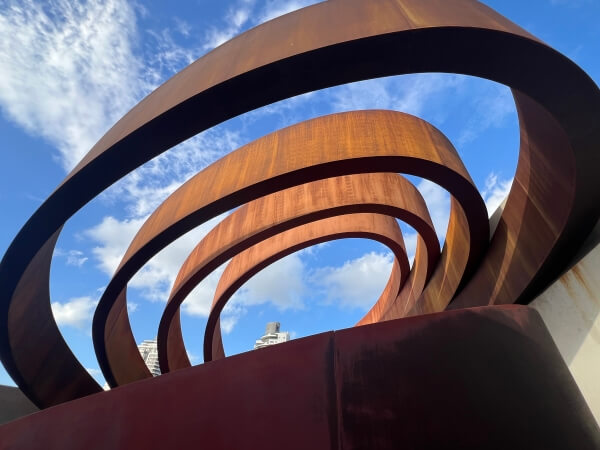
The Design Museum
Currently on view is “Heroines: Fashion and Hope in World War II,” an evocative exhibition that asks a profound question: What role can fashion play when the world is in crisis? Rather than simply showing clothes, the exhibition brings to life the stories of women who used garments and accessories to preserve their humanity, maintain morale, and cling to hope during one of history’s darkest eras.
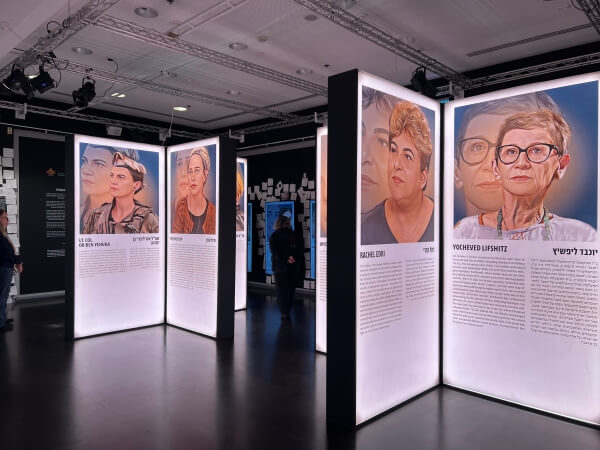
Heroines: Fashion and Hope in World War II
A few things stood out besides the building itself which is an architectural wonder: the display of Gottex bathing suits around an imaginary pool, the personal stories of the heroines of the October 7th War, and seeing the “We can do it!” poster for real.
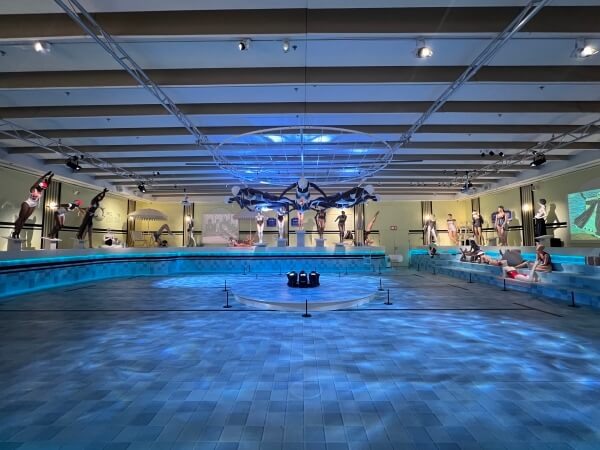
Gottex bathing suits on exhibit
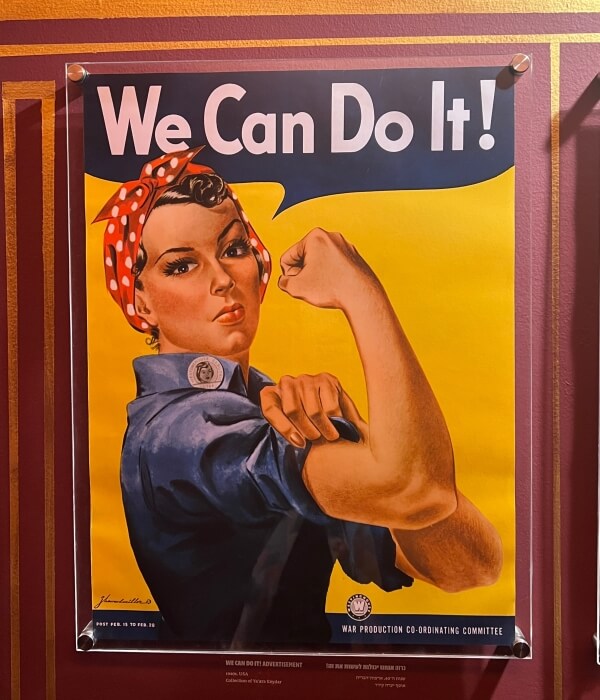
For dinner we went back down to Jaffa for Bandit, one of Tel Aviv’s newer dining destinations, a neighborhood gastropub and restaurant that’s been getting attention for its creative approach and lively, relaxed vibe. Led by Chef Yossi Shitrit, a well-known figure on the Israeli food scene, he’s famous for his previous fine-dining work, particularly at Hiba. At Bandit, he’s intentionally taken a freer, more playful and approachable direction.
We sat at the bar and watched the chefs perform their magic while schmoozing with them. Everyone is yelling, even the chefs. I could have done without that part of the experience. A father sitting next to us with his two kids was teaching them the art of eating raw oysters and sushi. Each dish that was presented was beautiful and while some were very good, they still didn’t surpass Barbur’s simple, but very tasty cuisine. And it wasn’t cheap.
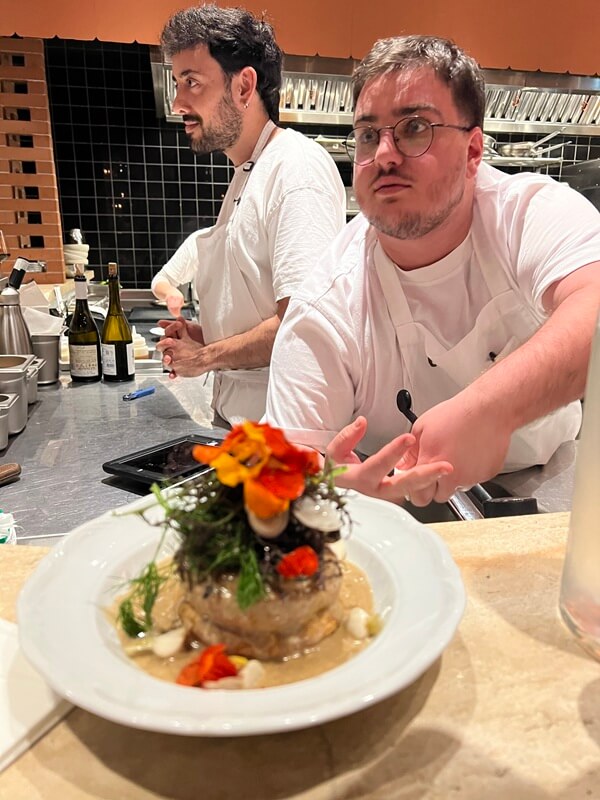
Observing the chefs at work at Bandit
Tuesday we had a date to meet Benjamin Pik from Expand-CPA in Jerusalem at the National Library of Israel. Benjamin is living in Jerusalem now, with regular trips back and forth to Paris. He has a team of accountants and CPAs in both cities, specializing in Expat issues. He’s one of the few accountants who can do both U.S. and French tax returns.
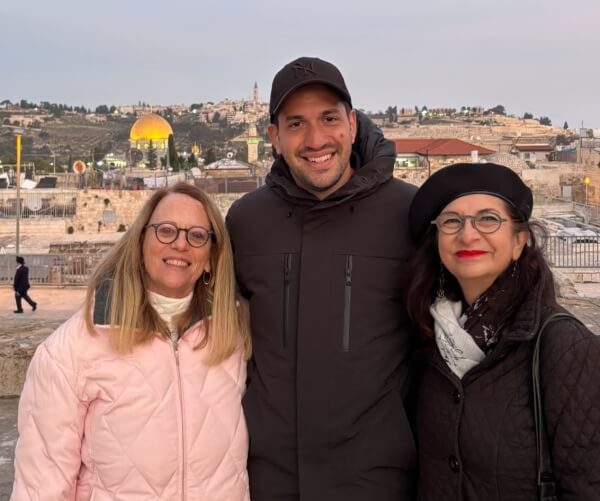
Kathy and Adrian with Benjamin Pik in Jerusalem’s Old City
The train from Tel Aviv made it easy to get to Jerusalem and then to walk to the library, which is located directly across from the Knesset, Israel’s legislature. The library was inaugurated just after the war started with no inauguration at all as a result.
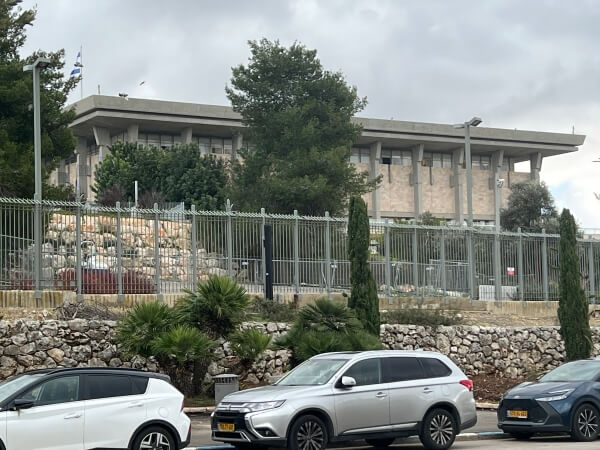
The Israeli Knesset in Jerusalem
Designed by the world-renowned Swiss architectural firm Herzog & de Meuron in collaboration with Israeli partners, the building spans roughly 45,000+ square meters and has a bold, sculptural presence that references an open book in its form and curved rooflines. I didn’t quite see that myself, but the interior is impressive, with its circular movement.
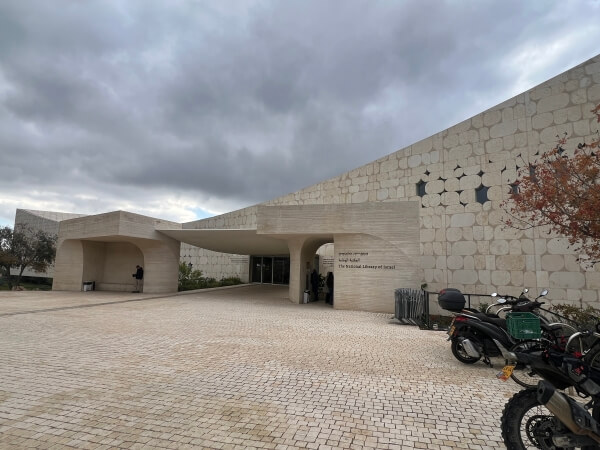
The National Library in Jerusalem
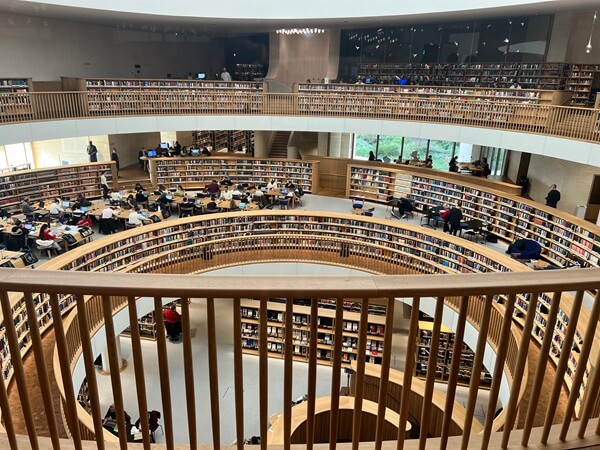
We took a tour with a guide (in English) and learned about its purposes and contents, while many others were making use of the library’s materials. It houses millions of books and rare treasures, hosts exhibitions and events, and serves as a dynamic center for research, public engagement, and the preservation of heritage. Again, worth a visit if you have the time.
From the library, we hopped a taxi to meet a tour guide at Jaffa Gate, one of the eight main gates into the Old City, on the west side, accessing the Armenian and Christian quarters. Historically, this gate marked the starting point of the road that led west to the Mediterranean port city of Jaffa (Yafo)—the main entry point for pilgrims, travelers, merchants, and immigrants arriving by sea. From Jaffa, people would journey inland to Jerusalem, and this was the gate through which they entered the holy city.
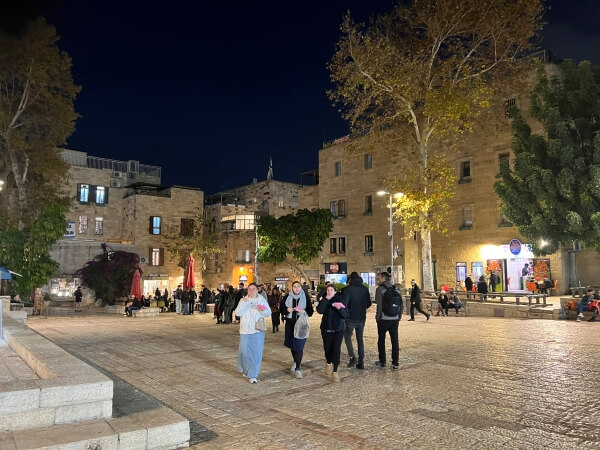
The Jewish Quarter in Jerusalem
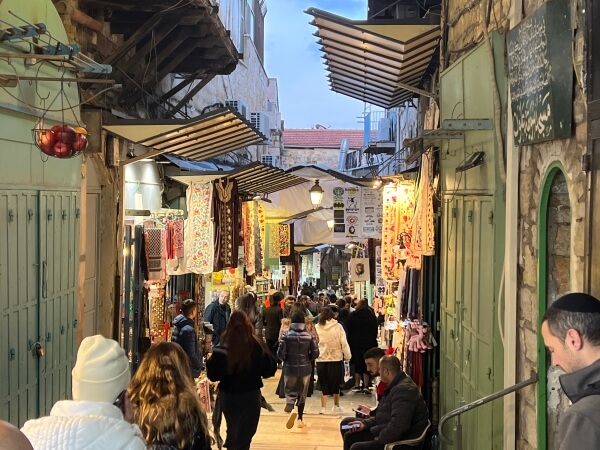
Shops lining the border between the Armenian and Christian Quarters
To arrive there, we strolled down the Mamilla Mall, a modern addition to West Jerusalem. It was a shock to my system to see Chanel and Dior adjacent to the Old City, but that’s the modernization of the world’s “vortex.” A vortex is a place where things are pulled inward, intensified, and cannot remain neutral. That’s Jerusalem.
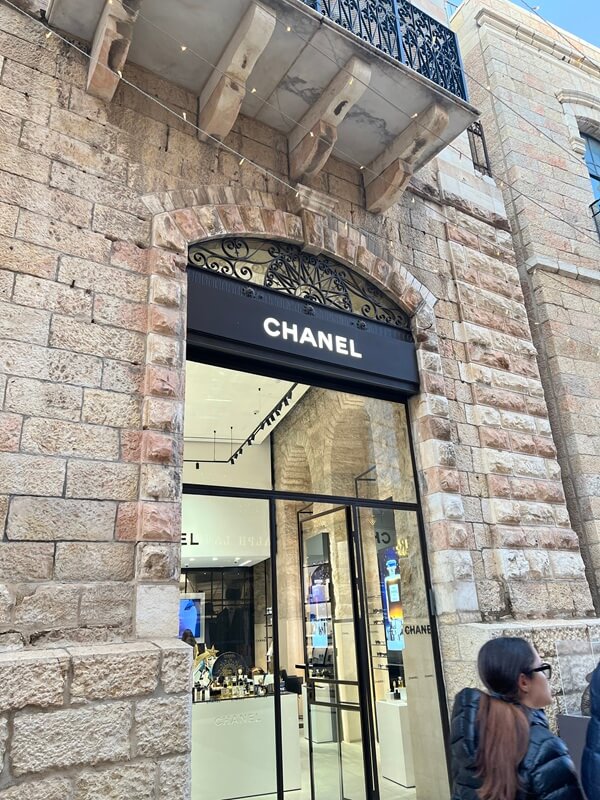
There is nothing quite like Jerusalem…Jerusalem of Gold. Jerusalem is built from its own earth—a warm, local limestone known as Jerusalem stone, quarried from the surrounding hills and used here for thousands of years. The stone contains traces of iron that soften into shades of honey and gold, and when Jerusalem’s high, clear light hits those surfaces—especially at dawn and dusk—the entire city seems to glow. That is why Jerusalem is not just called the City of Stone, but the City of Gold. I have photos from years past where the sky looks green because of the golden glow from the stone.
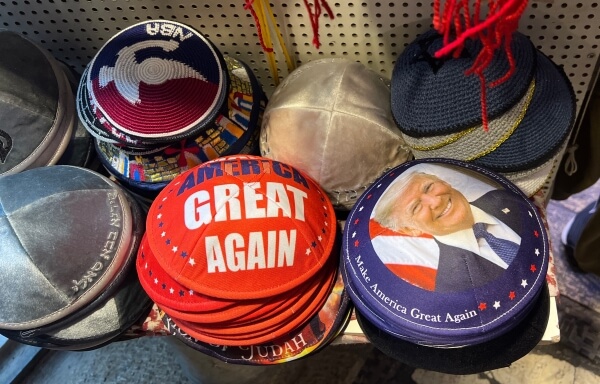
Yoni le Guide spoke French, English and Hebrew. Benjamin knew him well and hired him often to take friends and family around the city. He led us down into the Old City past the little shops selling everything from backgammon sets to skull caps with Donald Trump pictured on them, to his secret spots in Jerusalem. Up stairs and onto the roofs we went to have a fabulous view of the Dome of the Rock, the octagonal Islamic shrine at the center of the Al-Aqsa mosque compound on the Temple Mount in the Old City. It is the world’s oldest surviving work of Islamic architecture, the earliest archaeologically-attested religious structure to be built by a Muslim ruler, and contains the earliest inscriptions proclaiming Islam and the prophet Muhammad.
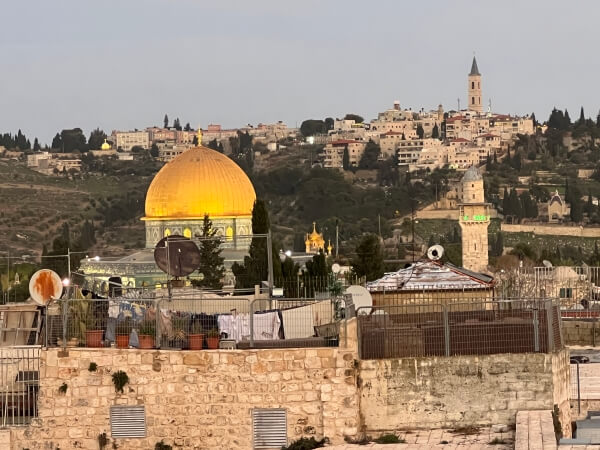
View of the Dome of the Rock
Yoni took us through the Jewish quarter to another special view of the Western Wall, and then to the wall itself. The Western Wall is the most sacred spot of all in the world for Jewry. It is an ancient retaining wall of the built-up hill known to Jews and Christians as the Temple Mount of Jerusalem. Its most famous section, known by the same name, often shortened by Jews to the “Kotel” is known in the West as the Wailing Wall, and in Arab world and Islamic world as the Buraq Wall.
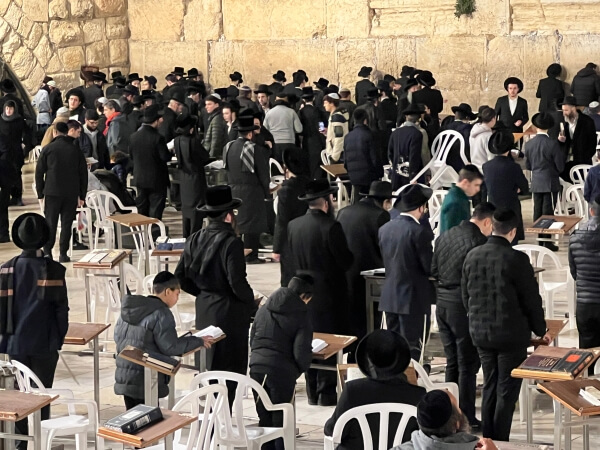
And this is what all the fuss is about. For Jews, it is not just a wall—it is the last physical remnant of the Temple, and therefore of Jewish sovereignty, worship, and continuity in Jerusalem.
There is a security check to enter the area. The security there may not seem very visible, but it’s there for sure. There are the usual tourists, but mostly religious Jews who regularly pray there, or those who come periodically to get their fix.
The number of Chasidim has really grown since the last time I was there. The Haredi (religious) population in Israel has been growing much faster than the overall population, driven largely by higher fertility rates (often around 6+ children per woman) and a very young age structure. This means that by 2030, the Haredim are expected to reach about 16% of Israel’s total population, and around 25% of those under age 20. My friends explained that many are leaving, too—especially women who want more out of life than rearing children. All this might affect the political leanings of the country.
On my last full day in Tel Aviv we went for hummus—a restaurant that specializes in hummus, “Hummus Hamudi.” In Tel Aviv’s hummus scene, Hamudi sits alongside many beloved but varied options—some more famous for thick Levantine style, others for bigger portions or more inventive twists. The menu here is classic hummus fare with a few extras. The vibe is relaxed and fun—a neighborhood joint with an easygoing feel where locals come for a satisfying lunch. There isn’t an English menu available, so go with friends or ask the waitstaff to help you choose. I refused to leave Tel Aviv without a good hummus fix.
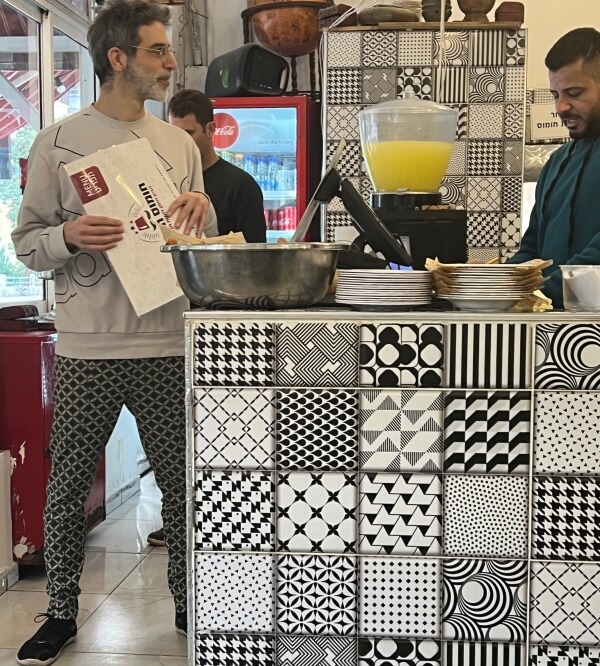
Inside Hamudi Hummis
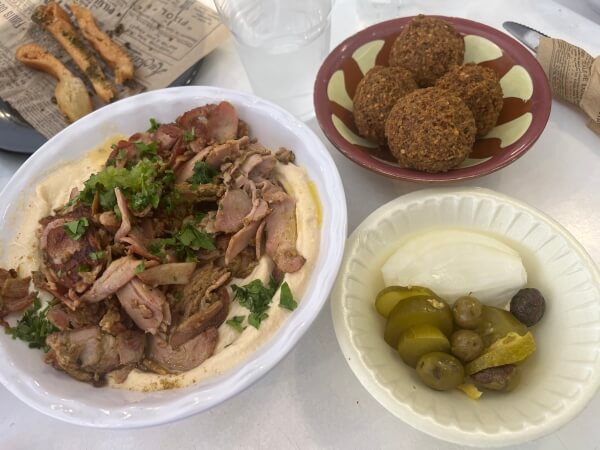
The delights to be had at Hamudi Hummus
Kathy took me after that to Neve Tzedek, Tel Aviv’s first neighborhood. Neve Tzedek means “Oasis of Justice” in Hebrew. It is one of the oldest Jewish neighborhoods in the Tel Aviv area, established in 1887—about a decade before Tel Aviv itself was founded—making it a precursor to the modern city. At a time when most of the Jewish population lived crowded inside the walls of old Jaffa, Neve Tzedek was among the first to stretch beyond them.
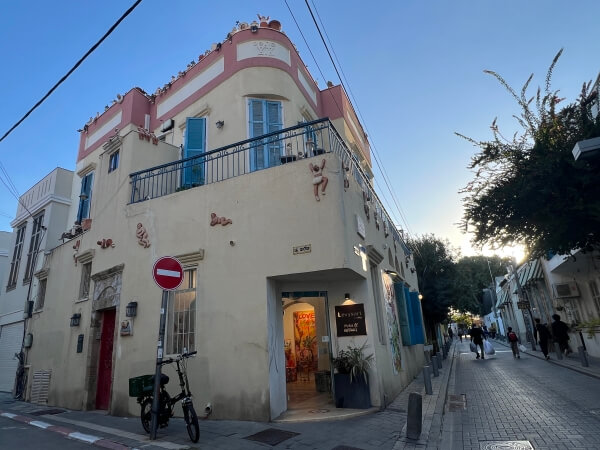
Neve Tzedek neighborhood in Tel Aviv
Neve Tzedek’s charm is visual as much as historical, with a real mix of old and new. Historic low-rise buildings are painted in soft pastels, with Art Nouveau and eclectic facades, worn shutters, narrow lanes, intimate courtyards and carefully preserved and renovated homes. New and classy boutiques now line the main streets, mainly Shabazi Street, where I found a practical and stylish jacket in a sweet little boutique filled with clothing of great style.
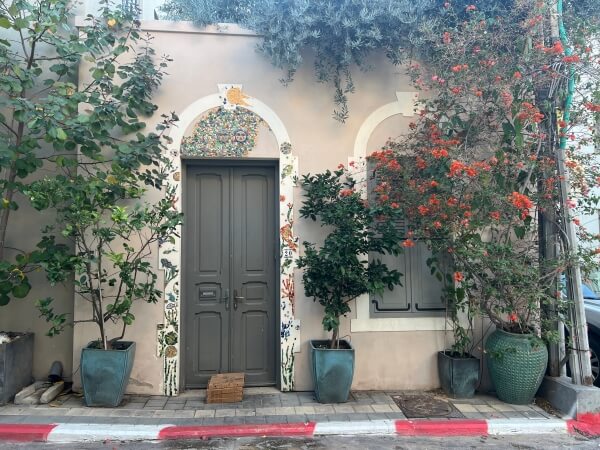
The facade of a home in Neve Tzedek
Neve Tzedek is one of Tel Aviv’s most expensive and prestigious neighborhoods, with average prices well above the citywide average and premiums on square-meter prices that reflect its historic charm, central location, and limited supply. Property here consistently ranks among the highest in Tel Aviv’s market. This is where there is a large concentration of French residents, at least those who are well-heeled, and we heard quite a bit of French spoken on the streets.
I didn’t want to miss a stroll through Jaffa’s flea market before heading back to Paris, so we headed that way, on route to an early New Year’s Eve dinner with two of Kathy’s closest friends (both American) at another of Tel Aviv’s trendy restaurants, Beit Kandinof. Jaffa has changed so much since the last time I ventured down those streets—all cleaned up and classy and very modern in spite of its centuries-old stone buildings.
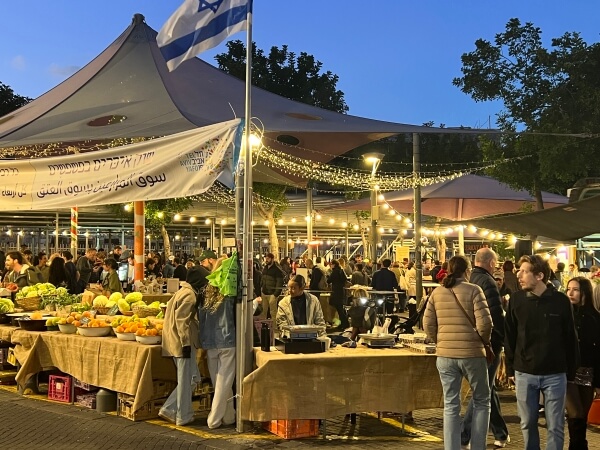
Beit Kandinof is located in a beautiful historic building in the Old City of Jaffa that dates back to the late 19th-century, constructed shortly after the walls of Jaffa were taken down to make way for urban expansion. It was part of a luxurious family property belonging to the Kandinoff family, a wealthy Bukharan Jewish family that had immigrated to the region in the late 1800s. It takes on an art gallery atmosphere—walls rotate local contemporary art every few months, making the restaurant as much a cultural venue as a place to eat.
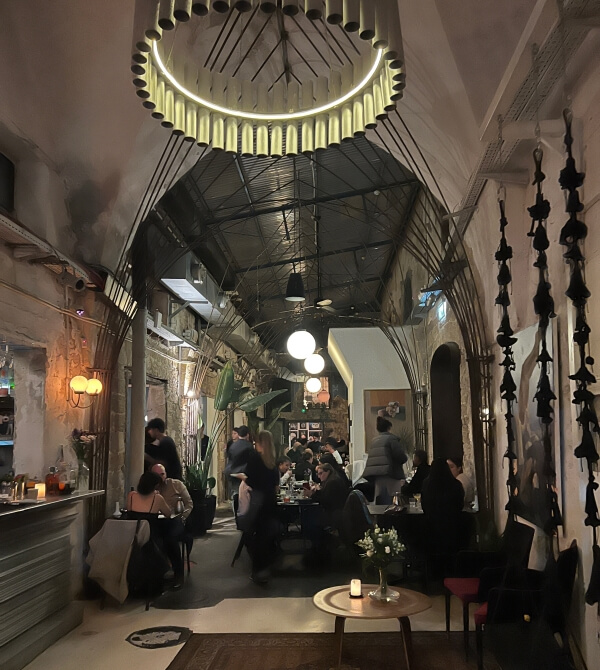
Inside Beit Kandinof
Beit Kandinof’s menu is best described as Mediterranean fusion with strong local Jaffa influences—creative yet grounded in regional flavors and fresh seasonal ingredients. The chefs design dishes that reflect the diverse culinary heritage of Jaffa and the Eastern Mediterranean, with a dash of modern technique and artistic flair.
We started with a sparkling wine, then as I was told, the gazpacho was a must. After that, it was a free-for-all sharing a variety of dishes, one better than the next. It was perfect for four American women, having an early New Year’s Eve dinner, in a place that barely knows it’s a holiday. I was the only one who seemed to care.
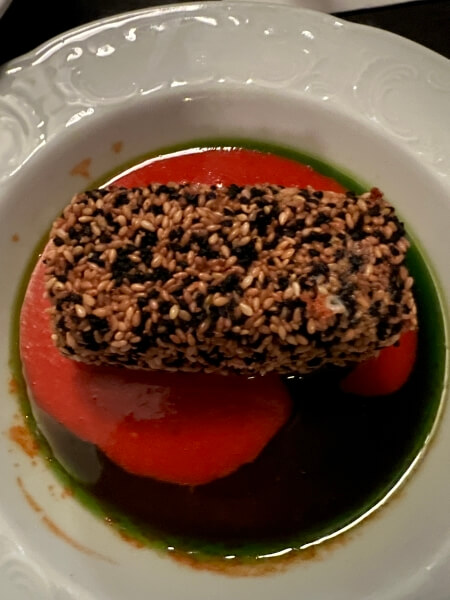
A Bryndza cheese dish at Beit Kandinof
Kathy and I headed home in a taxi, put on a movie and watched it till midnight, then watched fireworks in other cities on TV before saying “laila tov” (good night). It was certainly not the usual New Year’s Eve. The Hebrew I had learned so many years ago came back to me in dribs and drabs. I remembered a lot of vocabulary, but the ability to put the words together was another level of challenge I didn’t even bother to attempt. Maybe if I stayed longer…with a bit of coaching, I could get fluent again.
Observing the cultural aspects was most of the fun of the séjour. It confirmed that I’m in the right place—that France suits me best, in spite of my upbringing. A few observations…
My friends are all very much on the left, protesting regularly against the current government and its policies. They are in full agreement about a two-state solution and don’t condone what Netanyahu has done…mostly to protect himself, rather than his people. Around 57% of the population support separation from Palestinians or a two-state framework (including separation without formal peace), but only 24% explicitly support a full two-state peace deal; 24% favor annexing territory without full civil rights for Palestinians. Support for a one-state solution with equal rights is quite low overall (about 9%). These figures reflect diverse views within the population, with Israeli Arabs showing stronger support for a two-state solution and Jews showing higher support for separation-oriented positions.
I equate their feelings with my own about the current leadership in the U.S. As a citizen of the U.S., I have no direct influence on what my government does or doesn’t do and feel helpless. The Israelis feel the same way, and what’s happened on the global stage with public opinion has put them in precarious position. They live constantly under threat and for fear for their lives. It was this way when I was living there, and that’s the way it is now. When you live always on the defensive, it changes your perspective.
There is a camaraderie among Israelis that doesn’t exist in the U.S. or France, as a result. A woman on the train sitting across from us offered us some of the snack she was eating. That wouldn’t happen just anywhere. People talk freely with each other, as if they have known one another for years, even it’s a first encounter. People aren’t polite—they don’t need to be. They can just be themselves. It’s fascinating, really…and so unlike France and the French! It’s one of the things I missed most about France…it’s “politesse.”
For me personally, I prefer a less homogeneous society and more diversity. I like the fact that Paris is a very international city and people have come from all over the world to visit and live there. The City of Paris itself has just over two million residents within its administrative limits. About 25% of Parisians were born abroad, reflecting its cosmopolitan nature. Among these foreign-born residents, North Africa (Maghreb) is the largest origin group—roughly 28% of the foreign-born category, with many from Algeria, Morocco, and Tunisia. Europe (outside France) accounts for roughly 26% (notably people from countries like Poland, Serbia, Italy). Asia (including countries such as Vietnam and Cambodia) makes up about 20% of foreign-born residents. And all that weaves a very interesting tapestry of culture.
Eight days in Israel was perfect. I wanted to reconnect with old friends, and did that successfully. I got a taste of Israeli cuisine which is highly respected internationally—especially through its restaurants, chefs, and the global popularity of its dishes. Israeli restaurants are increasingly earning prestigious world rankings, chefs and culinary concepts from Israel are establishing global outposts, and travelers routinely cite Israeli food as a highlight of visiting the region. I’d have to agree. I landed in Paris a couple kilos heavier…and it was worth every bite!
Is it safe to travel to Israel? My answer to that is “yes.” I witnessed nothing of any concern, as long as you’re paying attention. But, let’s face it, for now, there is a peaceful period…until the next major conflict. And what I saw was a very modern and vibrant community that is doing its best to stay alive and follow their own traditions and way of life. They are traumatized by the effects of the attack. The lost hostages and soldiers, for all Israelis, is like having lost someone in their own families. These people were not just casualties of war. Each and every one of them meant a great deal and stole the hearts of the public. Those who survived the Hamas terror and torture, have become national heroes and celebrities—something they didn’t imagine would ever happen in their lifetime.
I hope you have enjoyed these two recent travelogues, even though your interest is France…it would have been impossible for me to have experienced all this without sharing it. Now, I’m back in France and happy to be home!
*Sabich is a sandwich of pita or laffa bread stuffed with fried eggplants, hard-boiled eggs, chopped salad, parsley, amba and tahini sauce. It is a staple of Jewish-Iraqi cuisine and was created by Iraqi Jews in Israel in the 1960s.
A la prochaine…
 Adria Leeds
The Adrian Leeds Group®
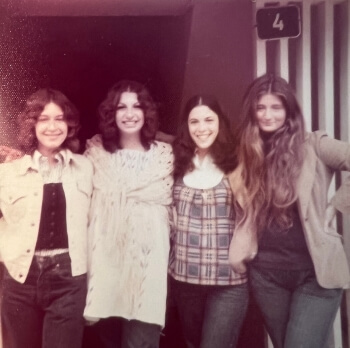
Adrian with her high school friends (from left to right): Wendy Halpern, Adrian, Kathy Leon Rasner and Ellen Dorfman Bitton, in Ramat Aviv in 1973, in front of the house in which two of them resided for a while. Wendy and Ellen are both now deceased, may they rest in peace.
P.S. Now we get back to work for our clients in the new year! In addition to our property services, we also focus on living in France on a practical level—like moving, renovating, etc. Our website is the perfect place to begin your education into everyday life in France.
5 Comments
Leave a Comment
Let Us create a custom strategy for you
You can live or invest in France-now.
Join us at our monthly Après-Midi.
Become a part of the Paris community.
Property for sale
Read & Subscribe
Dive into more by reading the French Property Insider
Better yet, subscribe to both and get the updates delivered to your inbox.
Global Money Services
Our contacts will help you invest in France.


See Adrian on HHI

Join us on Youtube
Dive into more on how to live, invest & escape to France
Be sure to subscribe!
To read more, click the links below.
Loved the second post about your visit to Kathy in Israel. I’ve been to many of these places with her, but now I have any more sites and restaurants on my list for the next time I’m there. The photo at the end was lovely, and also sad, knowing Wendy and Ellen are gone. Love, Renee
My name is Claire B., I am 72, I live in Québec and I am francophone. I have been reading you for years because I love Paris and France. I found extremely interesting your last Nouvellettre about Israel, a country of which I only knew what I saw in the News. Thank you so much for all your writing!
I wish you a very Happy 2026!
Fabulous travelogue! Didn’t think about visiting Israel before, but now I am.
Thank you for a fascinating account of your travels in Israel, Adrian. The food-centered approach of your narrative no is no doubt owed, at least in part, to your New Orleans upbringing. In the spirit of “Six degrees of separation”, when I read that your friend Kathy was a Leon, I wondered if she was related to Dr. William Leon, one of my favorite teachers at LSU School of Medicine in the 1970’s and beyond. A bit of research revealed to me that Kathy is Dr. Leon’s daughter. What a great surgeon and mentor he was. It does my heart good to think about him and his incisive comments in Dr. Isidore Cohn’s Saturday morning conferences, which I attended for years. Please relay to your friend how one student treasures her father’s contribution to his education.
Mike H
Always love to hear of your adventures, so very interesting and informative. A Bientot