

Adrian Leeds Nouvellettre®
Your taste of life in France!
Subscribe and don't miss an issue!
The Land of Milk and Honey
The check-in at CDG took every minute of two-and-a-half-hours due to the profiling questions the agents at El Al Airlines posed to their passengers. “Have you ever been to Israel?,” the beautiful young woman asked me. “Do you speak Hebrew? What is the purpose of your trip?”
I passed with flying colors when I explained my history with Israel and she waved me on. At the check-in desk, I was delayed because I hadn’t acquired the ETA-IL (Electronic Travel Authorization) new mandatory entry permit (as of January 1, 2025) that no one told me about. This is not a traditional visa sticker in your passport, but an electronic travel authorization you apply for online that must be obtained before boarding your flight valid for multiple entries and allowing stays of up to 90 days per visit. Fortunately it was possible to acquire by using my cell phone and only then was the boarding pass issued and my suitcase whisked off along the conveyor belt.
The moment I boarded plane, I knew I had entered a different world. These were no longer the quiet, well-behaved demure French as they were on the Air France flight to Los Angeles I’d experienced a month earlier. There were tons of kids and babies, a smattering of religious Jews in their tall black hats and yarmulkes, the high level of their voices made no difference to them (or to anyone). The entire plane was a bit chaotic. The flight itself was uneventful and the food served actually pretty decent, but I laughed to myself as I observed the cultural differences, even though a good portion of the plane was filled with the French, not just Israelis. Even upon exiting the flight, I noticed that the compartments above our heads were not filled in an orderly manner, as they had been on Air France…but like a “balagan” (a Hebrew/Yiddish term meaning chaos, mess, disorder, or a fiasco, often used to describe anything from a messy room to a chaotic situation or even a wild party).
The Hebrew I had learned when I lived in Israel—first from 1972 to 1973 on a kibbutz in the Jordan Valley, and then seven years later from 1979 to 1980 with my not-yet husband in an apartment in a Tel Aviv suburb—started to come back to me slowly. As I exited the plane, instead of saying “Merci, au revoir,” I said “Shalom, todah rabah.”
My oldest friend, Kathy Rasner, who was my BFF from the first day of kindergarten in New Orleans, met me at the airport with a big hug and my tears. I was supposed to have come two years earlier for a birthday celebration when the war broke out and my flights were cancelled. That was one of the reasons for planning this trip—now that the situation was much quieter and safer.
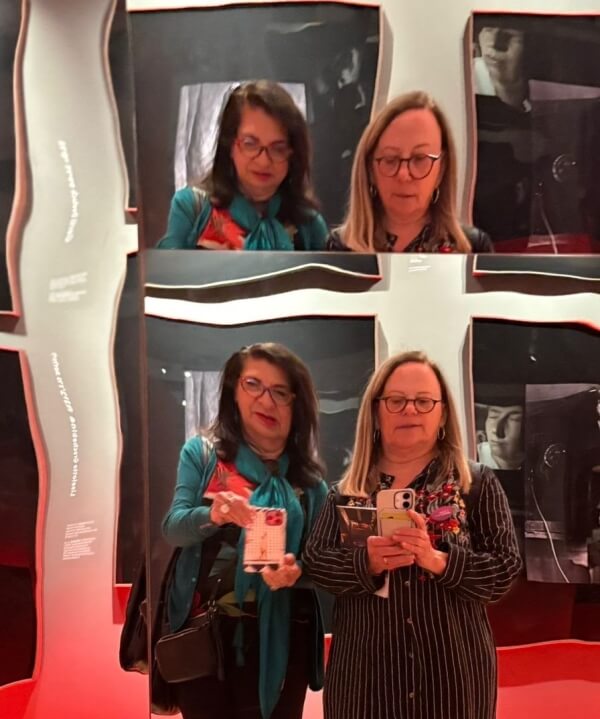
Adrian and Kathy Rasner
Kathy led me to the commuter train that would take us close to her home in Cochav Ha’Tzafon (Northern Star), a suburb of Tel Aviv. The chaos on the train and at the station was another sign of a new adventure, thanks to an annual “Festigal,” one of Israel’s biggest and most beloved annual children’s stage shows and holiday spectacles held every Chanukah/December season. Just exiting the train swimming upstream against a swarm of kids and their parents was quite challenging with two pieces of luggage and no one wanting to step aside to allow us out!
Kathy’s husband, Kobi, who has been a member of our family since we were in college, picked us up at the station and off we went to our first dinner together—a local spot with outdoor tables called “M25,” that served up kabobs and grilled meats, and other Middle-Easternish fare that didn’t break the bank. Then off we went to settle-in at home, in a modern high-rise building with beautiful views of other buildings similar to theirs.
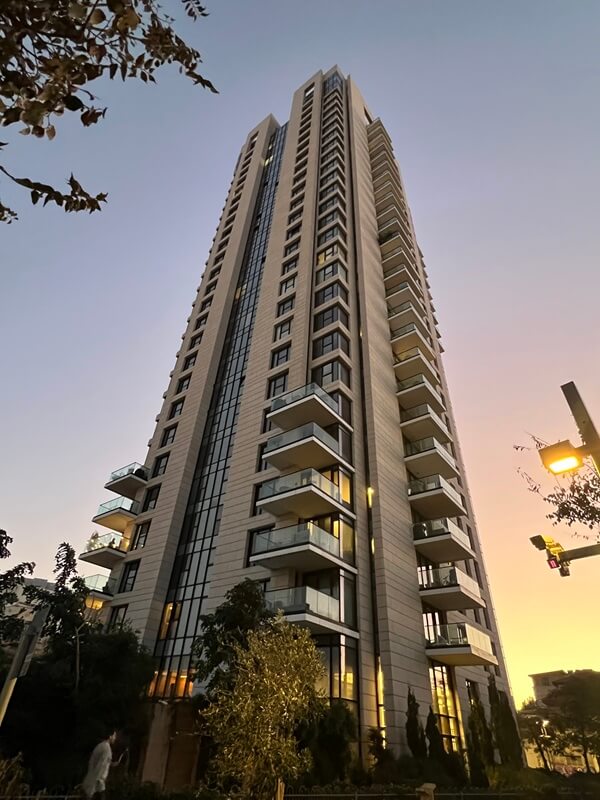
View of a high rise apartment building in Tel Aviv
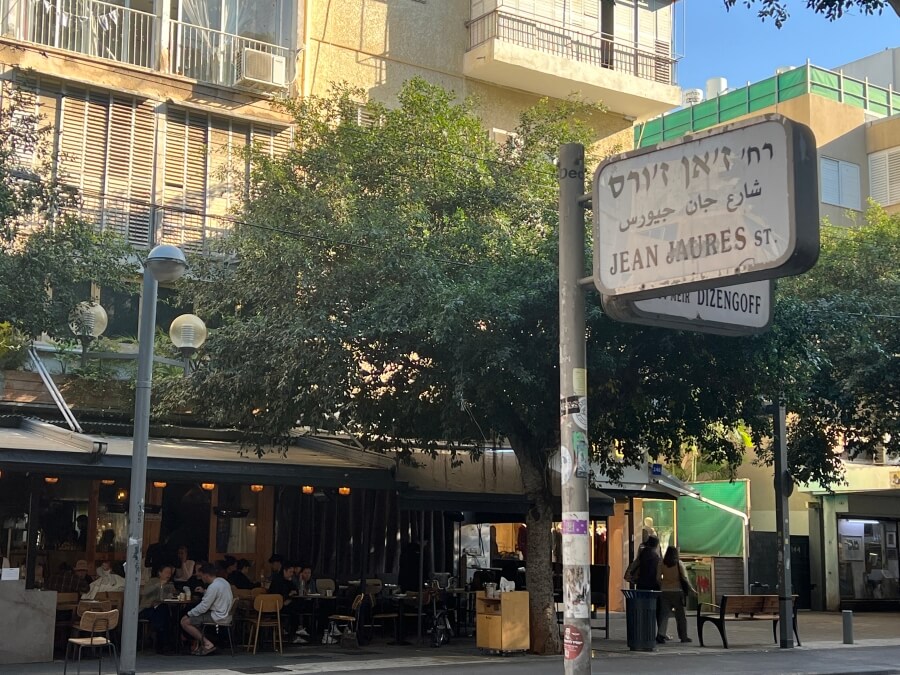
Our first day together was Christmas Day, although you wouldn’t have a clue that it even existed. After Kathy’s yoga class, our first real stop was at “NOLA,” her daughter, Talya’s, “American Bakery” at Dizengoff 197, opened in 2012. Tears welled up again when I gave Talya a big hello hug, and called her by the nickname we gave her when she was born: “tut sadeh,” meaning “strawberry.”
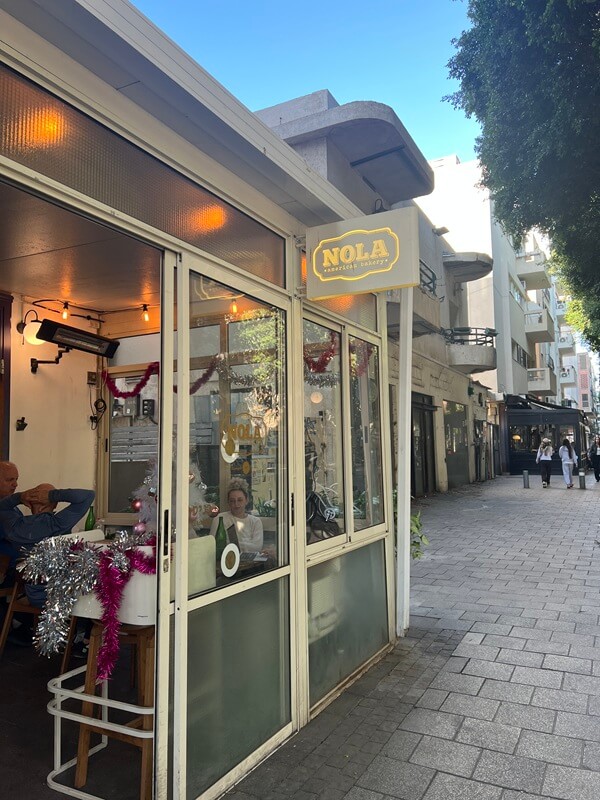
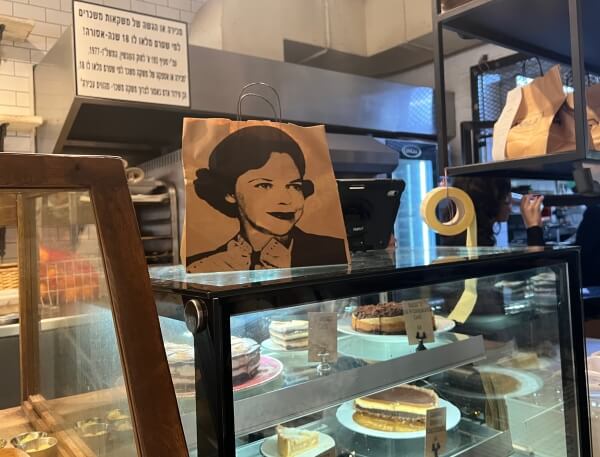
The baked goods at NOLA are amazing, even though they aren’t on my diet. The restaurant fare is a great array of old-standby’s and was as busy as I ever remembered it. Tears welled up in my eyes once again when I saw the take-away bags printed with a graphic image of Kathy’s mother as a young woman, Nathalie, who was like a second mother to me growing up in New Orleans.
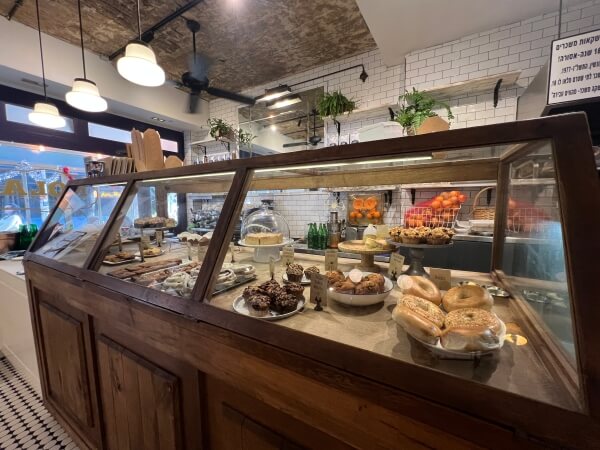
I have a special history with the café/bakery, named after our home town, “NOLA”, New Orleans, LA. When Erica and I came to Tel Aviv for Talya’s brother’s wedding in 2011, I introduced Talya to the woman who became her first baker, Hat Sternstein. Hat was a past client of ours, an Expat in Paris who opened and ran a “Gourmet Pet Bakery” in the 15th arrondissement. When her visa wasn’t renewed due to her lack of profits, she moved to Israel to live with cousins. It’s fascinating story with a sad ending, about which a book should be written, but I won’t go on that tangent now. The bottom line is that Hat and the Rasner family became very close friends. Hat died suddenly, from what they still don’t know, but she left a mark on the success of the establishment. Kobi called her a “comet” that came into their lives that lit up the sky.
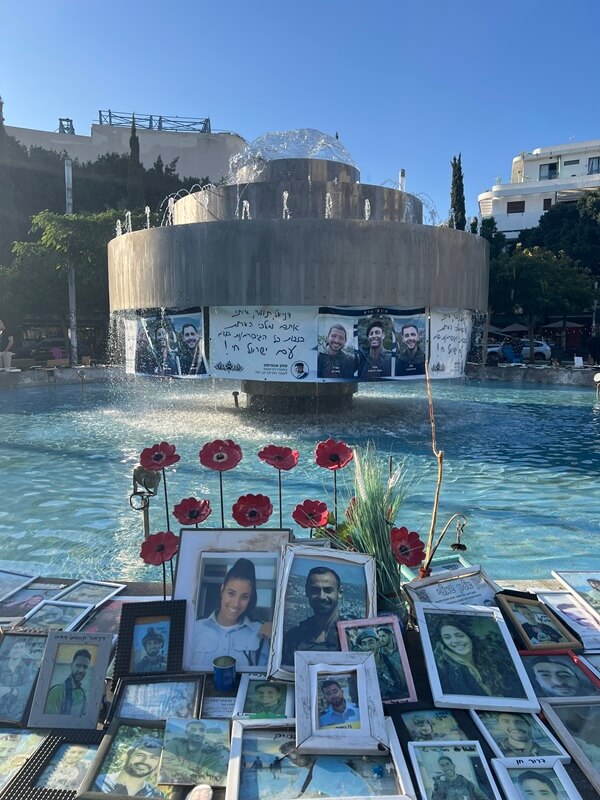
A stroll down Dizengoff is one of Tel Aviv’s most fun things to do. The shops that line the avenue are a mixed bag of old and new, out-dated and hip. Little by little it’s coming of age. At an important roundabout where Dizengoff Street, Reines Street and Pinsker Street meet, sits Zina Dizengoff Square, named after Zina (Tzina) Dizengoff, wife of Tel Aviv’s first mayor. In Hebrew, it’s “Kikar Tzina Dizengoff.”
Since the October 7, 2023 attacks and the war that followed, Dizengoff Square has become more than just a busy crossroads. What was once a place to meet for coffee or pass through on a walk has quietly become a place of remembrance. In the days after the attacks, people began leaving photographs, candles, flowers, and handwritten notes. Over time, especially around the fountain, these small gestures formed an informal memorial—a living tribute to the victims, the fallen, and the hostages. Locals and volunteers gently tend the space, keeping it simple, dignified, and deeply human. The square, once bustling with playful activity, has become solemn and reflexive. Kathy knew the stories of each and every one of the hostages, which impressed me, but it wouldn’t surprise me if almost every Israeli has the same vast bank of knowledge. They lived with these horrendous stories on a daily basis.
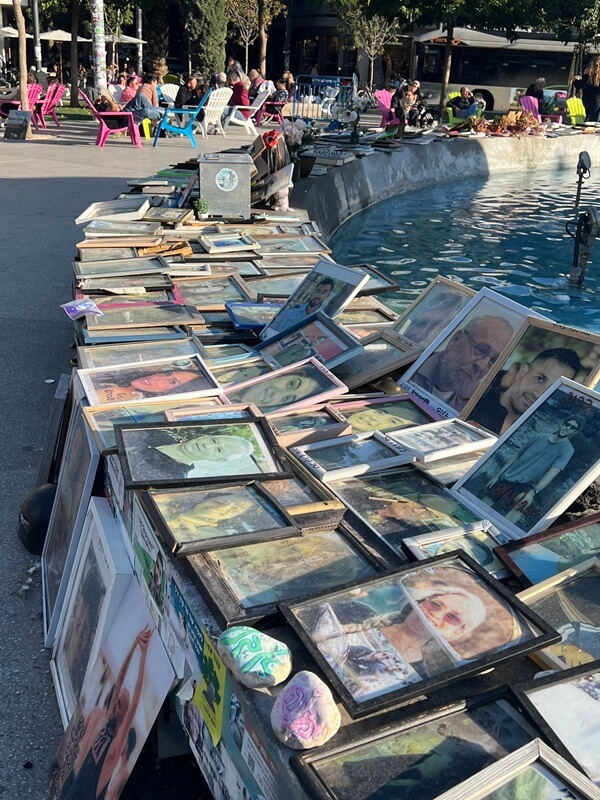
Past the square, we hopped a bus to Levinsky Street, one of Tel Aviv’s most beloved food markets that stretches from Eilat Street toward Derech HaHagana train station. It’s a historic market of spices, dried fruits, nuts, delis, bakeries, and specialty shops—a fragrant, colorful walk full of old-world charm. The market began in the 1930s as a working-class food hub and has grown into both a local favorite and foodie destination.
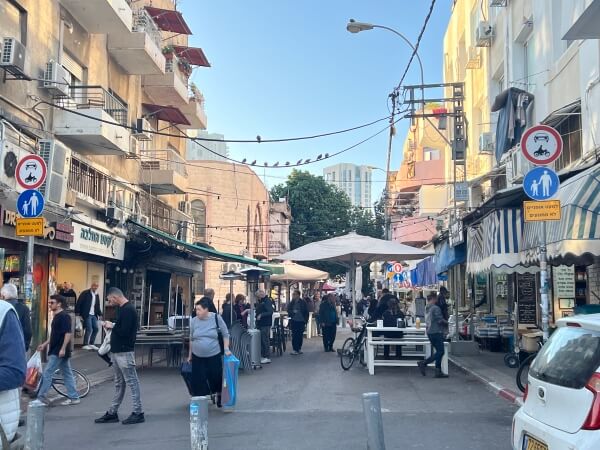
Looking down the Levinsky Street
Kathy explained that as Tel Aviv grew, and new neighborhoods took shape, immigrants from Greece (especially Thessaloniki), the Balkans, and later from Iran and other Middle Eastern countries began settling in the area around Levinsky Street. These communities established these particular shops turning the street into what would become a bustling, aromatic food market reflecting Tel Aviv’s multicultural roots.
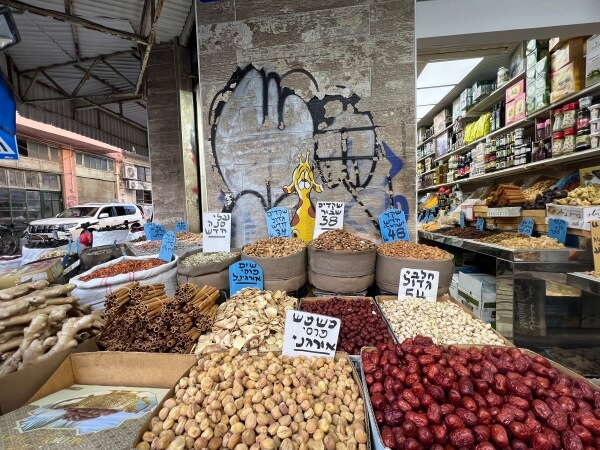
A spice shop on Levinsky Street
It was impossible to pass the halva shop without acquiring the smallest slice the proprietor was willing to cut. Making a choice among the dozen different flavors was no easy decision. The oily confection was a delicious treat in which we indulged over a cup of coffee after walking almost every inch of the neighborhood
If you have never had Halva, you haven’t lived. It’s a dense, sweet confection popular across many areas of the world, but particularly in the Middle East. It’s a rich, fudge-like sesame paste combined with nut butters flavored with nuts, spices, rosewater, and syrup. While the tahini (sesame paste) version is crumbly and nutty, semolina halva is moist and pudding-like, often served warm or cooled. The one we chose was layered with chocolate and pistachios. (It is NOT on my diet, but who cares?!)
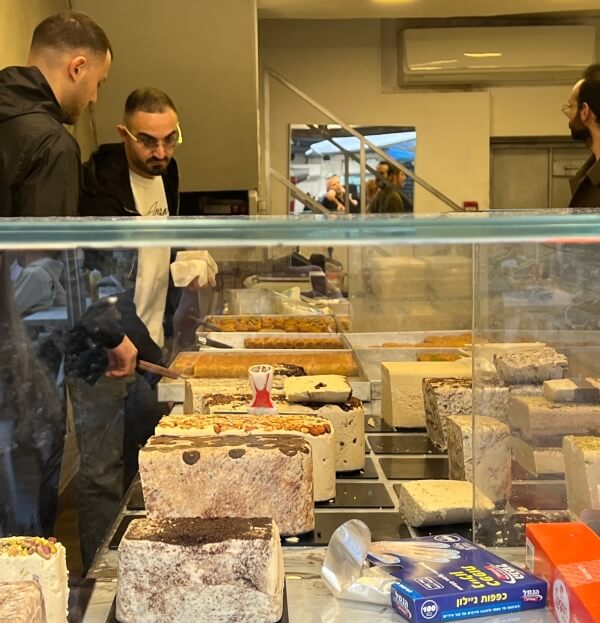
A display case of Halva
Kathy has a favorite spice shop where I indulged on a big bag of mixed nuts, choosing each one from their individual bins, then we headed off to our next destination—Park HaMesila (Railway Park). The route of the Ottoman railway between Nahalat Binyamin Street in the east and the station complex and Kaufman Street in the west has turned public park. Kids playgrounds, cafés and restaurants, lawns, bike paths and more make this a destination and a creative reuse of urban history. It helps connect certain neighborhoods like Neve Tzedek, Florentin, and Jaffa.
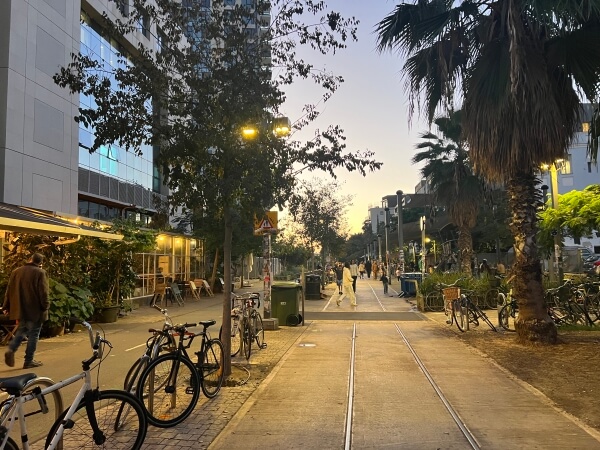
Park HaMesila
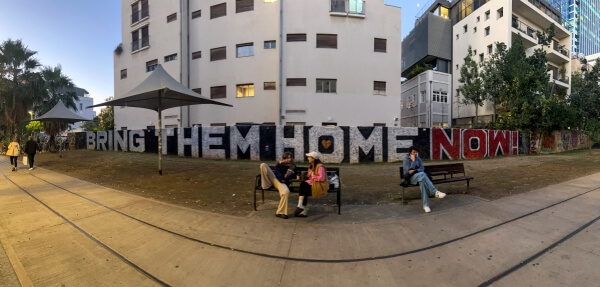
A “Bring Them Home Now” sign dominates a fence, the public rallying cry and protest slogan tied directly to the hostages taken during the October 7, 2023 Hamas attack on Israel. You see the slogan everywhere, and I wondered if they will come down once the last hostage’s body is actually returned. We hung out at a café facing that sign for a long time while waiting for our dinner plan, a new wine bar Kathy wanted to try. (The meal was excellent, but overall disappointing for the high price, so I won’t bore you with the name or experience!)
The town is totally turned upside down by the construction of the new Green Line Light Rail, a major next phase stretching roughly 39 km with around 62 stations. It will connect Holon and Rishon LeZion in the south, through central Tel Aviv, up to Herzliya in the north providing a true north-south transit spine. Construction is ongoing, with targeted openings around 2030 (previously expected earlier but delayed). A new Purple Line is another major route being built to link eastern suburbs with central Tel Aviv. Construction of these tramways has the city torn up and even more difficult to manage, but just like the tramways in Nice, will be sure to improve everyone’s lives and lifestyles. They just need a bit of patience. We learned that in Nice.

Tel Aviv is a lot smaller than I imagined, with a population of less than half a million, about the same size as Lyon. If you count the greater Tel Aviv area, you can count 4.5 million residents. Israel’s population is only a bit more than 10 million and of those almost 7.8 million are Jewish, about 78–79 % of the country’s population. Compare that with about the same number of Jews living in the U.S. But, Tel Aviv does not feel at all like a small town. It’s skyrocketing upward with construction of skyscrapers, making it feel more and more like New York of the Middle East. I observed the old buildings of Tel Aviv as I had remembered the town when I was living here 45 years ago and preferred them over the new towers, but that’s when the population was only about four million.
I spent time observing and reflecting on my own feelings about life in such a homogeneous society. At one point I joked with Kathy that “everyone looks like a relative!” They all seem to have my face or those of my cousins! She interacts with people naturally, in a way that it appears as if she knows that person well, even though she’d never laid eyes on him or her. It’s a kind of familiarity that the Israelis have with one another because they are sort of like “family,” and basically trust one another in that way. I asked about any trepidation she might have walking alone at night and immediately said, “No. There is crime, of course, but very little personal crime.”
There is no formality between people. No one says “shalom” before they address someone else, like the French would always say “bonjour” before saying another word. They just dive into their question or comment without any pretense. There’s very little utterance of “todah rabah, shalom” as one might in France leave an establishment by saying “merci, au revoir.” And I wondered if I were to live here would I lose my French “politesse?”
Friday, before Shabbat (the sabbath), when almost everything shuts down for 24 hours, including the buses, we took a public city car to the leafy Tel Aviv University campus on which sits the ANU Museum of the Jewish People. “Anu” means “we” in Hebrew, and that simple word captures the spirit of the place beautifully.
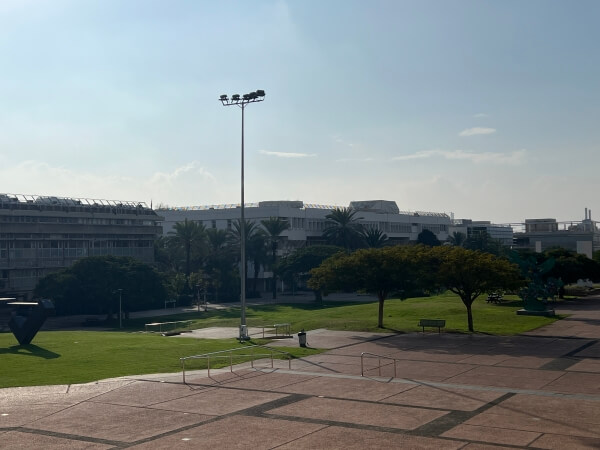
Tel Aviv university campus
Formerly known as Beit Hatfutsot (the Museum of the Jewish Diaspora), ANU reopened in 2021 after a major re-imagining. It now tells the story of Jewish life across 4,000 years—not as a dry historical timeline, but as a living, global, evolving narrative. Through immersive exhibits, films, objects, music and interactive displays, you travel from ancient communities to modern ones, from tradition to innovation, from memory to identity.
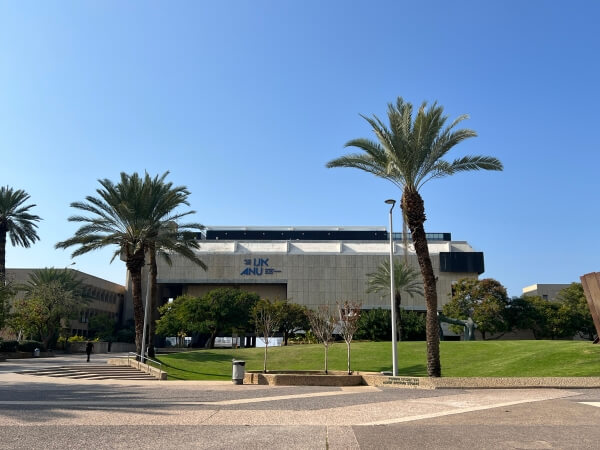
The Anu Museum
Any age can enjoy it’s brilliant presentation of the story of the Jews, as told via the artists who have contributed their works. It doesn’t present a single version of Jewish life, but many: religious and secular, European and Middle Eastern, artistic and scientific, past and present. It’s less about “what happened” and more about who we are—how a people scattered across the world managed to remain connected through culture, language, memory and values.
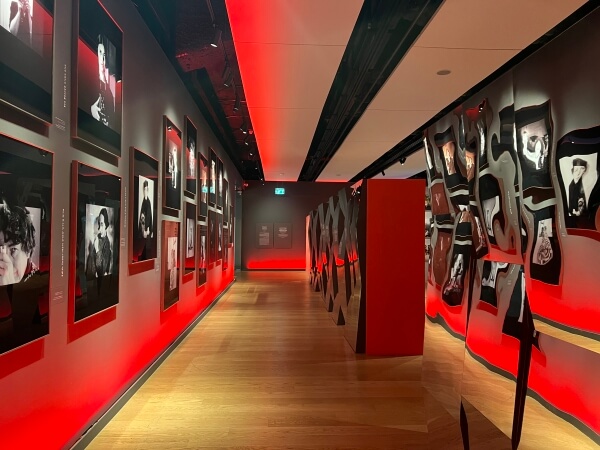
The first exhibit we saw was a temporary one—”A Lens of Her Own,” the works of 20 distinguished pioneering women photographers. What was most fascinating was actually how the works had been reproduced on a kind of canvas, then framed. It was obvious these aren’t their original works, but I found no information about this technique in any of their documentation.
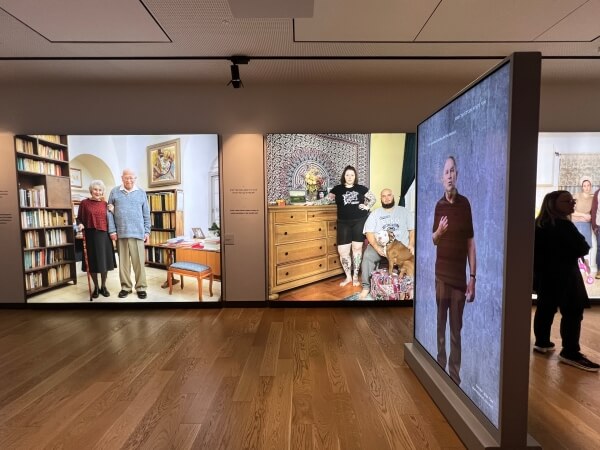
One permanent exhibition at the museum is “For me being Jewish means…”
an open prompt used to gather personal reflections and stories about contemporary Jewish identity. The museum uses diverse contributions to illustrate that Jewish life and identity are not monolithic, but a rich tapestry of experiences, beliefs, and cultures. I couldn’t help but think of my own answer to that question as I perused the others. Toward the end of the trip, I may have an even better idea of what my response would be.
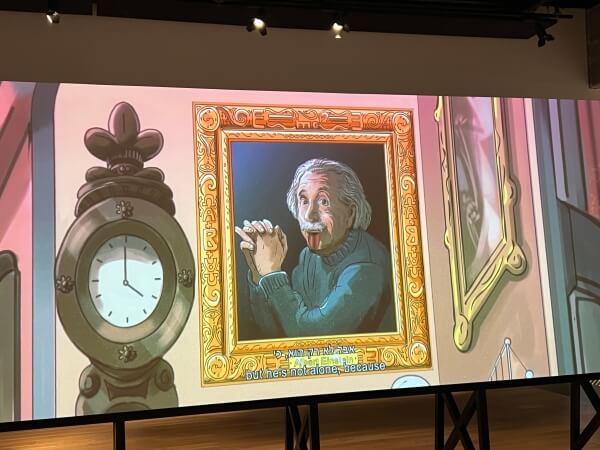
We could have spent many more hours enjoying the stories of all of the Jews who have made major contributions to society in spite of their small numbers. The facts are that the global Jewish population today is about 15.8 million people, out of roughly eight billion people —which is about 0.2 % of the world’s population. One of the most striking ways this shows up in global cultural and scientific achievement is in Nobel Prizes. Of the roughly 965 individual Nobel Prize winners through 2025, at least 220 have been Jewish or of Jewish descent—around 22 % of all laureates. Compare that to these facts, meaning the share of Nobel laureates is roughly 110 times greater than what you’d expect if it were proportional to population. This pattern has also been observed in other fields (science, literature, economics), though Nobel statistics are one of the clearest quantitative indicators of global influence.
What I got from the museum was that it was a way of letting Jews know that they should be very proud of who they are and of their achievements. But on the other hand, I questioned: How does that make the others feel? Is this why there is so much anti-semitism in the world today…and always has been? Is there a level of jealousy that morphs into hatred?
My friends and I discussed these points continually during my stay. We all agreed that the nature of the religion, to stop one day a week and devote it to study, to learn and to question our scriptures, not just follow them, is what leads the Jewish people to excel in intellectual ways. It’s thanks to this self-education that the “race” survives. Then the term “race” can be questioned.
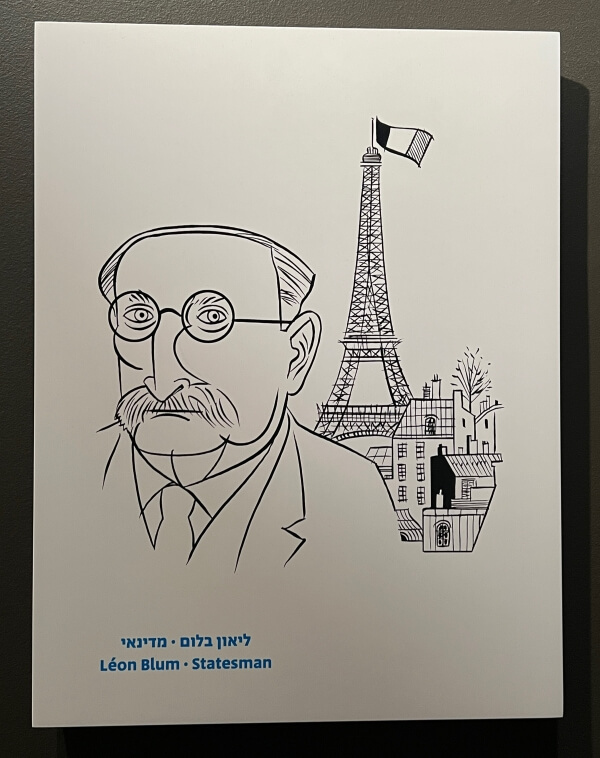
Written on the wall of the museum was a quote by Winston Churchill: “Some people like the Jews and some do not. But no thoughtful man can doubt the fact that they are, beyond all question, the most formidable and most remarkable race which has appeared in the world.” Antisemitic ideologies (especially Nazi ideology) falsely labeled Jews as a “race” in order to justify discrimination and genocide. That , however, was political and ideological, not scientific.
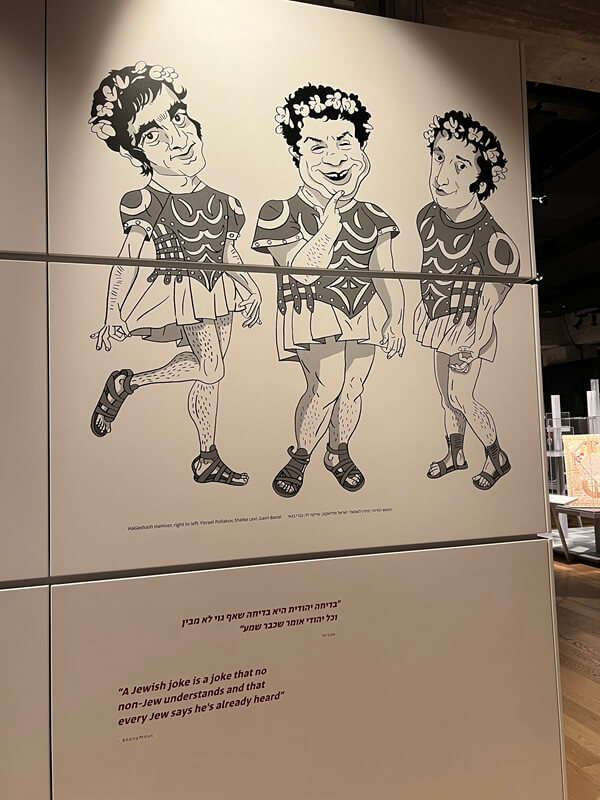
There was a section in the museum devoted to humor…and all of the comedians and actors who contributed a special brand of humor—Jewish humor. On the wall was the quote: The definition of a Jewish joke is itself a joke: “A Jewish joke is a joke that no non-Jew understands and that every Jew says he’s already heard.” We got it immediately and cracked up. If you don’t get it, then you’re likely not Jewish!
Kathy took me over to the area of the city where I lived for a while after kibbutz in 1973—Ramat Aviv. Those particular buildings were heavily damaged and partially destroyed by a missile strike this past June as part of the wider Israel–Iran conflict. The house where I lived is now a shell of its former self. Fortunately no one died, but about 20 people were injured.
The weather went from beautifully sunny and warm to cool and wet when we headed north to visit Kathy’s son at a kibbutz in Golan overlooking Lake Kineret Saturday. The route we chose by car took us past the kibbutz in which I lived from 1972 to 1973 in the Jordan Valley, south of Lake Kineret, Ashdot Ya’akov Meuhad. There was no gate, so we freely entered past a grove of avocado trees that I remembered from those years, then wound our way around the grounds of the kibbutz spotting the older buildings and getting a serious blast from the past.
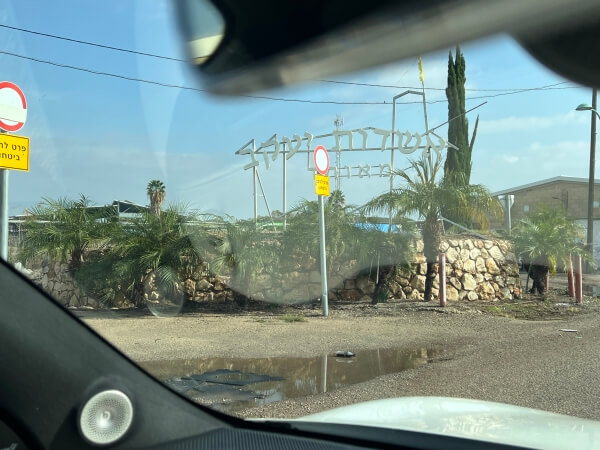
Entering the kibbutz, Ashodot Ya’akov Meuhad
Reminiscence of life on such a totally socialist-run kibbutz flooded over me. (Their politics have totally changed since then.) During my 10 months there, I was a nanny in the children’s house, where they slept apart from their parents. For a time I worked in the back of the kitchen washing dishes by hand for the 750 residents three meals a day, using a loofa and heavy detergents…ruining my hands but keeping warm in the winter over the hot tubs of water and suds. I held many different jobs during my time there, from picking olives to ironing shirts…testing which jobs suited me best, which is what the goal was—to get the best from their workers. I was a volunteer who spent half the day in “Ulpan,” learning Hebrew; the other half working…at something. The rest of the time was free to do whatever you wanted.
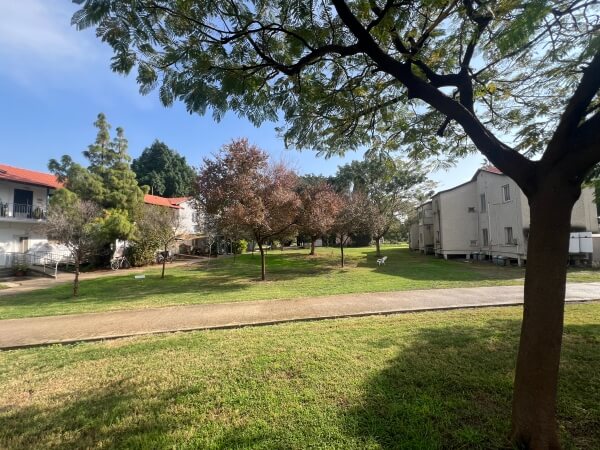
Kibbutz Ashodot Yaakove Meuhad
Even then, I thought that everyone coming from a capitalist society should experience life like this to fully understand the advantages and disadvantages of both. There are choices and trade-offs we make in life. But when you’ve experienced both ways of living, you can have a more balanced view. I’ve discovered that if both sides contribute equally to the equation, then everyone wins, rather than everyone losing. But, I digress…
After that brief stroll down memory lane, up, up, up we went on hair-pin turn after hair-pin turn to reach Kathy’s son’s home in a kibbutz in the southern part of the Golan. The view from his large picture window is normally breathtaking of Lake Kineret, but that day, the fog rolled in and pretty-much stayed most of the day. It was here in this spot that he and his bride took their vows on the hill overlooking that same view in 2011. Erica and I were privileged to have been there. And now, 14 years later, they have four kids, a big beautiful house and a hobby beekeeping! We learned a lot about it and tasted his bees’ delicious honey. That was the perfect highlight to a beautiful Shabbat.
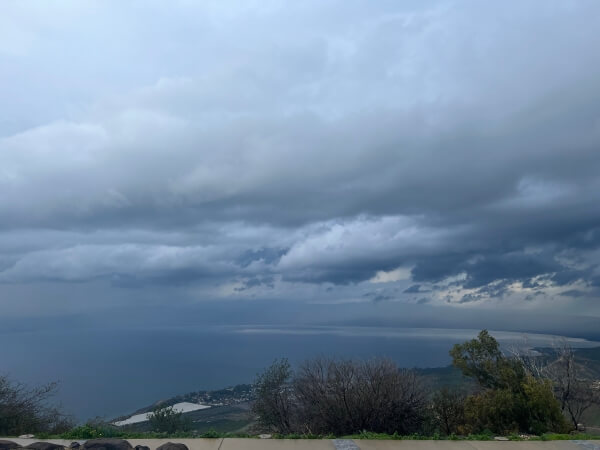
Over slightly overcast view of Lake Kineret in Tel Aviv
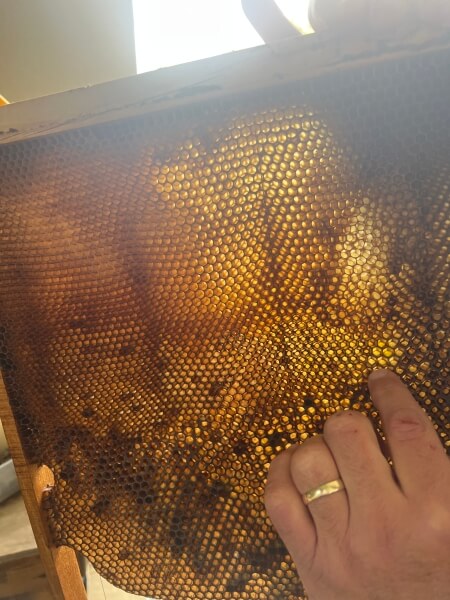
A honeycomb from the beehive
Let’s face it, it’s the Land of Milk and Honey.
“The Land of Milk and Honey” refers to the Land of Israel—specifically Canaan/ancient Israel—as described in the Hebrew Bible (the Old Testament). It is a poetic description of the land promised to the Israelites. “I have come down to rescue them from the hand of the Egyptians… and to bring them up out of that land into a good and broad land, a land flowing with milk and honey.”—Exodus 3:8
A la prochaine…
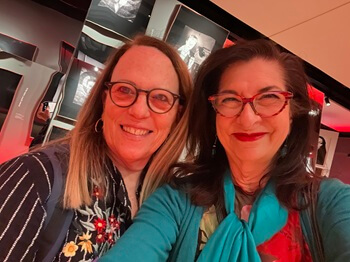 Adria Leeds
The Adrian Leeds Group®
Adrian with Kathy
P.S. As of this writing, only one hostage remains unreturned—the body of Israeli police officer Ran Gvili, which is still in Gaza and has not been brought home. Just for the record, a total of 251 people were taken hostage during the Hamas-led attack on October 7, 2023. Of those hostages 168 were returned alive over time through rescues and cease-fire deals, 83 people taken captive were killed and their deaths are confirmed.
P.P.S. Our offices close between Christmas and New Year’s, but I’ll continue to write about my experiences in Israel in next week’s Nouvellettre®—as we have a special trip to Jerusalem planned where we will meet-up with our CPA and Expert Comptable, Benjamin Pik!
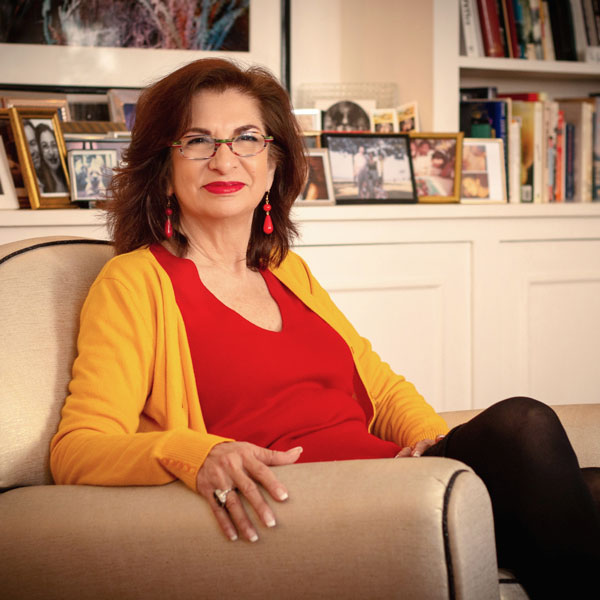
Let Us create a custom strategy for you
You can live or invest in France-now.
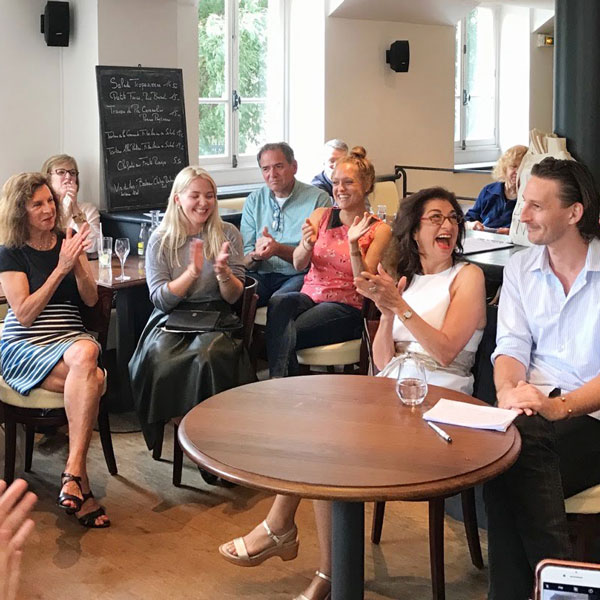
Join us at our monthly Après-Midi.
Become a part of the Paris community.
Property for sale

Read & Subscribe
Dive into more by reading the French Property Insider
Better yet, subscribe to both and get the updates delivered to your inbox.
Global Money Services
Our contacts will help you invest in France.


See Adrian on HHI

Join us on Youtube
Dive into more on how to live, invest & escape to France
Be sure to subscribe!
To read more, click the links below.