


Weekly insights about property in France!
Subscribe and don't miss an issue!
Hot Weather, Cold Facts: How to Improve Your DPE Before It Improves You
Volume XXIV, Issue 27

By Jay Corless, edited by Adrian Leeds
Surviving the recent heat wave in France has made one thing painfully clear: climate change and energy efficiency are no longer abstract subjects reserved for policymakers, engineers, or the most environmentally minded among us. They are now part of daily life, felt in our apartments, our houses, our utility bills and, increasingly, in the value and legal usability of our properties. Météo-France reported on June 29, 2026, that the canicule (heat wave) was easing in much of France but not over, with more heat still expected later in the week.
IN FRANCE, ALL ROADS LEAD TO THE DPE
The Diagnostic de Performance Énergétique, or DPE, is the energy performance rating that every buyer, seller, landlord, and tenant has learned to watch closely. Once treated as just another technical document in the thick dossier of a French real estate transaction, it has become one of the most important indicators of a property’s future. The official French administration explains that the DPE estimates a property’s energy consumption and greenhouse gas emissions and is required for most sales and rentals.
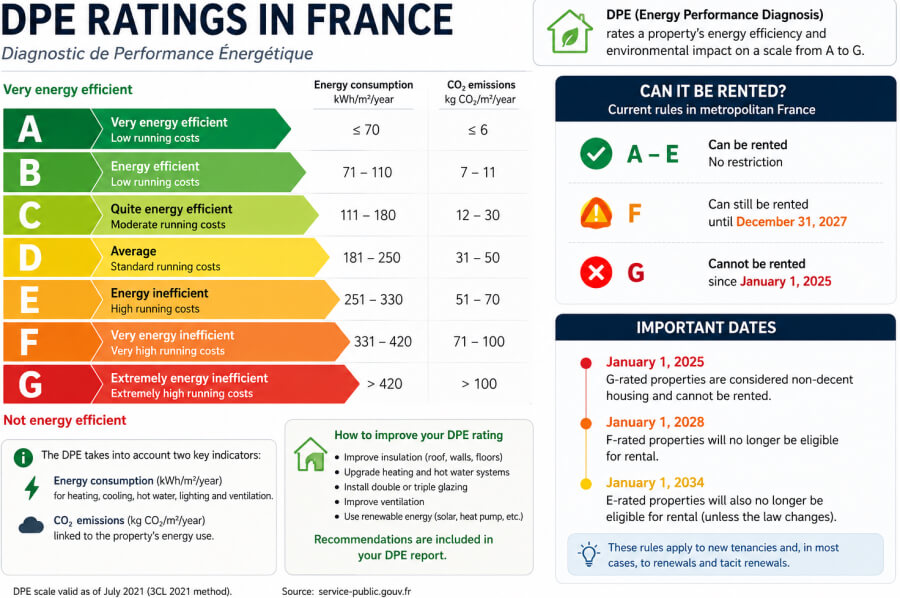
A good DPE can make a property more attractive, more comfortable, more economical to live in, and easier to rent or sell. A bad DPE can reduce value, limit rental possibilities, and trigger expensive work at the least convenient moment.
As of today, the rule is that G-rated properties cannot legally be rented in metropolitan France. Since January 1, 2025, they are considered non-decent housing for rental purposes. This applies to new leases and, in many cases, lease renewals or tacit renewals.
This does not mean that you cannot own and live in a property that has a low DPE rating! And it doesn’t mean that you, as a tenant, can’t rent one with a low rating, but it does place the onus on the owner to make the property improvements to the property.
Future deadlines for the DPE ratings are:
* January 1, 2028: F-rated properties become ineligible for rental
* January 1, 2034: E-rated properties are also scheduled to become ineligible for rental unless improved

Because of a change to the DPE calculation that took effect on January 1, 2026, many electrically heated homes automatically improved by one energy class without any renovation work. For example, some apartments previously rated F or G are now rated E or F, making them rentable again or postponing future restrictions. Owners can obtain an updated official DPE attestation through the government system if their property qualifies.
The good news? A DPE is not destiny. In many cases, it can be improved, sometimes dramatically, with the right sequence of works. The trick is knowing where to begin.
Almost every DPE report includes recommendations for improving a property’s energy performance, although the level of detail varies depending on when the report was issued.
A modern DPE (especially those issued since the methodology changed in July 2021) typically includes:
* A list of recommended improvements, prioritized by impact
* Estimated energy savings from each recommendation
* Estimated cost ranges for the work (approximate, not quotes)
* The expected DPE rating after improvements, sometimes showing a step-by-step progression (for example, from F to E, then to D)
* Recommended sequence of work, since some improvements are more effective when done before others
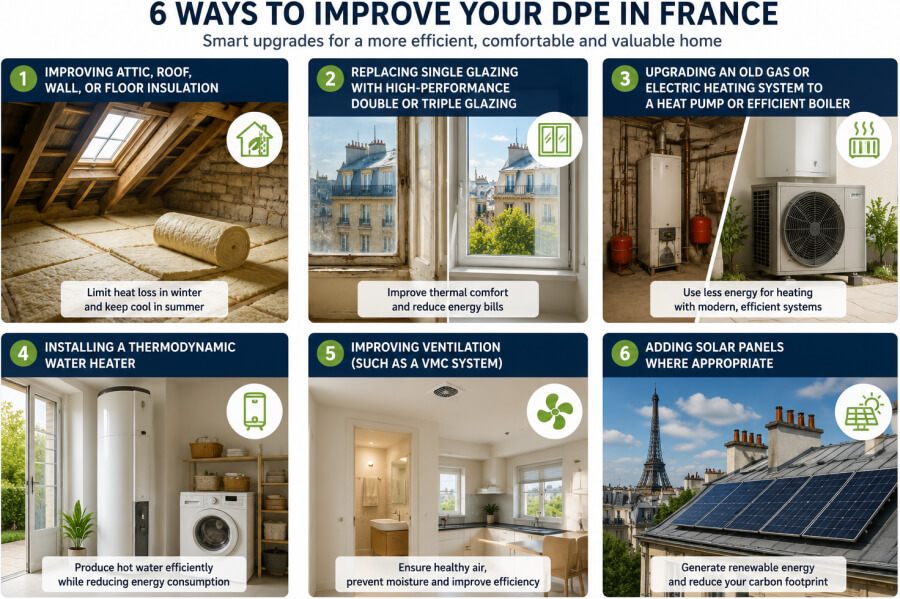
Common recommendations include:
* Improving attic, roof, wall, or floor insulation
* Replacing single glazing with high-performance double or triple glazing
* Upgrading an old gas or electric heating system to a heat pump or more efficient boiler
* Installing a thermodynamic water heater
* Improving ventilation (such as a VMC system)
* Adding solar panels where appropriate
The DPE is not a renovation blueprint. It generally does not:
* Specify exact products or brands
* Provide contractor specifications
* Guarantee that completing the recommendations will achieve the predicted rating
* Replace an energy audit for major renovations
If a property is an passoire énergétique (energy sieve), an additional audit énergétique (energy audit) is required when selling most houses. This audit is much more detailed than the DPE and typically presents several renovation scenarios, costs, and the projected energy label after each package of improvements.
If you’re evaluating a property for purchase, the DPE recommendations can be very helpful—but I generally recommend looking beyond the DPE. An independent energy consultant or architect can often identify more cost-effective improvements and confirm whether the suggested upgrades are realistic for that particular building.

START WITH THE ENVELOPE: INSULATION FIRST
The most common mistake is to start with the heating system before addressing the building itself. That is like buying a designer coat while leaving all the windows open. If the walls, roof, floors, and windows allow heat to escape in winter and enter in summer, even the most modern heating or cooling system will be fighting a losing battle.
For houses, the first priority is often the roof or attic. Heat rises, and poorly insulated combles (attic) can cause significant energy loss. Insulating the attic is often one of the most cost-effective improvements, particularly in older homes. France Rénov’ identifies insulation as a key lever in energy renovation, including roofs, walls, floors and windows.
For apartments, the situation is more nuanced. You may not control the roof, façade or common areas if you are in a copropriété, but you may still be able to improve interior insulation, windows, shutters, ventilation and heating controls. In some buildings, the best improvements require a vote by the copropriété, particularly for façade or roof insulation, collective heating systems, or window changes that affect the building’s external appearance. France Rénov’ provides specific guidance for energy renovation in copropriété buildings, including collective works and renovation planning.
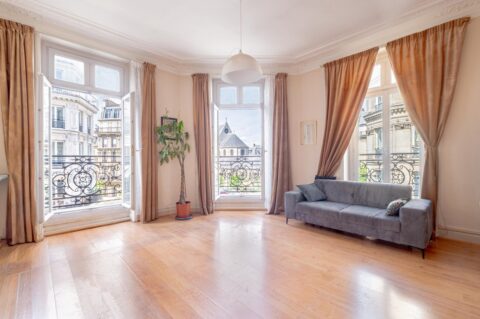
In classic Parisian apartments, we must also remember that charm and efficiency are not always best friends. Those beautiful old windows, high ceilings, and decorative moldings may be part of what made us fall in love with the property in the first place, but they can also make the DPE suffer.
UPGRADE THE WINDOWS, BUT DO IT INTELLIGENTLY
Replacing single-glazed windows with double glazing can make a noticeable difference in energy performance, comfort, and noise reduction. This is particularly important in urban settings, where buyers and tenants are increasingly sensitive to both energy efficiency and sound insulation. A quiet, well-insulated apartment on a busy street can become far more desirable than a charming but drafty one.
However, in France, window replacement is rarely just a matter of ordering new windows. In a copropriété (homeowner association), the style, color, and material may be regulated. In a protected building or historic area, there may be additional urban planning restrictions. Before changing windows, check the Règlement de Copropriété (bylaws), consult the Syndic (managing agent) and, where necessary, verify whether permission from the Mairie (city hall) is required. The French public service portal explains that prior declarations of works may be required for changes that modify the exterior appearance of a building. The goal is to improve the property without creating a legal or aesthetic problem.
VENTILATION: THE FORGOTTEN HERO
Insulation without ventilation is a recipe for humidity, condensation, and mold. This is where many renovation projects go wrong. Owners seal up a property to keep heat in, but they forget that a home must breathe. A proper ventilation system, often a ventilation mécanique contrôlée (VMC), helps regulate indoor air quality and humidity. France Rénov’ emphasizes the importance of ventilation for maintaining indoor air quality and preventing humidity issues during renovation.
Good ventilation is particularly important in bathrooms, kitchens, and older buildings where moisture can become trapped. It may not be the most glamorous improvement, but it is essential to comfort, health, and long-term property maintenance. And yes, it can affect the DPE.
MODERNIZE THE HEATING SYSTEM
Once the property is properly insulated and ventilated, it makes sense to look at the heating system. Old electric convectors, aging gas boilers, and inefficient hot water systems can drag down a DPE. Replacing them with more efficient systems can improve both energy consumption and greenhouse gas emissions. Depending on the property, options may include:
– More efficient electric radiators
– A modern condensing boiler
– A heat pump
– Improved hot water production
– Wood or pellet heating in certain houses
– Connection to a more efficient collective system, where available
For houses, heat pumps can be very attractive, but they must be properly sized and installed. France Rénov’ provides guidance on heat pumps, including the need to choose a system adapted to the dwelling. For apartments, the possibilities depend heavily on the building, the existing system and copropriété rules.
The important point is this: do not choose a heating system in isolation. The best solution depends on the property’s size, insulation, layout, region, energy source and use. A pied-à-terre used occasionally does not have the same needs as a primary residence occupied year-round.
ADD SMART REGULATION
Sometimes the simplest improvements are also the most sensible. Thermostats, programmable controls, thermostatic radiator valves, and better zoning can reduce unnecessary consumption. These systems allow you to heat the rooms you use, when you use them, rather than heating the entire property blindly. The French energy agency Agence de la transition écologique (ADEME) explains that regulating and programming heating can reduce energy consumption and improve comfort.
This is particularly useful in larger apartments and houses, where different rooms may have very different patterns of use. A well-regulated heating system is more comfortable, less wasteful, and more attractive to future occupants.
THINK SUMMER COMFORT, NOT JUST WINTER HEAT
The DPE has historically led many owners to focus mostly on winter: heat loss, heating bills, and insulation against the cold. But after this heat wave, we all know better. Energy performance is also about summer comfort. A property that becomes unbearable in July and August is no longer just inconvenient—it is vulnerable.
Improvements that help in summer include shutters, exterior blinds, good ventilation, roof insulation, wall insulation, reflective or protective window treatments where allowed, and thoughtful landscaping for houses. In the south of France, orientation, cross-ventilation, and solar protection are becoming increasingly important in buyer decisions. ADEME advises keeping heat out with shutters, blinds and ventilation strategies before relying on air conditioning.
Air conditioning may be tempting, and sometimes necessary, but it should not be the first or only answer. A property that is better protected from heat will always perform better than one that relies entirely on mechanical cooling.
FOR APARTMENTS: WORK WITH THE COPROPRIÉTÉ
Improving the DPE of an apartment can be frustrating because the owner does not control everything. You may want to insulate the façade, improve the roof, change the collective heating or renovate common systems, but these decisions may require copropriété approval. That does not mean you are powerless. It means you need a strategy.
Start by understanding what belongs to you privately and what belongs to the building collectively. Then look at the latest diagnostics, energy audits and meeting minutes from the copropriété. Has an energy audit already been discussed? Are works planned? Has the building considered roof insulation, façade works, heating improvements, or ventilation? France Rénov’ details the collective renovation process for copropriétés and the role of audits and project planning.
A mediocre DPE in a building that has already voted for major improvements may be a very different story from a mediocre DPE in a building with no plan at all. For buyers, this is crucial. A poor DPE is not always a reason to run away, but it is always a reason to ask better questions.
FOR HOUSES: TAKE A GLOBAL VIEW
With a house, you usually have more control and more responsibility. A house can often be improved more dramatically than an apartment because you can address the roof, walls, floors, windows, heating, hot water, ventilation, and sometimes renewable energy production. But here again, the order matters.
A proper energy audit can be very useful, especially for houses rated E, F, or G. It can show which works will produce the greatest improvement and whether it is better to proceed in stages or undertake a more comprehensive renovation. France Rénov’ explains that an energy audit can propose work scenarios, estimate energy savings, indicate the expected DPE rating after works and identify available aid.
The most effective approach is often a “global renovation,” not a series of disconnected gestures. Replacing the boiler without insulation, or insulating without ventilation, can lead to disappointing results. Think of the house as a body. You would not treat the lungs, heart, and skin as completely separate systems. A home works the same way.
DO NOT RENOVATE BLINDLY
Before spending tens of thousands of euros, get professional advice. A DPE tells you where the property stands. An energy audit can tell you how to improve it. A qualified professional can help identify which works are technically feasible, which are eligible for aid, and which are likely to produce the best gain in rating.
This matters because the goal is not simply to “do work.” The goal is to improve the rating, reduce consumption, increase comfort and protect the property’s value. Not all works produce the same effect on the DPE. Some expensive improvements may have only a modest impact on the rating, while other better-targeted works may move the property up one or more classes.
LOOK INTO FINANCIAL AID
France offers several forms of assistance for energy renovation, including MaPrimeRénov’, certificates of energy savings, eco-loans and, in some cases, local or copropriété-level aid. France Rénov’ describes MaPrimeRénov’ as the main state aid for energy renovation, available to owner-occupiers, landlords and copropriétaires (owners), with aid levels depending on income and project type. The official French administration also explains the éco-prêt à taux zéro, or zero-interest eco-loan, for eligible renovation works.
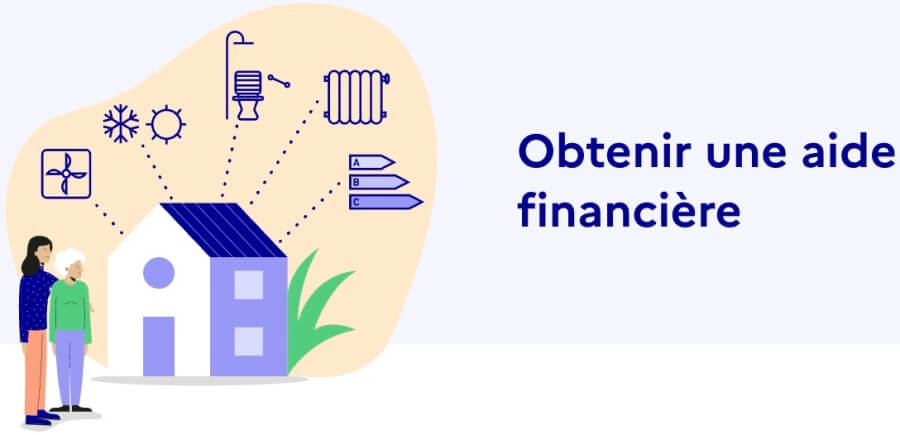
The rules change, budgets shift, and eligibility depends on the owner, the property, the works, and whether the home is a primary residence, rental property, or part of a copropriété. So this is not something to assume. It must be checked carefully before signing estimates. And always be cautious. The renovation market has attracted its share of aggressive salespeople and questionable offers. If someone promises miracles for one euro, run, preferably toward a reputable advisor.
THE RENTAL CLOCK IS TICKING
For landlords, the DPE is no longer optional background noise. In mainland France, the least efficient properties are being progressively restricted from the rental market. G-rated housing has already crossed a major threshold, with F-rated housing next in line in 2028 and E-rated housing later in 2034. The French public service portal explains that in mainland France, G-rated housing will be considered non-decent from January 1, 2025; F-rated housing, from January 1, 2028; and E-rated housing, from January 1, 2034.
That means owners who rent, or plan to rent, must think ahead. Waiting until the last minute is risky because contractors may be booked, copropriété votes may take time, and renovation aid may evolve. The best moment to improve a DPE is before you are forced to.
THE MARKET IS CHANGING
Buyers are paying attention. Tenants are paying attention. Banks, notaires, agents, and insurers are paying attention. A beautiful property with a poor DPE can still sell, of course. We are in France, after all, and emotion still matters. A stone house in Provence, a Haussmannian apartment in Paris, or a village home with a view can still make hearts beat faster.
But the conversation has changed. Today’s buyer is more likely to ask, “What will it cost to heat?” Can I rent it? Will I be able to resell it easily? What work is required? Has the copropriété planned anything? How hot will it be in August? These are not small questions. They affect negotiation, timing, and long-term value.
THE BOTTOM LINE
Improving a DPE is not just about pleasing the bureaucracy. It is about making a property more livable, more resilient, and more valuable. The best approach is practical and sequential.
First, understand the current DPE. Then, identify the weakest points. Insulate before oversizing the heating. Ventilate before sealing everything up. Regulate consumption intelligently. Work with the copropriété when needed. Use qualified professionals. Check available aid. And think not only about winter warmth, but summer survival.
After the heat we have just lived through, no one needs to be convinced that the climate is changing. The real question is whether our homes are changing with it. In France, the DPE is the scorecard. Comfort is the reward. And the smartest owners will act before the market, or the law, forces them to.
À bientôt,
 Adrian Leeds
The Adrian Leeds Group®
P.S. We’re the folks who can make your French property investment dream come true, while protecting you from making serious mistakes. We are equipped to provide all the services you need. Review the services we offer to help you find the perfect property in France!
1 Comment
Leave a Comment

Let Us create a custom strategy for you
You can live or invest in France-now.
Property for sale
what's happening
Check out upcoming events, conferences, or webinars. Join us!
GET FINANCING
Learn about French Property Loan Information.

Read & Subscribe
Dive into more by reading the Adrian Leeds Nouvellettre®
Better yet, subscribe to both and get the updates delivered to your inbox.

Get started with your dream of owning property in Paris.
Join us on Youtube
Dive into more on how to live, invest & escape to France
Be sure to subscribe!
To read more, click the links below.
Thank you for the insight, Adrian! Looking forward to working with you in the near future!