


Weekly insights about property in France!
Subscribe and don't miss an issue!
Paris Property: The Market That Wants to Wake Up…But Keeps Hitting Snooze
Volume XXIV, Issue 28
By Jay Corless, edited by Adrian Leeds
There’s a funny little phrase in the latest report from the Notaires du Grand Paris: “un marché qui peine à transformer l’essai”—”a market that is struggling to capitalize on its opportunities.”
For those of us who live and breathe Paris real estate, that sounds about right.
The market is no longer in free fall. It is no longer frozen. It is no longer behaving like the anxious, interest-rate-shocked market of 2023 and 2024. But it is not exactly dancing in the streets either. It is moving, yes, but slowly, cautiously, and with one eye on interest rates, one eye on the news, and one hand still firmly on the wallet.
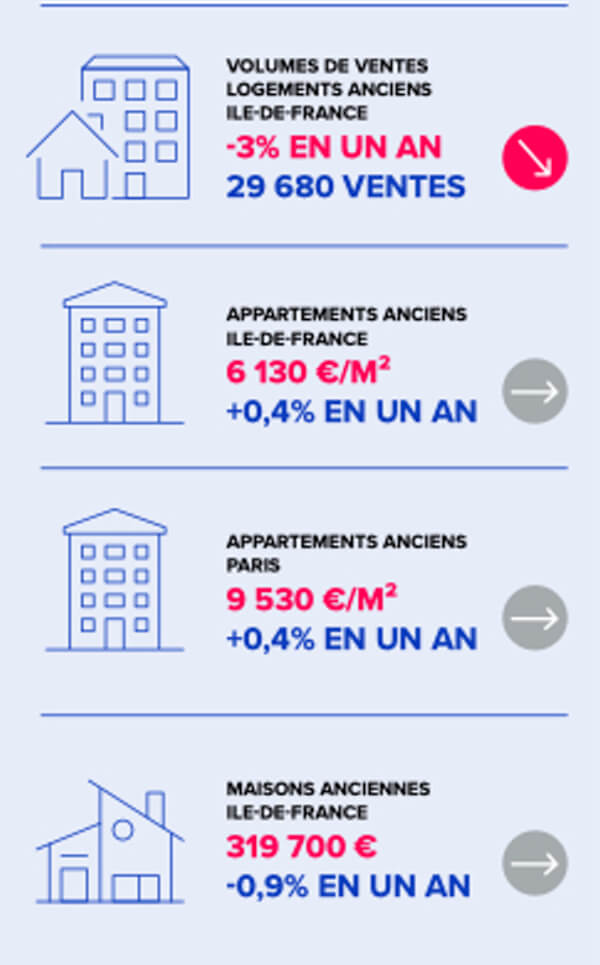
Between February and April 2026, 29,680 sales of older homes were recorded in the Île-de-France region, down 3% from the same period in 2025. In Paris proper, sales volumes fell 5% year-on-year. But the notaires are careful to point out that early 2025 was somewhat artificially boosted by buyers rushing to complete purchases ahead of higher transfer taxes. So, the decline is not necessarily a new slump—more like a correction after a distorted comparison period.
And here’s the important part: over two years, sales volumes are still up 19%, with apartment sales up 17% and house sales up 25%. That tells us the market is not dead. It is recovering, just very, very slowly. The notaires call it a “normalisation lente,” a slow normalization. I call it the Paris market, doing what Paris does best: refusing to be rushed.
PRICES: STABLE, NOT SPECTACULAR
For buyers waiting for another dramatic price drop, the latest figures may be disappointing. Prices are no longer tumbling.
In April 2026, the average price for older apartments in Paris stood at €9,530 per square meter, up a modest 0.4% over one year. Across Île-de-France, older apartments averaged €6,130 per square meter, also up 0.4%. Houses, however, are still softening, with the average older house price in Île-de-France down 0.9% year-on-year to €319,700.
The forward-looking indicators from preliminary contracts suggest more of the same: apartment prices should remain relatively stable through July, while house prices may continue to adjust. The notaires project Paris apartment prices at €9,650 per square meter for the May-July 2026 period.
So, what does this mean?
It means we are no longer in a market where sellers can name any price they like and expect five offers before lunch. But we are also not in a buyer’s paradise where every property is negotiable to the bone. Good properties in good locations remain good properties in good locations. Paris has not suddenly become a bargain basement. It has simply become more reasonable.
THE FOREIGN BUYER STORY: SMALL MARKET, BIG INFLUENCE
Now for the part of the report that caught our eyes—and perhaps yours, too.
The notaires included a special focus on buyers residing outside France. In 2025, non-resident buyers completed 2,660 purchases of older homes in Île-de-France, representing only 2.2% of total sales. That is tiny at the regional level. But in Paris, it matters.
Paris alone accounted for 60% of all non-resident purchases in Île-de-France, with 1,610 acquisitions, equal to 6.9% of sales in the capital. Foreign non-residents represented 3.7% of Paris purchases, while French citizens living abroad represented 3.2%.
That confirms what we see every day: international buyers are not buying all of Paris, despite what the dinner-party complainers might say. But they are very present in the parts of Paris that international buyers love, central, beautiful, historic, walkable, and emotionally irresistible.
And guess who leads the foreign non-resident category in Paris?
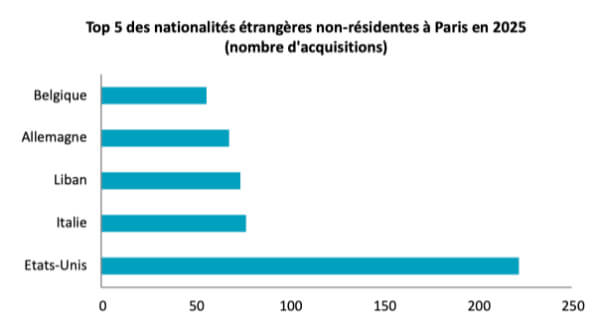
The Americans. Among foreign non-resident buyers in Paris in 2025, Americans were the top nationality, with 220 acquisitions, representing 26% of purchases by foreign non-residents in the capital. They also had the highest median purchase price: €864,000, for a median surface area of 65 square meters.
That number says a lot. American buyers are not coming to Paris only for tiny pied-à-terres tucked under the rooftops. Many are buying serious apartments, often with a long-term lifestyle plan attached: part-time living, eventual retirement, family use, remote work, or simply the dream of having a real home in Paris.
WHY AMERICANS STILL LOVE PARIS
This is where the statistics meet the heart. Americans are practical people, at least we like to think we are. We look at interest rates, taxes, exchange rates, closing costs, building condition, and rental regulations. We ask for spreadsheets. We ask for diagnostics. We ask whether the elevator has been voted on at the last copropriété meeting.
And then we walk into a Paris apartment with herringbone parquet, marble fireplaces, tall windows, a view of a zinc rooftop, and suddenly all our rational calculations become a little more…flexible. Paris does that.
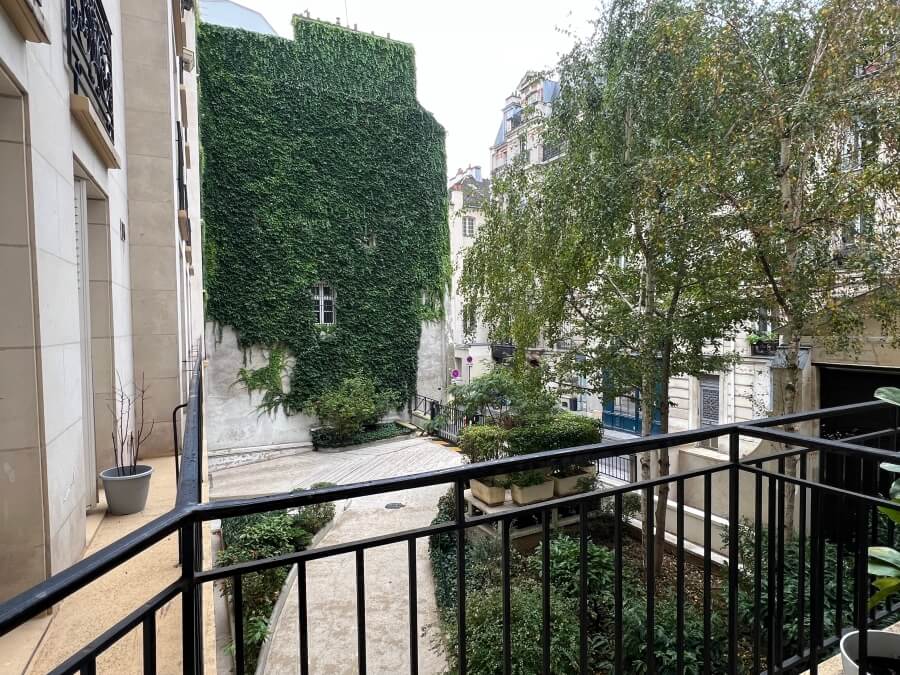
But there is also a more serious story here. Many American buyers are relatively less dependent on French mortgage financing. Some purchase with cash. Some use equity from U.S. assets. Some are motivated by lifestyle diversification, political fatigue, retirement planning, or the desire to establish a European base. That may help explain why, as the notaires note, foreign non-resident buyers tend to have higher acquisition budgets and may be less sensitive to financing conditions than local buyers.
In other words, the American buyer is not driving the whole Paris market, but in certain neighborhoods and price brackets, they are absolutely part of the story.
WHAT THIS MEANS FOR BUYERS
For buyers, the message is: this is still a good moment, but not a moment for fantasy pricing.
There is more breathing room than during the overheated years. Sellers are more realistic. Properties that are overpriced can sit. Negotiation is possible, particularly for apartments with flaws: high floors without elevators, poor energy ratings, awkward layouts, heavy renovation needs, or locations just outside the most coveted streets.
But the best properties still move. If you are looking for classic Paris charm, a good building, a proper elevator, light, quiet, and a desirable arrondissement, you will still face competition. Not always frantic competition, but competition nonetheless.
The key is to be prepared. Financing, proof of funds, French banking logistics, tax planning, and decision-making all need to be in order before the perfect apartment appears. Paris rarely rewards hesitation.
WHAT THIS MEANS FOR SELLERS
For sellers, the message is equally clear: price correctly, or prepare to wait. The market is not collapsing, but buyers are no longer willing to suspend disbelief. A seller who prices at 2021 levels may discover that the phone does not ring the way it used to.
The properties that sell are the ones that meet the market: well-presented, well-documented, properly priced, and easy for buyers to understand. Energy efficiency matters. Building maintenance matters. Monthly charges matter. A beautiful apartment can still be punished by a bad DPE, an expensive copropriété project, or an unrealistic asking price. Paris will always have buyers. But today’s buyers read the documents.
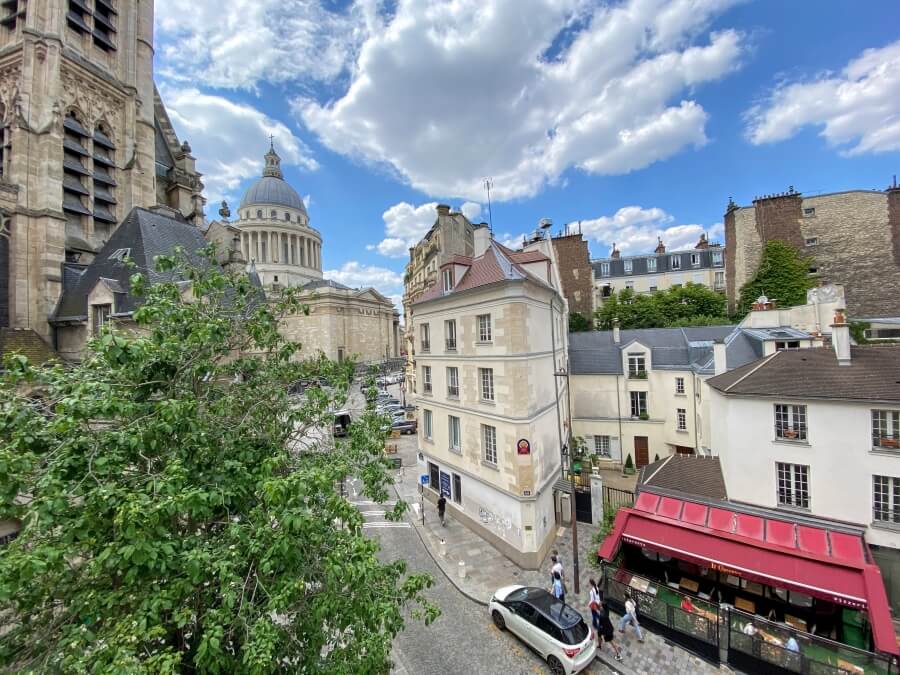
A SLOW MARKET IS NOT A BAD MARKET
The notaires’ report paints a market that is fragile, cautious, and slow to regain momentum. Geopolitical uncertainty, energy prices, and interest rates continue to weigh on confidence. The report also notes that the European Central Bank’s recent rate increase from 2% to 2.25% could eventually affect mortgage rates, making the recovery more uncertain.
But there is another way to read this. A slow market is not necessarily a bad market. It can be a healthier market. It gives buyers time to think, compare, negotiate, and inspect. It forces sellers to be more realistic. It brings the conversation back to value, not panic.
And Paris? Paris remains Paris. It is still the city that attracts dreamers with spreadsheets, retirees with museum passes, remote workers with laptops, families seeking a European chapter, and Americans who arrive “just to look” and somehow end up discussing notaire appointments.
The market may be struggling to “convert the try,” as the notaires put it. But for those who know what they want, prepare properly, and move with both head and heart, Paris still has plenty of game left.
Read the report in its entirety (in French).
And if you’re ready to have the pied-à-terre of your own in Paris, we’re the resource that makes it possible. Visit our website to learn more.
À bientôt,
 Adrian Leeds
The Adrian Leeds Group®
P.S. Talk to us to discuss whether to rent or buy? It’s a conversation we have almost daily with our clients. Buying, at least for now, isn’t always the answer, but don’t be afraid of buying property. I’ve never regretted any of it, even if I am the Poster Child for property problems! Contact us to learn more and book your personal consultation today.

Let Us create a custom strategy for you
You can live or invest in France-now.
Property for sale
what's happening
Check out upcoming events, conferences, or webinars. Join us!
GET FINANCING
Learn about French Property Loan Information.

Read & Subscribe
Dive into more by reading the Adrian Leeds Nouvellettre®
Better yet, subscribe to both and get the updates delivered to your inbox.

Get started with your dream of owning property in Paris.
Join us on Youtube
Dive into more on how to live, invest & escape to France
Be sure to subscribe!
To read more, click the links below.