


Weekly insights about property in France!
Subscribe and don't miss an issue!
How to Determine the Price of Property in France
Volume XII, Issue 14

Want to know the price of property in France? It’s easy!
The Chambre de Notaires de France provides detailed information for every nook and cranny in the country via their site, Immoprix. You will find the prices and indexes for each type of property — house, apartment, land — depending on geographical location — region, county, town, district, neighborhood.
The site is in French (of course), so get out your dictionary if you need it. Streetwise France has a great Glossary of Terms should you need it: streetwise-france.com/.
____________
THE METHOD
Since September 2011, the price displayed on this site now is the net selling price* and not the purchaser net price. Moreover, the statistics published in the province, regions, departments and administrative districts correspond to median prices rather than average prices.
*Net selling price does not include the amount of furniture and the agency commission (about 5%).
Unique in France, with more than 9 million references, the base of real estate Notarial references managed by PERVAL SA was created in 1990 to allow the practice of real estate appraisal by comparison, and is the only proven method used by the courts.
It identifies through volunteering notaries, real estate sales of all types (buildings, houses, apartments, land, busine
ss premises, agricultural and agricultural property, garages) and indicates the actual transaction prices. The data allow for more than 15 years by the Notaries of France to produce statistics and price trends. The first indexes of property prices were calculated in partnership with INSEE in 1996.
The field of observation covers the new and old apartments, the old houses and their land which represents over 85% of sales of real estate houses.
Trends for new homes cannot be studied because this market is not processed by notaries as such: it is in fact done for the vast majority of construction contracts. Consequently, only the homes sold within 5 years of their completion are recorded in the database PERVAL.
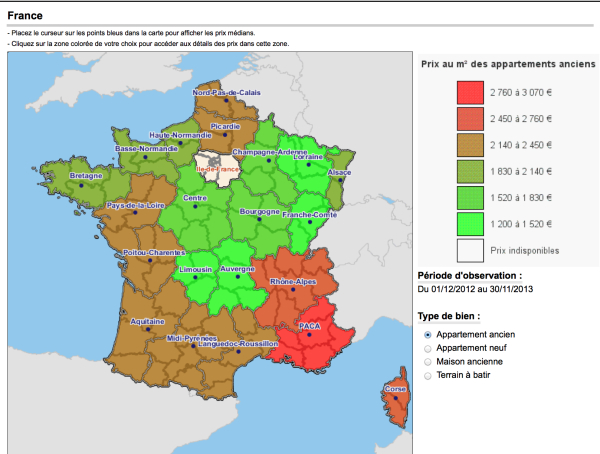
Transactions included in the calculation of statistics concerning properties:
– Unoccupied at the time of sale (or occupied by the seller)
– Acquired outright by a sale of OTC (over the counter)
– For strictly residential use
Life annuity properties (“viager”), transactions of atypical properties, such as servants’ quarters, lofts, workshops, mansions or châteaux and acquisitions made by real estate professionals are excluded.
For a given type of property, several geographical levels can be observed: region, state, district, city, neighborhood, vicinity of an address.
The statistic is computed only if the number of properties recorded in the database for the study PERVAL period is greater than or equal to 20.
Markets in all regions and provincial departments are observed as well as the DOM (overseas territories).
In old houses and apartments, there are more than 600 cities that are available with a detail by district for about 80 of them.
Communal maps match the breakdown of IRIS. IRIS are groupings of islands and were defined at the time of the population census in March 1999 by the INSEE. Only IRIS habitats have been selected — they include 1,800 and 5,000 inhabitants and are homogeneous with respect to habitat type.
The statistics are calculated over a period of 12 months.
Observed prices are exclusive of transfer taxes but including VAT for the new build properties. They correspond to the seller’s net price (not including the value of furnishings and the agency commission). Note: from January 2010 to August 2011, only purchasers’ prices (including the value of furnishings and the agency commission) were presented on this site.
The statistics published in the province, regions, departments and administrative districts correspond to:
A median price per square meter for apartments.
A median sales price for homes and land.
The median is the middle value that divides all prices observed in the two groups of equal strength: 50% below and 50% below.
In cities, neighborhoods and around an address, the price range is displayed:
The price corresponds to the first quartile of the price per square meter for apartments and the price for the sale of houses and land. The first quartile is based on the first level of prices obtained after elimination of one-quarter of the sales at the lowest price.
The maximum price corresponds to the third quartile of the price. The third quartile of the price is the last price level obtained after elimination of the corresponding quarter of sales at the highest price.
The statistics are updated each month. Given the time to provide the real estate databases, statistics appear with a lag of three months. Example: in July 2010, available statistics are calculated from the transactions carried out between April 1, 2009 and March 31, 2010.
Calculating an average price gives a snapshot of the level of prices in a market in a given period. It is an indicator of the expense for the buyers, which is closely related to the size, the intrinsic qualities or the environment of homes sold during the period. Thus, the average price increases if these criteria are more favorable one year compared to another. If the characteristics are identical, the price may not have changed or changed in a different way.
To remedy this problem, in partnership with INSEE the notaries have developed a tool for monitoring the evolution of the market: the price index. They have been using this method in Paris since 1992 and in the province since 1996.
It focuses only on old houses and old apartments for tax purposes, that is to say more than five years or having undergone a second mutation in the five years from completion.
The index measures the evolution of a reference fleet sold between 1998 and 2001. The methodology is based on so-called hedonic econometric models explaining the price of housing in terms of its characteristics. Using these models, the value of each property of the reference fleet (whose characteristics are fixed) price of the current period is estimated. The index measures quarterly changes in the value of the park by taking as 100 the fourth quarter of 2000.
Transactions included in the calculation of indexes for the following properties:
– unoccupied at the time of sale (or occupied by the seller);
– acquired outright by a sales agreement;
– for strictly residential use.
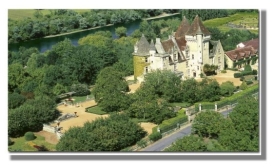 Châteaux in France considered atypical propertiesTo avoid atypical transactions, the statistics exclude non-standard properties such as servants’ quarters, lofts, workshops and châteaux and acquisitions by real estate professionals.
The price used is the net selling price, excluding transfer taxes, notary fees and agency commission.
The index is calculated every quarter but it is on an annual sliding scale, that is to say, it is based on the change in a period over four quarters. Given the power of the base, two indexes are calculated each quarter: a provisional index and a final index.
Example: early July 2007 will be available: firstly, the final index of 2006, compiled from transactions that occurred in 2006, and secondly, the provisional index of the first quarter of 2007, compiled from transactions the last three quarters of 2006 and the first quarter 2007.
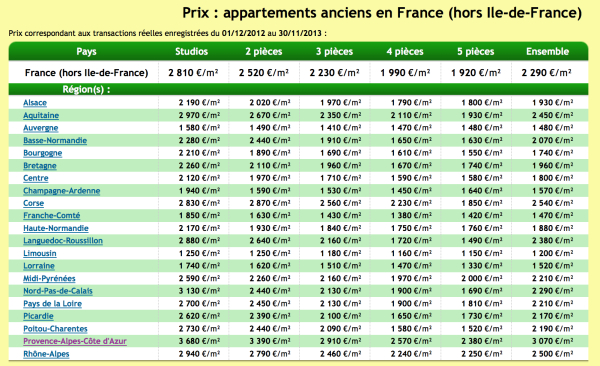
Price indexes are presented by geographic areas: provinces, regions, departments.
____________
And even with all this, be careful how you interpret the prices.
Remember, they are out-of-date, are net of agency fees, furnishings and ‘cash under the table’ (which is illegal, but done) and use a median, rather than average of the quality of the properties in any one given area.
As in any case, the comparable properties for sale on the market are the true indicators of price! And of course, it’s still based on ‘what the market will bear!’
A bientôt,
 Adrian Leeds
Editor, French Property Insider & Director of The Adrian Leeds Group, LLC
Email: [email protected]

 P.S. We’re filming another House Hunter’s International episode this coming mid-May in Paris. I am seeking a property in which we can film: a two-bedroom apartment in the West side of Paris (16th, 7th, 15th, 17th) with elevator if higher than 3rd floor. The filming takes about three hours, with a total crew of seven people and there’s nothing for you to do but watch (if you like) and then have fun seeing your own apartment on national TV! If you have a property like this and would be willing to let us film there, please email me at [email protected].
P.P.S. It IS possible to realize your dream of owning an apartment in Paris, on the Riviera or a home in the French countryside. My team of rental professionals can assist you in finding the ideal property based on your specific preferences, budgets and needs. For details or to book our services, visit French Property Consultation or email [email protected].

Let Us create a custom strategy for you
You can live or invest in France-now.
Property for sale
what's happening
Check out upcoming events, conferences, or webinars. Join us!
GET FINANCING
Learn about French Property Loan Information.

Read & Subscribe
Dive into more by reading the Adrian Leeds Nouvellettre®
Better yet, subscribe to both and get the updates delivered to your inbox.

Get started with your dream of owning property in Paris.
Join us on Youtube
Dive into more on how to live, invest & escape to France
Be sure to subscribe!
To read more, click the links below.