


Weekly insights about property in France!
Subscribe and don't miss an issue!
Paris Property: A Market That’s No Longer Falling—But Not Yet Flying
Volume XXIV, Issue 23
By Jay Corless, edited by Adrian Leeds
The latest figures from the Notaires du Grand Paris are in, and the message is clear: the Paris and Île-de-France property market is no longer in free fall. But don’t expect fireworks just yet.
After the bruising correction of the past few years, the market is showing signs of life—slowly, cautiously, and unevenly. The notaires describe it as a lente remontée, a slow climb back. I would call it a market that has found its footing, but not yet its stride.
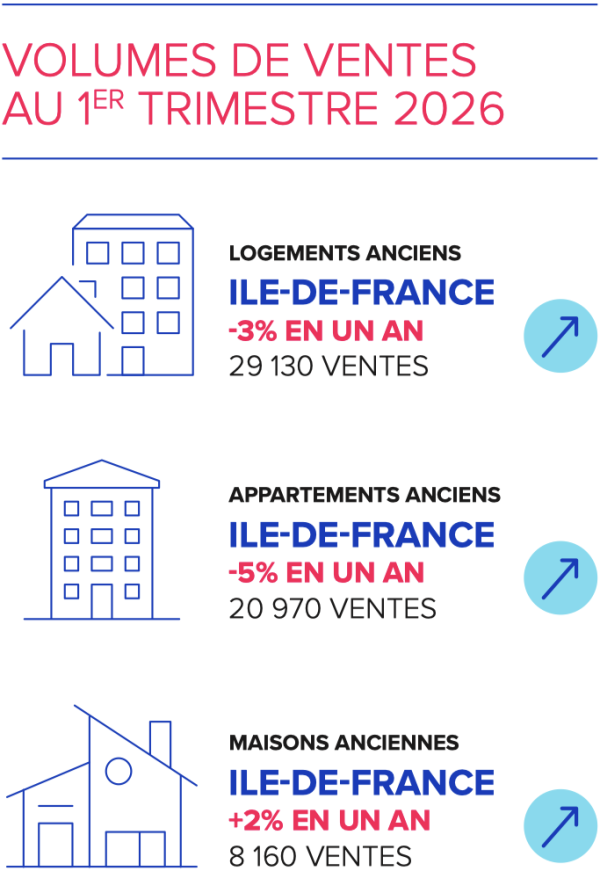
At the end of the first quarter of 2026, Île-de-France recorded 29,130 sales of older residential properties, down three percent from the same period in 2025. That sounds negative at first glance, but it needs context. The first quarter of 2025 was artificially boosted by buyers rushing to complete purchases before the increase in transfer taxes in several departments. Compared with the very weak market of 2024, activity is still improving. Over the past 12 months, nearly 124,000 older homes changed hands in the region.
For buyers, especially those coming from North America, this is exactly the kind of market worth watching closely. It is not euphoric. It is not overheated. Sellers are no longer in denial, the way they were two years ago, but buyers are also no longer alone at the negotiating table. This is the in-between moment—the one that rewards preparation.
PARIS PRICES: STABLE AT €9,600 PER SQUARE METER
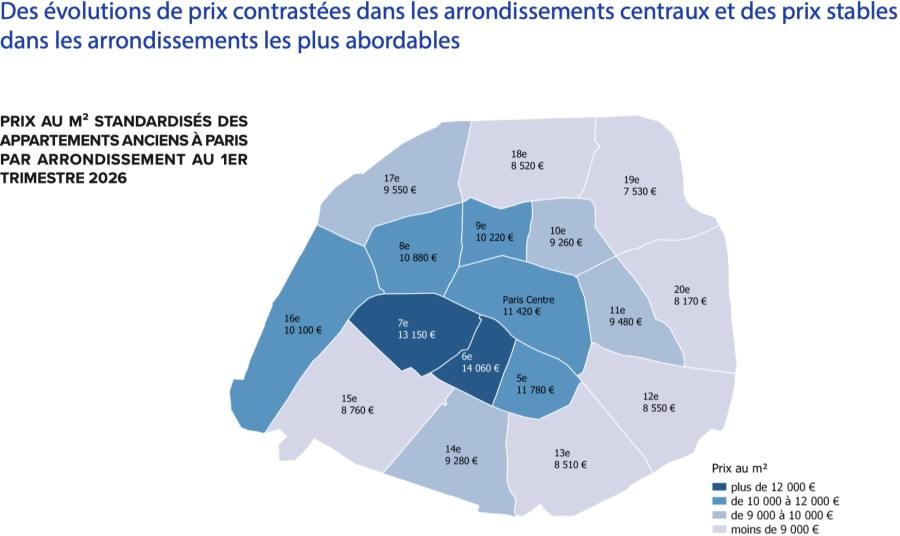
In Paris proper, the average price of an older apartment stood at €9,600 per square meter in the first quarter of 2026, up just one percent over one year and unchanged from the previous quarter. The notaires expect prices to remain around that level through June.
Screenshot
That number matters. For months now, Paris prices have hovered just under the psychologically important €10,000-per-square-meter mark. The great correction brought prices down from their peaks, but Paris has not collapsed. Nor should we expect it to. Paris is still Paris: limited supply, global demand, architectural beauty, historic neighborhoods, walkability, culture, transportation, cafés, schools, museums, parks, and that intangible quality we all know but cannot quite quantify.
But the market is no longer uniform.
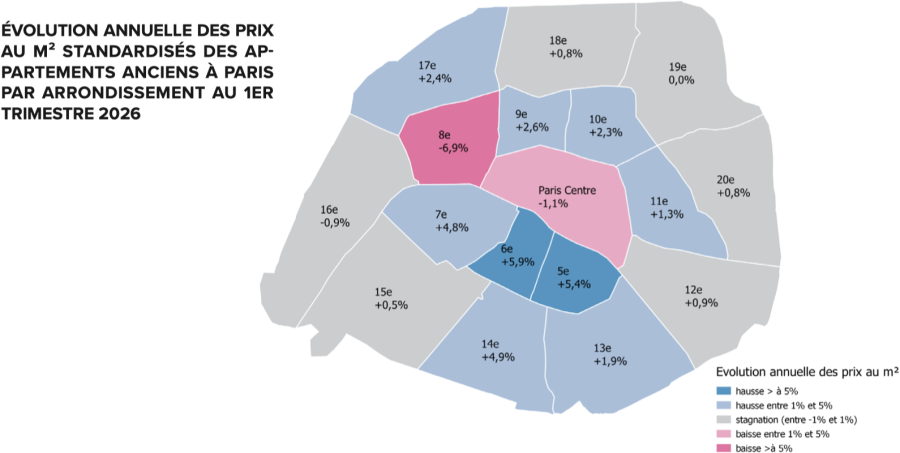
The 6th arrondissement remains the most expensive, at €14,060 per square meter, while the 19th is the most affordable at €7,530 per square meter. That means the 6th is nearly 1.9 times more expensive than the 19th. The annual price changes are just as revealing: the 6th rose by 5.9 percent, while the 8th fell by 6.9 percent.
In plain English: the Paris market is no longer moving as one. It is being fragmented by arrondissement, building quality, energy rating, floor, elevator, light, outdoor space, and whether the property is truly ready to live in.
THE BEST PROPERTIES STILL MOVE
This is the part of the market report that statistics cannot fully capture.
A mediocre apartment with a poor layout, a bad diagnostic de performance énergétique (DPE), a dark courtyard view, and an ambitious seller will sit. A beautiful apartment in a good building, with charm, light, an elevator, good diagnostics, and fair pricing, will still attract serious buyers.
The buyers may negotiate. They may take longer to decide. They may ask more questions. But they are there.
For North American buyers, this is important. The dream of Paris has not disappeared. What has changed is the market’s psychology. The frantic, post-pandemic energy has cooled. Buyers are more cautious. Financing is more difficult. Rental investment has slowed. The notaires even note that investment buying is largely absent from current transactions, with the market now resting mainly on purchases of primary residences.
That creates opportunity for lifestyle buyers—those looking for a pied-à-terre, a future retirement base, a family apartment, or a long-term foothold in France.
APARTMENTS ARE HOLDING BETTER THAN HOUSES
Across Île-de-France, apartment prices rose by one percent over one year, reaching €6,170 per square meter. Houses, by contrast, were essentially stable, down 0.4 percent, with an average price of €323,700.
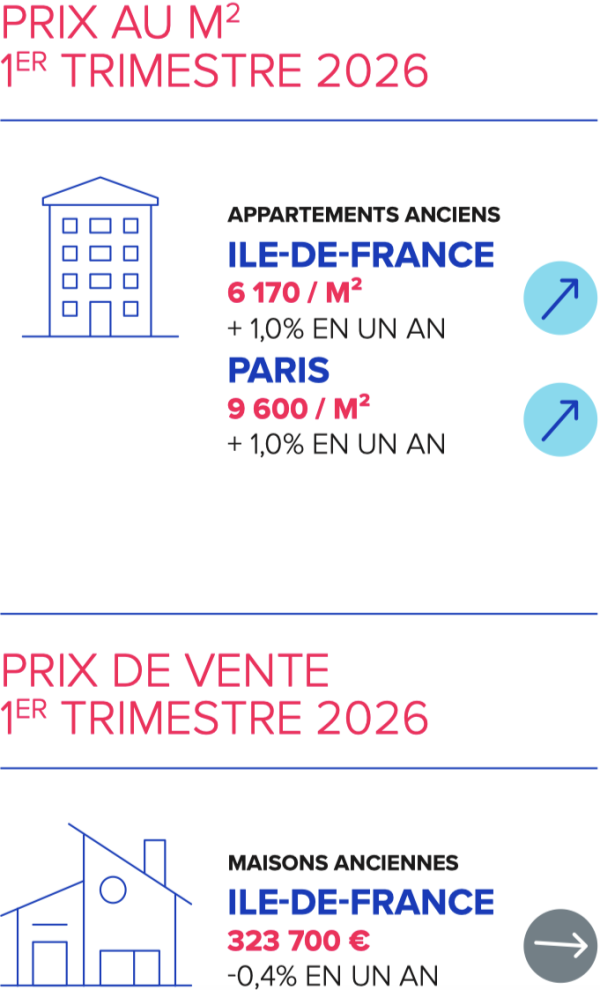
The volume story is also mixed. Apartment sales were down five percent region-wide, while house sales rose two percent. In Grande Couronne, house sales increased four percent, showing that buyers still have an appetite for more space farther out—especially where budgets stretch further.
But the outlook for houses is softer. The notaires’ projections from preliminary contracts suggest house prices could decline slightly in the second quarter, with variations by department. Apartments, especially in Paris, appear more stable.
This reinforces a pattern we have seen again and again: central Paris apartments, when well located and well presented, remain one of the most resilient segments of the French property market.
THE MARKET IS FRAGILE—AND THAT’S THE OPPORTUNITY
The notaires are cautious about the months ahead. They point to geopolitical tensions, economic uncertainty, the possible return of inflation, and the risk of rising interest rates. They now expect the market to remain slow at least until 2027.
That sounds gloomy, but from a buyer’s perspective, it may be exactly what creates room to breathe.
A slow market gives you time to think. It gives you time to compare. It gives you room to negotiate. It gives you the chance to do your homework properly—building, diagnostics, copropriété charges, renovation costs, rental rules, inheritance planning, financing, and currency strategy.
But slow does not mean asleep.
The best properties will not wait forever. And when the broader market finally turns, the window for calm decision-making may close quickly.
WHAT THIS MEANS FOR BUYERS
For buyers, this is not the time to be timid—but it is the time to be disciplined.
Know your budget. Know your neighborhood. Know whether you are buying for lifestyle, rental, legacy, retirement, or all of the above. Be ready with your financing, currency plan, notaire, and advisory team. In a market like this, hesitation can cost you the right property, while over-enthusiasm can cost you money.
Paris is not on sale. But Paris is negotiable again.
And that is something we haven’t been able to say for quite a while.
WHAT THIS MEANS FOR SELLERS
For sellers, the message is equally clear: price correctly or prepare to wait.
The days of aspirational pricing are over. Buyers are informed. They are cautious. They compare. They calculate renovation costs. They read diagnostics. They understand that financing conditions matter. A property priced as if it were still 2021 will struggle.
But a well-priced, well-presented property can still succeed—especially in Paris.
The market has not disappeared. It has simply become more selective.
THE BOTTOM LINE
The first quarter of 2026 confirms what many of us on the ground have already felt: the market is stabilizing, but without real momentum. Prices are no longer tumbling. Sales volumes are no longer collapsing. Paris remains resilient. But uncertainty continues to weigh on buyers, sellers, and investors alike.
For those who love Paris, this is not discouraging. Quite the opposite. It is a reminder that real estate here is not a short-term game. It is about patience, timing, discernment, and above all, choosing well. Because in Paris, the right property is never just a square-meter price. It is a life.
Let us help you construct that new life in Paris (or anywhere in France). Visit us https://adrianleeds.com/contact-us/ to learn how.
Download the full PDF report (in French).
A bientôt,
 Adrian Leeds
The Adrian Leeds Group®
P.S. Talk to us to discuss whether to rent or buy? It’s a conversation we have almost daily with our clients. Buying, at least for now, isn’t always the answer, but don’t be afraid of buying property. I’ve never regretted any of it, even if I am the Poster Child for property problems! Contact us to learn more and book your personal consultation today.
1 Comment
Leave a Comment

Let Us create a custom strategy for you
You can live or invest in France-now.
Property for sale
what's happening
Check out upcoming events, conferences, or webinars. Join us!
GET FINANCING
Learn about French Property Loan Information.

Read & Subscribe
Dive into more by reading the Adrian Leeds Nouvellettre®
Better yet, subscribe to both and get the updates delivered to your inbox.

Get started with your dream of owning property in Paris.
Join us on Youtube
Dive into more on how to live, invest & escape to France
Be sure to subscribe!
To read more, click the links below.
Bonjour Adrian!
Do you see “bargain” arrondissements emerging? In other words, arrondissements that are undervalued in terms of their lifestyle (the intrinsic, intangibles, and qualitative factors) compared to the quantifiable cost/sqm? For instance, Central Paris dropping 1.1%, is that a bargain? How about 8e dropping 6.9%? Are there reasons for the steep drop that translate to lifestyle? I hope to make the transition someday soon!
– Tai