


Weekly insights about property in France!
Subscribe and don't miss an issue!
Paris in the Middle Ages: Some Things Haven’t
Volume XI, Issue 7

|
|
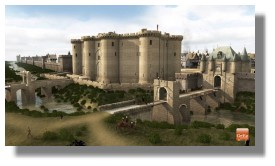
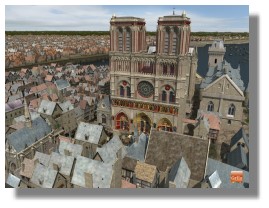
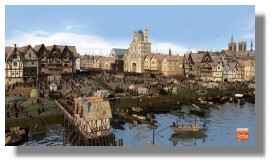
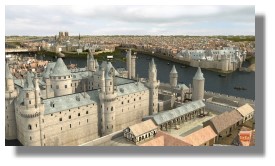
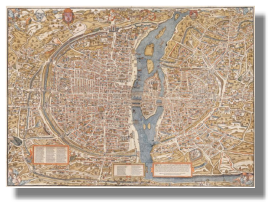
Wouldn’t you love to revisit Paris during the Middle Ages, long before Haussmann tore down 20,000 buildings, when the Ile Saint-Louis was just a cow pasture? Well, Grez Productions has done just that — giving us a guided walk in the heart of Paris — the Ile de la Cité and its surroundings in the year 1550, just as it was during the reign of Henry II — before the great Renaissance. In a purchasable DVD, Grez Productions shows you a view of Paris that has almost entirely disappeared. The history of the monuments and places we know today is traced and discussed. (Purchase the DVD)
According to parisrama.com, the city became the largest in France throughout the Middle Ages, but Lyon was the administrative capital under the Roman rule. It evolved on the three major sites we know today: the Ile de la Cité, the Right Bank and the Left Bank. The Philippe-Auguste wall confined the three sites and later in Medieval Paris, the city oscillated between the two banks. The Romans preferred the Left Bank. Then a major port developed on the Right Bank. In the 13th- century, the University of Paris re-established the Left Bank and by the year 1500, the two banks were more in balance.
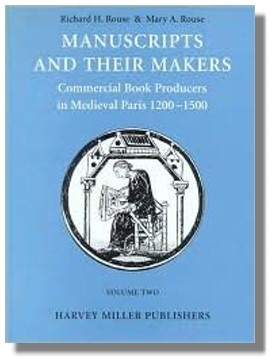
Researching Paris in the Middle Ages also uncovered that Paris was the undisputed center for commercial manuscript production in Northern Europe at that time and, much like it is today, was home to a great number of scribes, illuminators, bookbinders, parchment, paper sellers, etc. Manuscripts and Their Makers: Commercial Book Producers in Medieval Paris, 1200-1500 by Richard H. and Mary Rouse is a book that focuses on this period of literature in Paris’ history. (Sound familiar? Things haven’t changed all that much!)
In Simone Roux’s Paris in the Middle Ages, it is said that Philippe-Auguste ‘willed’ Paris into existence, turning it into the first rate town it became. Vineyards were uprooted to make way for houses and the kings and lords subdivided their properties into housing units, vigilantly maintaining control over their real estate. Residents were ordered to pave their streets, but that took decades as landowners weren’t always willing. Newer houses were cheaper than older ones, creating mixed neighborhoods. (Sound familiar? Seems like in hundreds of years, things haven’t changed all that much in this arena, either!)
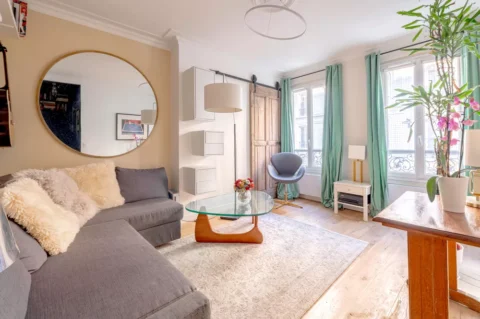
Rue Pavée in the 4th district was one of the first streets in the Capital to be paved. In 1235, the area between the rue du Roi-de-Sicile and the rue des Francs-Bourgeois was called the “rue du Petit-Marivaux.” Renamed in 1406 “rue du Petit Marais” and “rue Marivaux,” its name was replaced in 1450 by “rue Pavée-au-Marais” and then “rue Pavée.” The street was extended in 1838 to the “old rue Saint-Antoine,” and was later shortened during the construction in 1854 of the Rue de Rivoli. Coincidentally, one of our Parler Paris Apartments is situated at this very spot — “Au Vieux Paris” — available for long term rental.
For those interested in old maps, mark your calendars for Saturday, November 9th, 2013 for the 12th edition of the Paris Map-Fair at the Hotel Ambassador (16, Bd Haussmann, 75009 Paris) where you will find 37 International map dealers from France, England, The Netherlands, Belgium, Germany, USA, Spain, Austria, Italy offering thousands of maps, atlases, views and globes.
A bientôt,
 Adrian Leeds
Director of The Adrian Leeds Group, LLC
Respond to Adrian: [email protected]

P.S. Now you can own two shares of the luxurious two-bedroom fractional ownership apartment Le Palace des Vosges at a special price. The cost of two shares is normally 295,800€, but if you and your friends or relatives want to purchase two in tandem, you will pay a total of 289,000€ — that’s a savings of 6,800€! There are only three shares left so don’t wait — visit Le Palace de Vosges for more information or contact us now at [email protected].
P.P.S We have been making some updates to our Web site and the system through which we produce and send our newsletters. This has caused some delay in delivery of French Property Insider this week. Please accept our apologies if your newsletter arrives later than normal. All should be back on schedule next week!

Let Us create a custom strategy for you
You can live or invest in France-now.
Property for sale
what's happening
Check out upcoming events, conferences, or webinars. Join us!
GET FINANCING
Learn about French Property Loan Information.

Read & Subscribe
Dive into more by reading the Adrian Leeds Nouvellettre®
Better yet, subscribe to both and get the updates delivered to your inbox.

Get started with your dream of owning property in Paris.
Join us on Youtube
Dive into more on how to live, invest & escape to France
Be sure to subscribe!
To read more, click the links below.