


Weekly insights about property in France!
Subscribe and don't miss an issue!
The 'Allure' of ALUR and the Higher Price of a Purchase
Volume XII, Issue 8

AN UPDATE ON ALUR
 Everyone wants to know what’s going on in France regarding the Loi ALUR — (lAccès au Logement et à un Urbanisme Rénové). The bill indicates that the short-term rental of your primary residence is permitted, as long as you follow some basic rules including written agreement from the owner (if you are the tenant). It also affects short-term rental of secondary residences, mostly applied to the country’s larger cities.
The bill is currently being considered by the National Assembly and the Senate. According to some sources, 20% of all dwellings are rented furnished in France. Furnished rentals are not only more profitable for the landlord than unfurnished rentals (higher rents), but are less vulnerable to troublesome tenants (squatting and other nuisances). A furnished lease of one year is more flexible for the tenant, allowing for a one-month cancellation compared to a 90-day cancellation attached to an unfurnished rental which carries a three-year lease.
In larger cities, the short term rental of a secondary residence will be permitted. Cities will not have the authority to ban short-term rental of these properties, but they will be able to define specific compliance criteria and require a change of usage designation for the property, as a commercial property. The cities affected are those over 50,000 population and where there is a marked imbalance between supply and demand for housing…such as in Paris.
The bill attempts to control increases in rents upon re-letting a property. A property may not increase in rent to a new tenant higher than the “IRL” or legal benchmark, unless substantial work has been performed on the property. This has already had an impact on the market as rents rose less by percentage in 2012 and 2013 than in previous years.
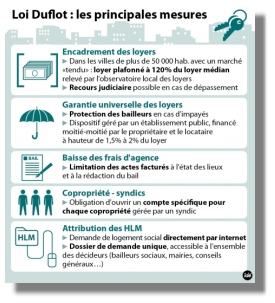 For new leases, the rent cannot exceed the cap of 20% over the median benchmark (except for exceptional rental services and major work). Upon renewal of a lease, the rent may be adjusted up or down, to the median benchmark imposed by the IRL. The benchmark rents will be calculated from information gathered by rental statistics taken from the entire stock of housing (the “market”). The “market” rent is about 105 euro above the average rent, which is already above the median rent.
Forecasters say these measures will further reduce rents as more comply with the measures and there is greater transparency. In 2012, 390,000 residences in Paris were rented, of which 94,000 rented higher than the adjusted median rent — 3.7 euros per square meter more. Thirty-two thousand have rents more than 30% below the median benchmark — 2.4 euros per square meter less. Reductions in rent will therefore average 4% to 6% depending on the location and type of housing, bringing rent levels to those recorded in 2010.
But adjustments in rent will take time and conflicts between landlord and
tenant are sure to evolve. The average rent for housing occupied more than 10 years by the same tenant is already 20% lower than the average. Landlords will be penalized by sedentary tenants and restrictions that will control potential rent increases. In contrast, tenants who have lived in their homes a long time might see significant increases to their rents.
It is noted that only construction of housing in areas where the housing shortage is acute will solve the problems of the market. Rent control is merely a temporary measure, and it’s not enough.
NEWS ON TRANSFER TAX INCREASES
 It’s going to cost a bit more between March 1, 2014 through February 29, 2016 to purchase a property, thanks to the Finance Act of 2014 (Act No. 2013-1278 of December 29, 2013). The taxes for land registration and registration fees will increase from 3.8% to 4.5%, although the increase must be approved by the department and after that date, reduced back.
In real terms, the additional cost on a property in Paris purchased for 500,000 will cost an additional 3,600. Notary fees, however, will not change.
A bientôt,
 Adrian Leeds
Editor, French Property Insider & Director of The Adrian Leeds Group, LLC
Email: [email protected]

P.S. Over the next two weeks I’ll be writing you from first New York and then “La Nouvelle Orléans” — where I will be exploring real estate in these two U.S. cities for investment compared to Paris and Nice! Doesn’t it make sense to have investments in all four? That’s what I intend to find out!
P.P.S. There is only one share left at Le Palace des Vosges, the outstanding fractional ownership property at the best address in Paris, Place des Vosges — and once it’s gone, it’s gone! Don’t be disappointed…the final share is only 147,900. For more information visit Le Palace des Vosges or email [email protected].

Let Us create a custom strategy for you
You can live or invest in France-now.
Property for sale
what's happening
Check out upcoming events, conferences, or webinars. Join us!
GET FINANCING
Learn about French Property Loan Information.

Read & Subscribe
Dive into more by reading the Adrian Leeds Nouvellettre®
Better yet, subscribe to both and get the updates delivered to your inbox.

Get started with your dream of owning property in Paris.
Join us on Youtube
Dive into more on how to live, invest & escape to France
Be sure to subscribe!
To read more, click the links below.