


Weekly insights about property in France!
Subscribe and don't miss an issue!
You Don’t Choose the Apartment…the Landlord Chooses You
Volume XXIV, Issue 13

By Jay Corless, Edited by Adrian Leeds
If you’ve ever tried to rent an apartment in Paris or Nice as a foreigner, you’ve likely experienced a particular kind of frustration—one that feels both puzzling and, at times, deeply personal. You may have a strong financial profile, substantial savings, or even the ability to pay rent well in advance, and yet your application seems to go nowhere. Emails go unanswered, dossiers are declined without explanation, and apartments disappear almost as quickly as they appear.
It’s easy to assume that something must be missing from your profile. But in reality, the difficulty has very little to do with you as an individual. Instead, it lies in the way the French rental system is designed—and in how differently it defines what makes a “good” tenant.
Paris for all its charm and elegance, is one of the most competitive rental markets in the world. Demand consistently exceeds supply, particularly in the neighborhoods most sought after by international clients: the Left Bank, the historic Marais, and the lively yet increasingly popular areas of the 11th and 12th arrondissements. According to market overviews, it is common for a single rental listing to receive dozens of applications within days.
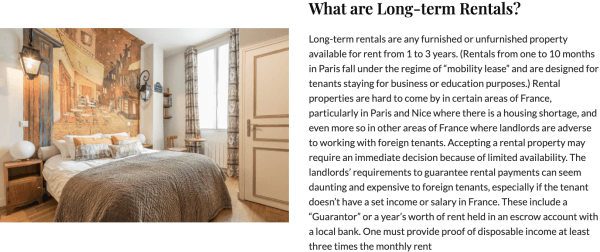
Nice is just as competitive as Paris, if not more. In such an environment, landlords are under no pressure to take risks. Quite the opposite, they are in a position to be exceptionally selective. And this is where the disconnect begins.
In North America, landlords tend to look at the broader financial picture. They consider your assets, your creditworthiness, your overall ability to pay. In France, however, the evaluation is far more structured—and far more rigid. The ideal tenant, from a French perspective, is someone who fits neatly within a very specific framework: employed in France, on a permanent contract (CDI), earning at least three times the monthly rent, and supported by a guarantor based in the country.
This model works well for local tenants, but it immediately excludes many expats, even those with significant means. A retired executive living off investments, a consultant earning income abroad, or a couple with substantial savings but no French employment contract may all appear “strong” in one system and “uncertain” in another.
Layered on top of this is a factor that many expats don’t initially realize is so influential: insurance. A large number of landlords in France rely on what is known as “garantie loyers impayés,” or unpaid rent insurance. This coverage provides security in the event that a tenant fails to pay, but it comes with strict conditions. Typically, it requires that the tenant’s income be earned in France and supported by local documentation.
If those criteria are not met, the insurance may not apply. For the landlord, this creates a simple calculation. Without insurance, they bear the full risk. And given the strong protections afforded to tenants under French law, including eviction protections and procedural timelines, that risk is not insignificant.
Then there is the matter of the guarantor. In France, the guarantor (caution) is not just a formality, it is a cornerstone of the rental process. This is the person who agrees to cover the rent if the tenant cannot. For French applicants, this is often straightforward. For expats, it can be a major obstacle.
Foreign guarantors are frequently viewed as difficult to enforce, and cross-border legal action is rarely appealing. While private guarantor services such as Garantme.fr have emerged to bridge this gap, not all landlords are comfortable relying on them, and some remain unfamiliar with how they work.
Even when these hurdles can be addressed, the process itself presents another challenge: the dossier. Renting in Paris or Nice is not a casual affair. It is, in many ways, closer to applying for a loan. A complete dossier may include identification, tax returns, pay slips, bank statements, employment contracts, and detailed information about any guarantor.

And it must be presented quickly—often immediately following a viewing.
For expats, assembling a dossier that aligns with French expectations can be surprisingly complex. Documents may need to be translated, financial situations may require explanation, and what seems perfectly clear in one context may not translate easily into another. In a competitive environment, simplicity and familiarity often carry more weight than complexity and nuance.
Timing, too, plays a decisive role. Apartments in Paris and Nice move quickly—sometimes within a matter of days. Being physically present, able to visit on short notice and submit a complete dossier without delay, can make all the difference.
All of this is reinforced by the broader legal framework. French rental laws, particularly those governing primary residences under the Loi Alur, are designed to protect tenants and regulate rents in many urban areas. Once a lease is signed, it can be difficult for a landlord to regain possession of the property.
This is an important safeguard, but it also means that landlords approach the selection process with a high degree of caution. They are not simply choosing a tenant, they are entering into a long-term commitment with limited flexibility.
Seen through this lens, the challenges faced by expats begin to make more sense. The issue is not one of desirability, but of compatibility. The French system is built around a particular definition of stability, and expats, by their very nature, often fall outside of it.
And yet, this does not mean that securing an apartment in Paris or Nice is out of reach. Far from it. What it requires is an understanding of the system and a willingness to adapt to its expectations. Presenting a clear, well-structured dossier, using recognized guarantor solutions, and, when appropriate, considering alternative lease structures can all make a meaningful difference.
In the end, the rental market is not as opaque as it first appears. It simply operates according to its own logic, one that places a premium on predictability and reassurance.
For expats, the challenge is learning how to speak that language. Fortunately, we’re here, to not only translate, but give you the edge to be at the top of the desirable list. Our representation gives you the clout you need to bypass all the others. And our agent is working daily with those holding the keys to find and secure the best properties available in the cities.
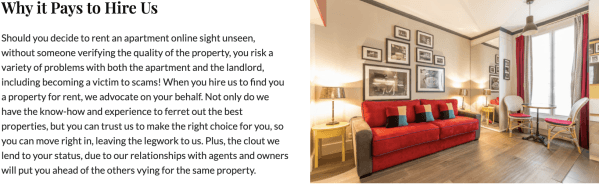
So, when you see all those Facebook posts and other social media outlets complaining about how difficult it is to find an apartment to rent in France, it’s a big clue they tried to do the job on their own. But, with us leading the search and making contact with the landlords and owners, the process becomes not only manageable, but ultimately rewarding.
And when you finally receive the keys to your Paris or Nice apartment, you’ll know that you’ve got more than just a secure place to live, you’ve successfully navigated one of the most complex rental markets in the world.
A bientôt,
 Adrian Leeds
The Adrian Leeds Group®
P.S. To learn more about our rental apartment search services, visit our website. Our expert consultants in both cities are at your service!

Let Us create a custom strategy for you
You can live or invest in France-now.
Property for sale


what's happening
Check out upcoming events, conferences, or webinars. Join us!
GET FINANCING
Learn about French Property Loan Information.

Read & Subscribe
Dive into more by reading the Adrian Leeds Nouvellettre®
Better yet, subscribe to both and get the updates delivered to your inbox.

Get started with your dream of owning property in Paris.
Join us on Youtube
Dive into more on how to live, invest & escape to France
Be sure to subscribe!
To read more, click the links below.