
Adrian Leeds Nouvellettre®
Your taste of life in France!
Subscribe and don't miss an issue!
Filming in Lyon, Living in Lyon
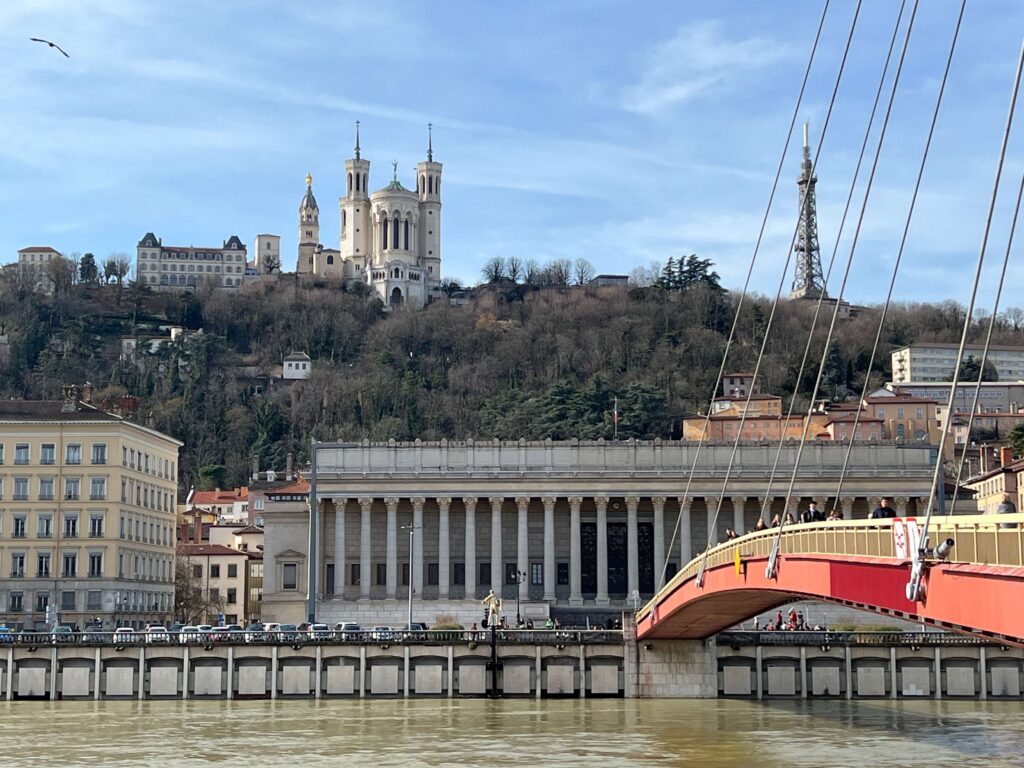
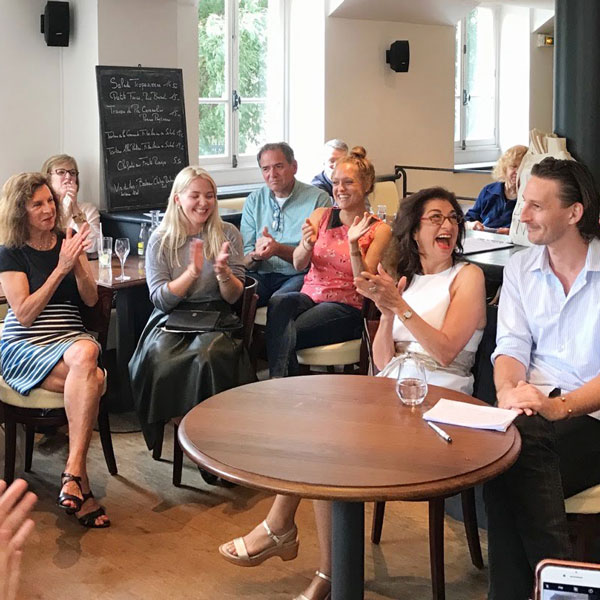
If you’re reading our Nouvellettres®, then you already know I spent four days in Lyon filming a House Hunters International episode this past week. To get to know Lyon a better, I invited readers to join me at a local café for a drink and a conversation the day before the shoot began.
A few people showed up, including two French women who couldn’t wait to tell us all about “their” Lyon. And during our gathering, a couple from the US came up to the table who recognized me from the TV show. They just happened to be visiting Lyon from Strasbourg to where they had moved about six months ago. Meanwhile, the director of the show came to witness the event and take a few videos, in case something particularly interesting happened, worth using on the show.
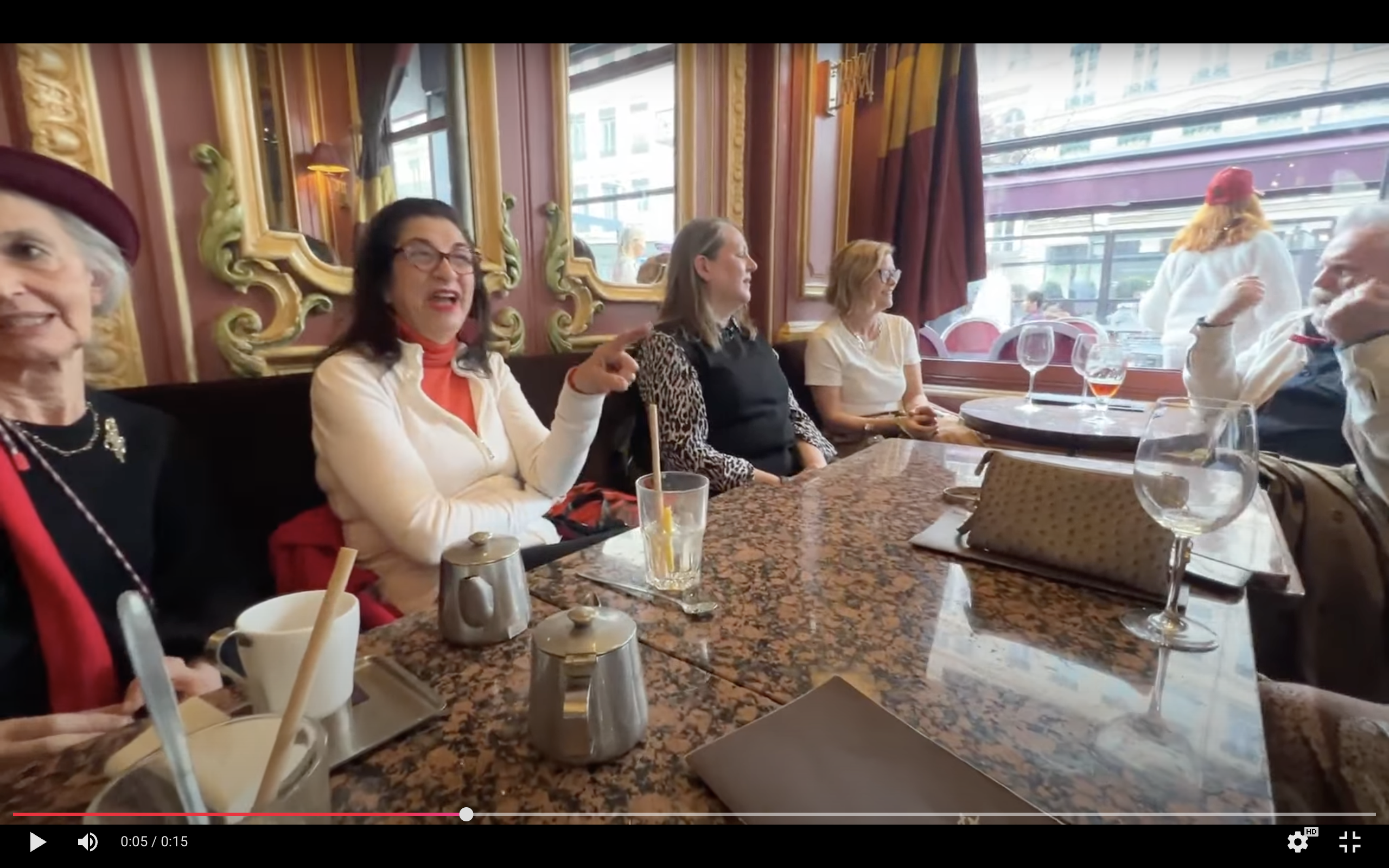
Meeting up with Americans and French residents and visitors of Lyon
I learned a lot, not only about the city, but about expat life from people who were experiencing it first hand. These were all adventuresome people who were having the time of their lives acclimating to a very new and different way of living. They noted that it’s not for everyone—they remarked that some people come stuck in their American default mode and complain when things don’t work the way they did Stateside…and those were the few that wouldn’t last long.
I fully agreed. Having consulted with thousands of North Americans wanting to make the move over the last 20-something years, the red flags go up pretty quickly to spot the very few who might have a tough time crossing the cultural divide. There aren’t too many.
The contributor to the show, Leah, a young woman from Texas who has lived in many places around the globe, explained that Lyon came onto her radar thanks to her “Astrocartography” chart!
I’d never heard of it. As it turns out, Astrocartography is a branch of astrology that maps your birth chart onto the world map to show where different planetary energies are strongest for you geographically. Based on your birth data, it’s a strategic (not mystical, but interpretive) look at where you would likely feel most aligned for living, not just visiting. It was developed in the 1970s by astrologer Jim Lewis, who trademarked the system.
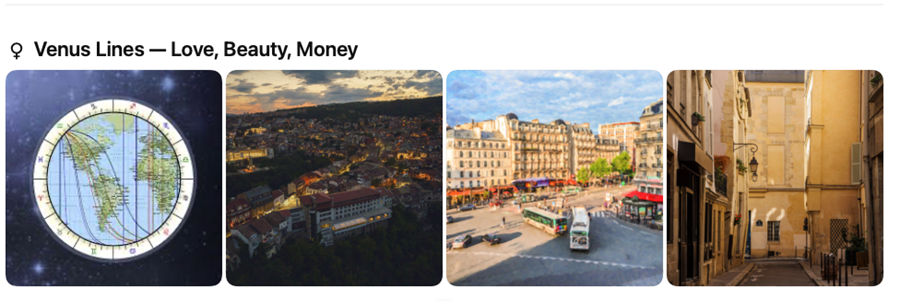
I tried it myself. All you need to know is where you were born, what date and what time. And for me, it was spot on! It was shocking, actually. I asked Chat GPT to do the chart: “Where is the BEST place for me to live long-term?”
From a harmony + identity + lifestyle standpoint, this is what it told me:
1) Nice/Côte d’Azur – Best for lifestyle harmony
2) Paris – Best for authority, legacy, and brand expansion
3) Northern Italy – Best for beauty and emotional fulfillment
4) California Coast – Reinvention Energy
“Interestingly…your lived choices already align strongly with your chart.”
The only place I haven’t lived on the list is Northern Italy, but I wouldn’t mind!
So, perhaps Leah’s choice of Lyon is spot on, too. During the three days of filming, I really learned a lot about Lyon and had a chance to see much of the city—at least the most important, most central parts. Getting the lay of the land isn’t too difficult once you understand how the two rivers run through the town north to south and merge at the southern end of the city—Le Rhône (masculine) and La Saône (feminine).
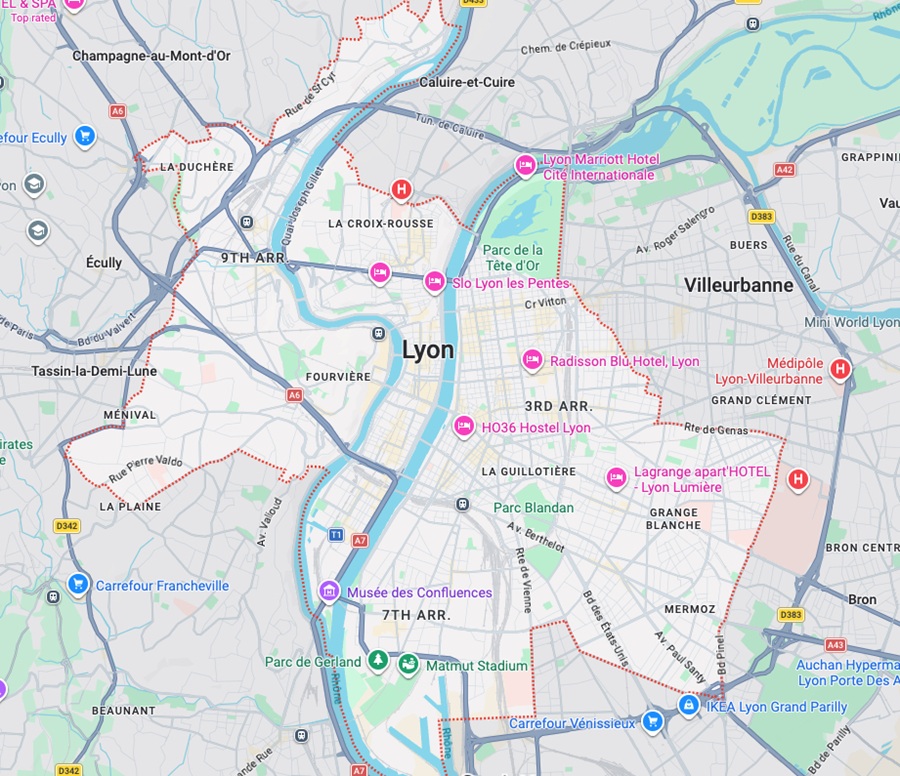
Screenshot
The reason for these gender differences is because the name Rhône comes from the Latin Rhodanus, which was masculine. The Saône has a more complicated evolution—the ancient name was Arar (Latin), but shifted phonetically and regionally and in French usage it became feminine because of how speakers naturally integrated the word into French patterns.
Go figure. It’s French and in a weird way, logical. These are some of the the nuances of the French language and France that fascinate me.
Long before Lyon became France’s gastronomic capital or a crossroads of modern Europe, it was “Lugdunum”—the capital of Roman Gaul. Founded in 43 BCE by the Roman consul Lucius Munatius Plancus, the city rose strategically at the meeting of the rivers. It became the administrative and commercial heart of Gaul, complete with aqueducts, forums, baths, and grand theaters—the very ruins you can still walk through on Fourvière Hill. Even the Roman Emperor Claudius was born here, a reminder that Lyon’s importance predates Paris by centuries. When I say Lyon has gravitas, I mean it quite literally—its roots are imperial. That sense of authority, culture, and strategic significance isn’t new; it’s been woven into the fabric of the city for more than two thousand years.
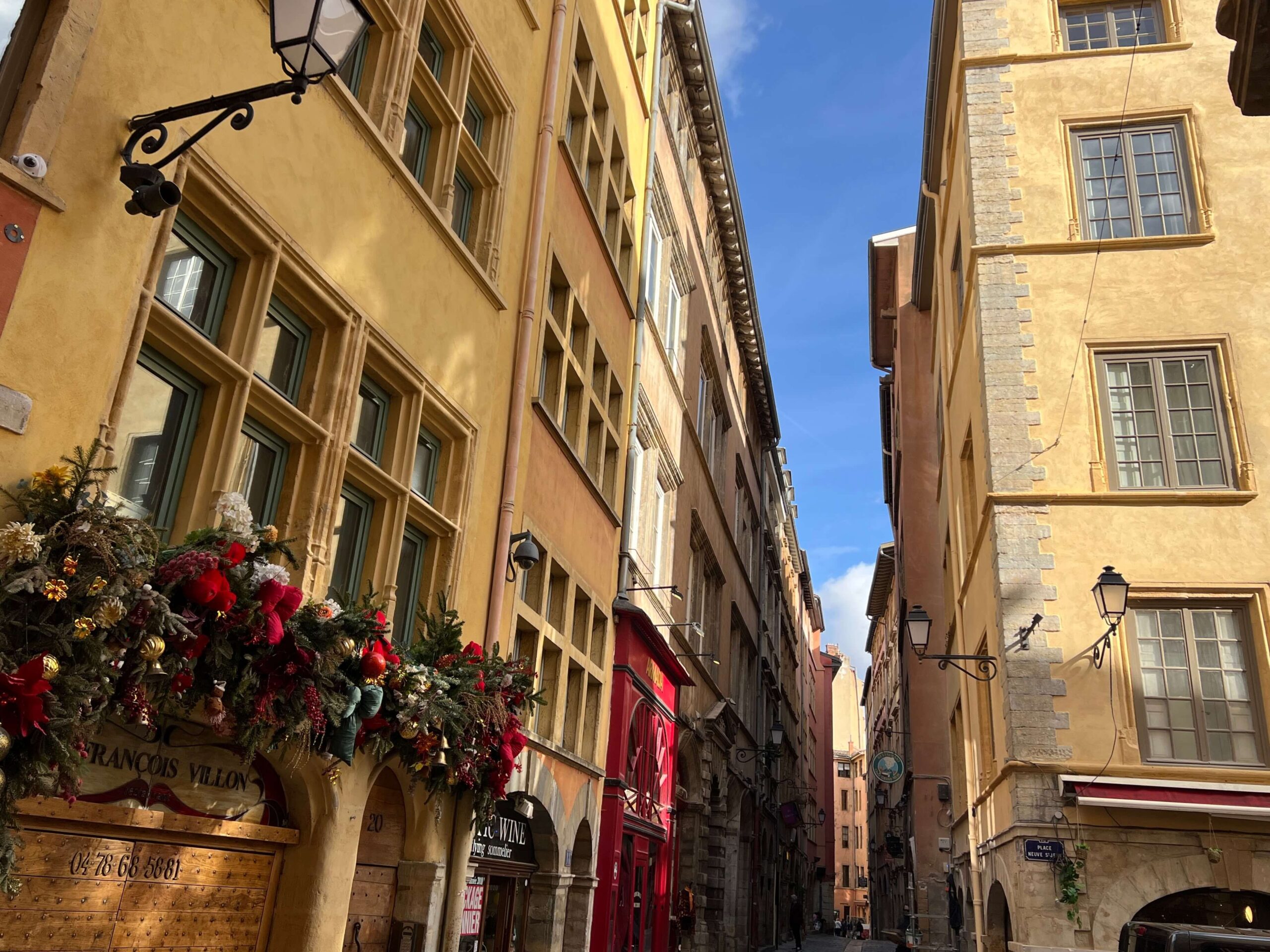
Vieux Lyon
This makes Lyon one of the most “French” cities in France, if you know what I mean by that. The cities that border other countries derive much of their personalities by their neighboring countries. Strasbourg is Germanesque. Lille is Belgianish. Nice is Italiano. You get the point. Those cities have been influenced by their borders, but, Lyon is La France with a Capital F.
The area between the two rivers is the “2nd Arrondissement” known as Presqu’île and Confluence—Lyon’s “downtown.” Publicity calls the building style here “Haussmannian,” but it’s not, in my opinion. So much publicity about Lyon compares it to Paris, but that’s what I discovered most of all. It’s not at all like Paris. The buildings are not Haussmannian. Lyon is Lyon and is very much its own city. Its history is profound and centuries old making it very unique.
Some of the highlights of our touring Lyon included La Fresque des Lyonnais—one of the city’s most iconic visual statements. It is a monumental “trompe-l’œil” mural painted on the side of a building at the corner of 49 quai Saint-Vincent and 2 rue de la Martinière, near the Saône River. It covers about 800 square meters (8,600+ square feet) and transforms a once-blank façade into a theatrical tableau of Lyon’s history. The mural was painted between 1994 and 1995 by the Lyon-based artists’ cooperative CitéCréation, a group internationally known for large-scale urban murals. It was commissioned as part of a city initiative to beautify blank walls and celebrate Lyon’s cultural identity.
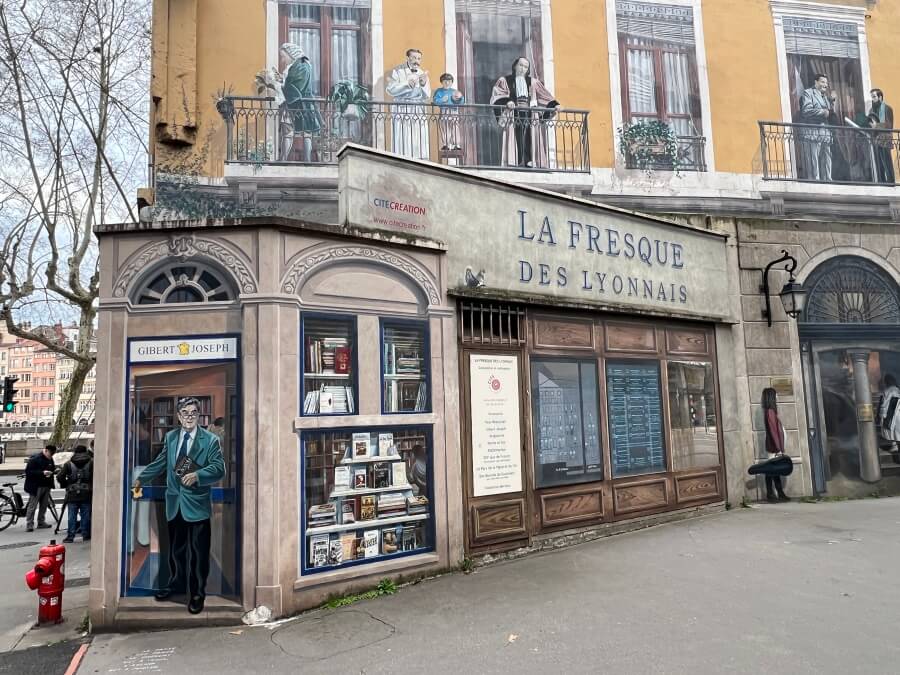
The fresco depicts about 30 famous Lyonnais figures standing on painted balconies, in windows, and on staircases—blending seamlessly with the building’s architecture. Among the recognizable faces are Paul Bocuse—legendary chef and ambassador of Lyonnaise gastronomy, Antoine de Saint-Exupéry—author of The Little Prince and Auguste Lumière and Louis Lumière—inventors of early motion picture technology. The effect is remarkably realistic—the figures appear to inhabit the building, leaning on railings and interacting across floors.
To get a bird’s eye view of the city, we ventured up to the Basilique Notre-Dame de Fourvière perched high above Lyon on the Fourvière hill. This dramatic white basilica is the city’s most recognizable landmark. From almost anywhere in Lyon, you can look up and see it watching over the rooftops—and that’s exactly the point.
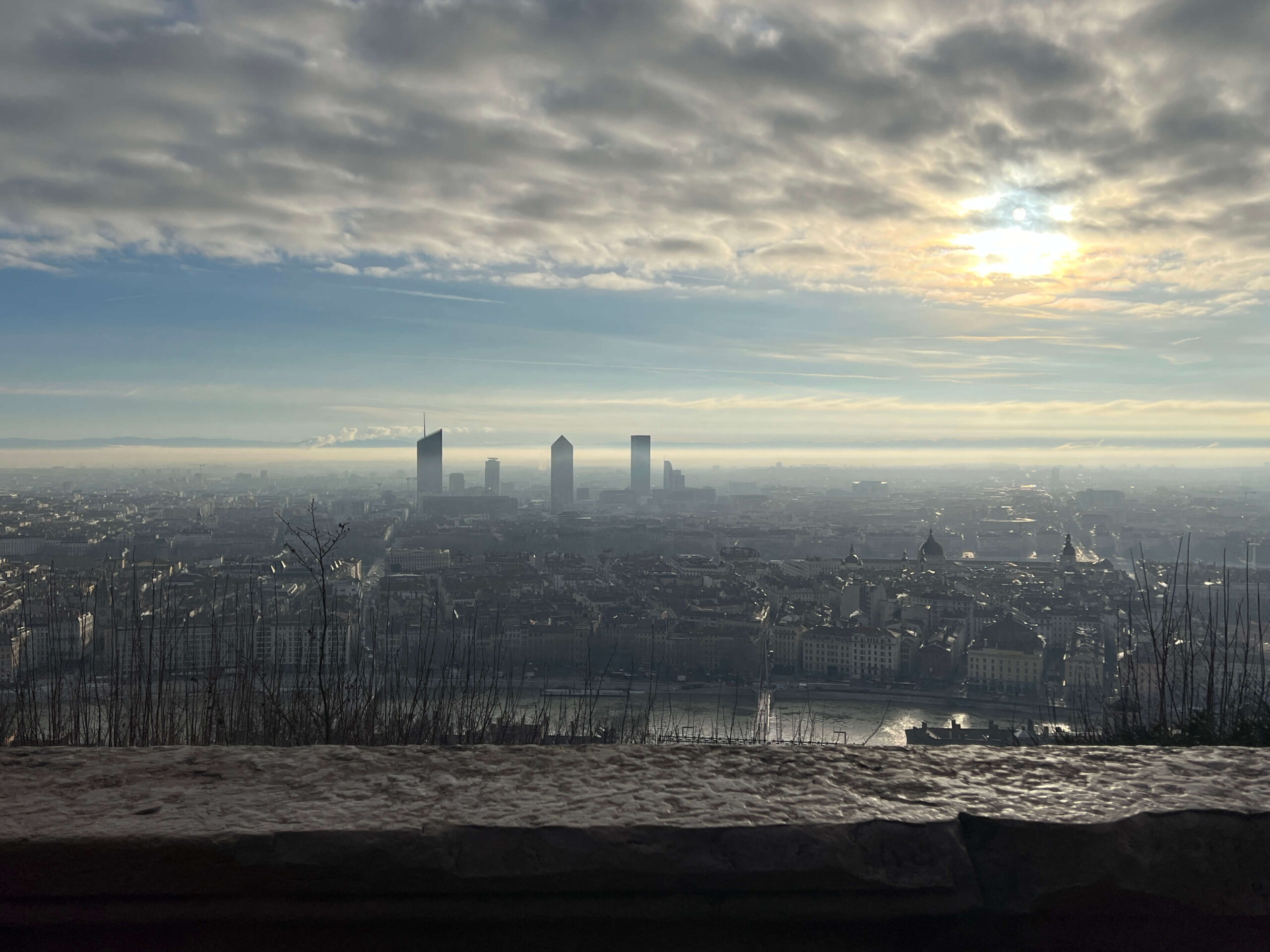
A view of Lyon from the Fourvière
It’s not as old as one might think—constructed between 1872 and 1884, in the aftermath of the Franco-Prussian War as a symbol of gratitude and protection—a very visible statement of faith overlooking the city. From the esplanade you get one of France’s great urban panoramas: the Saône winding below, the Presqu’île between the rivers and even the Alps faintly visible on very clear days. It’s the view that could make you fall in love with Lyon. Take the funicular from Vieux Lyon that is so charming and easy, like we did.
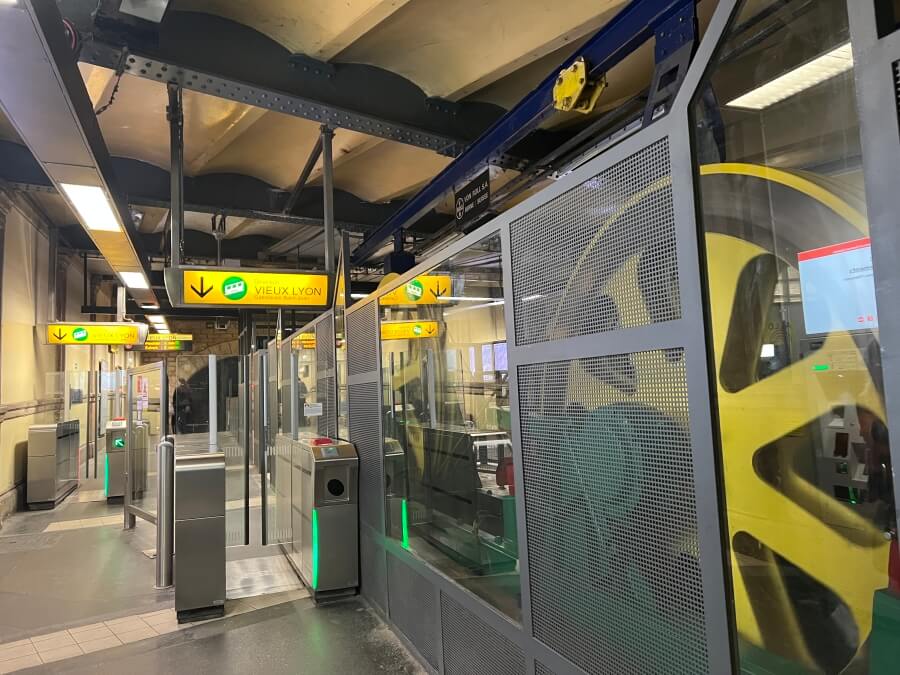
The funicular to Fourvière
Lyon has the largest, most famous, and best-preserved network of “traboules” in the world. That was a new word for me. A traboule is a hidden passageway that cuts through buildings, connecting one street to another—often via courtyards, staircases, and interior corridors. The word comes from the Latin transambulare—“to pass through.” They were practical shortcuts long before they were romantic. Lyon has an estimated 400+ with about 40 open to the public. You find them in Vieux Lyon (Renaissance-era) and the Croix-Rousse (19th-century silk workers’ district).
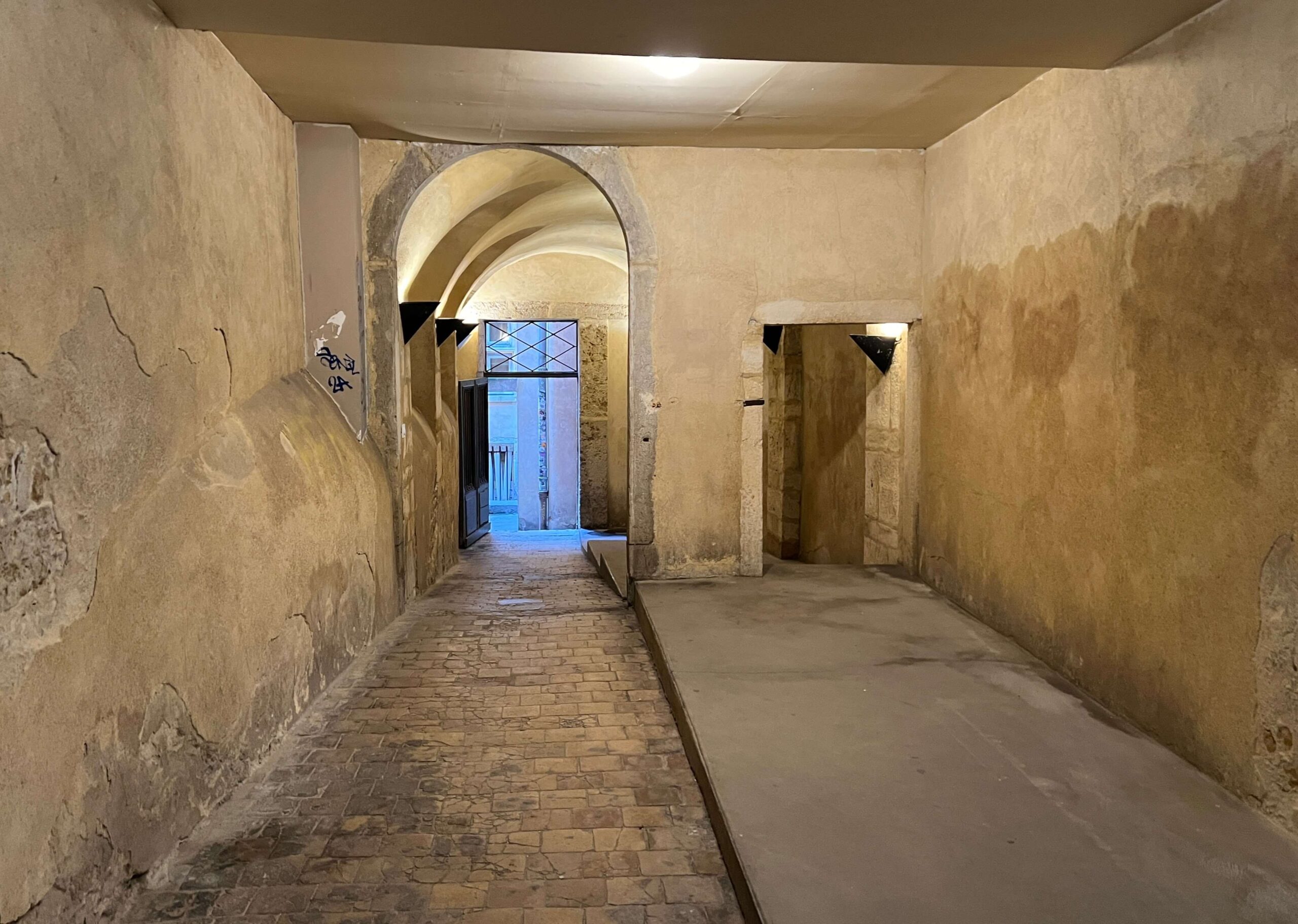
A view inside a traboule
The reasons they exist are because for the silk trade (canuts), the workers used them to transport delicate fabric from workshops down to the Saône without exposing it to rain. During World War II, the French Resistance used them to evade the Gestapo because Lyon was a major Resistance hub. And for geographical reasons, the steep hill between Croix-Rousse and the river made shortcut passages practical.
We ventured into one called The Long Traboule that links rue Saint-Jean and rue du Boeuf, winding its way through the buildings, allowing for entrances and even elevators to the upper floors. Entering immediately gives one the feeling of the centuries past and how there might have been quite a lot of traffic within their walls at one time.
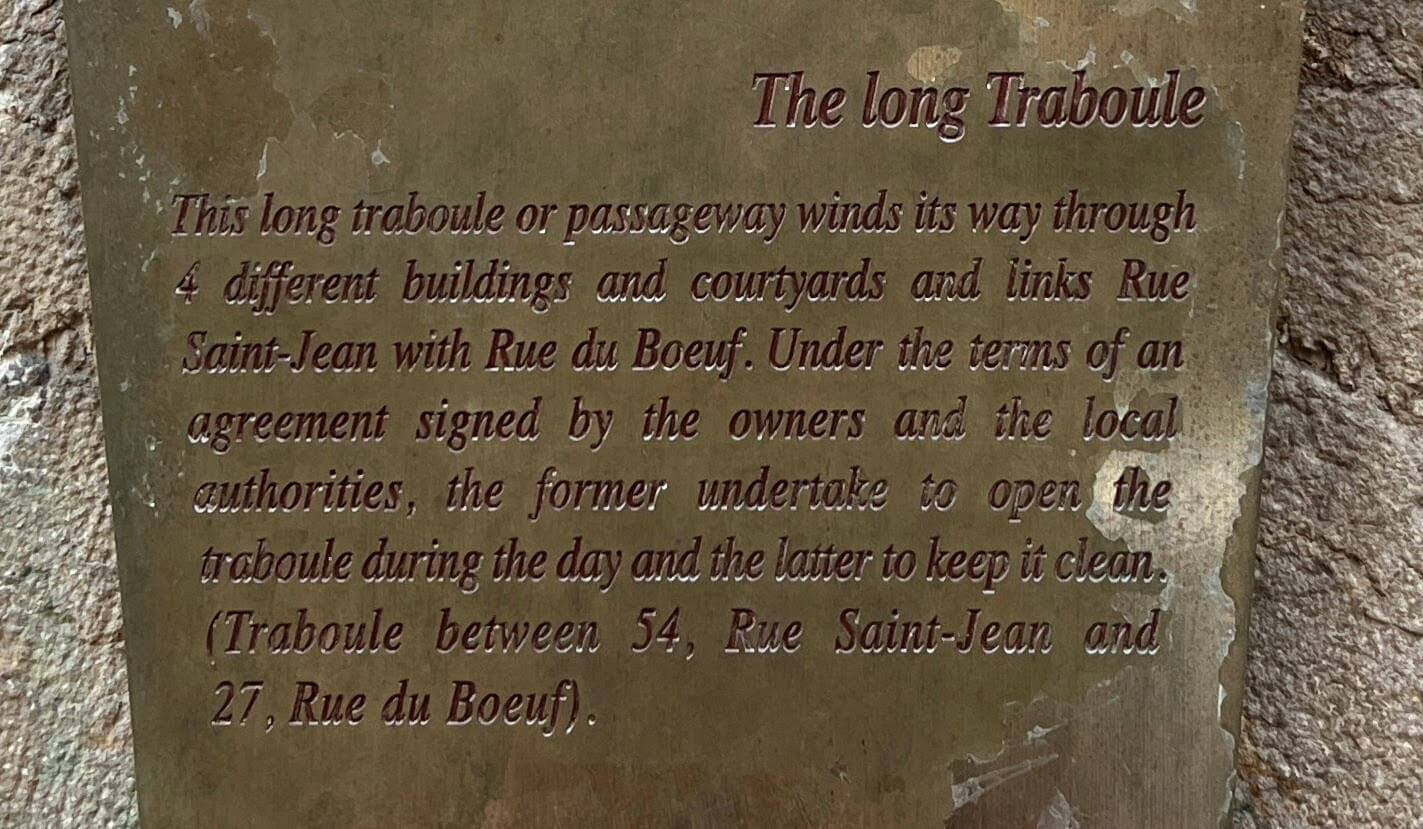
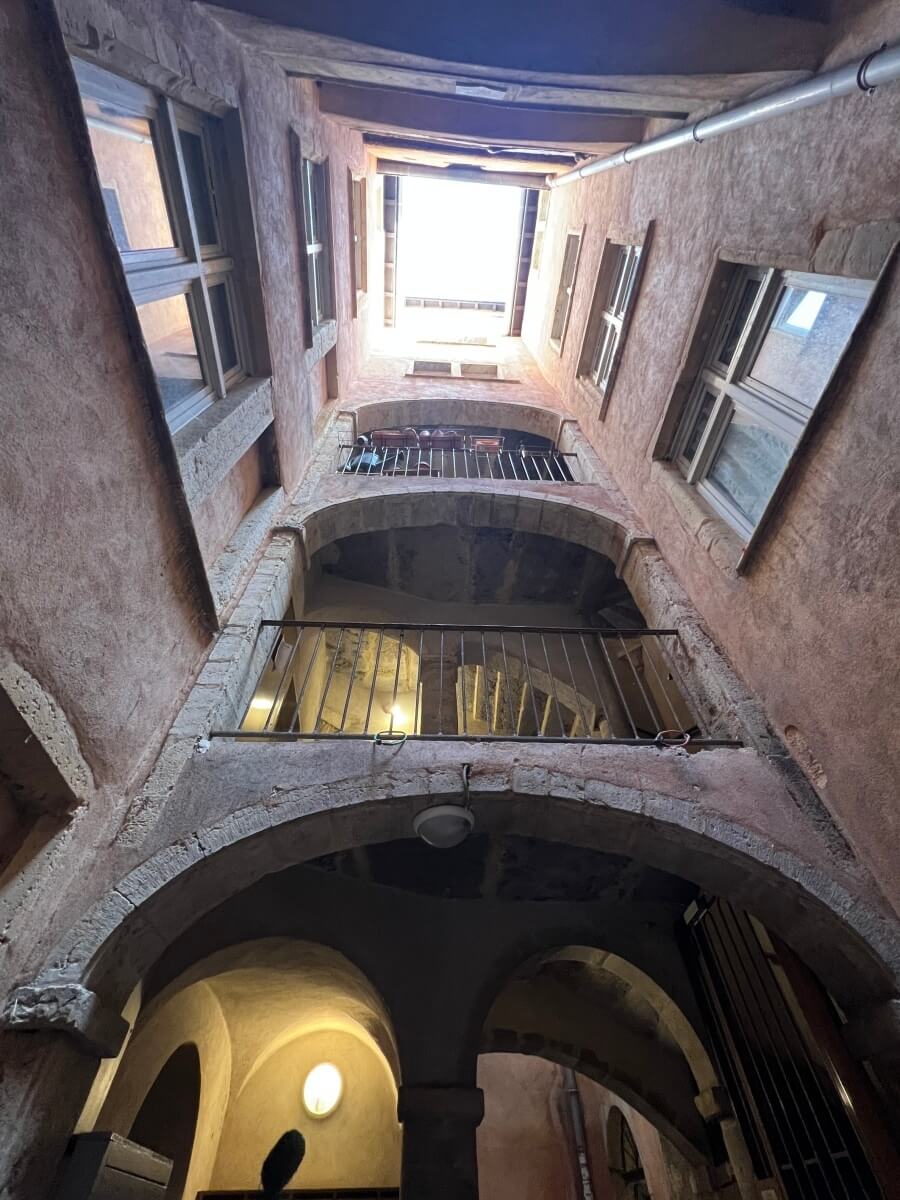
A view from inside a traboule
Another part of Lyon’s rich history has to do with the puppets, The Guignols of Lyon. If you want to understand the soul of Lyon, they say you have to meet Guignol. He’s not just a puppet—he’s a symbol of the Lyonnais spirit: witty, rebellious, practical, and fiercely protective of the “little guy.” He was born in the Silk District, around 1808 by former silk-worker, Laurent Mourguet. After the silk trade declined during the Revolution, Mourguet turned to dentistry (yes, dentistry!) and used puppet shows to distract his patients from their pain. The puppet performances became more popular than the tooth-pulling—and Guignol was born.
Guignol quickly became the voice of Lyon’s working class, especially the silk workers of La Croix-Rousse. Guignol, the canut, wears a brown coat and black hat, is clever, sharp-tongued, and morally grounded, and outsmarts authority figures constantly. His best friend, Gnafron, a cobbler, you can recognize by his red nose and cheeks because he loves his Beaujolais wine, is jovial and slightly bumbling. Madelon is his wife. She’s the voice of reason and is strong and practical.
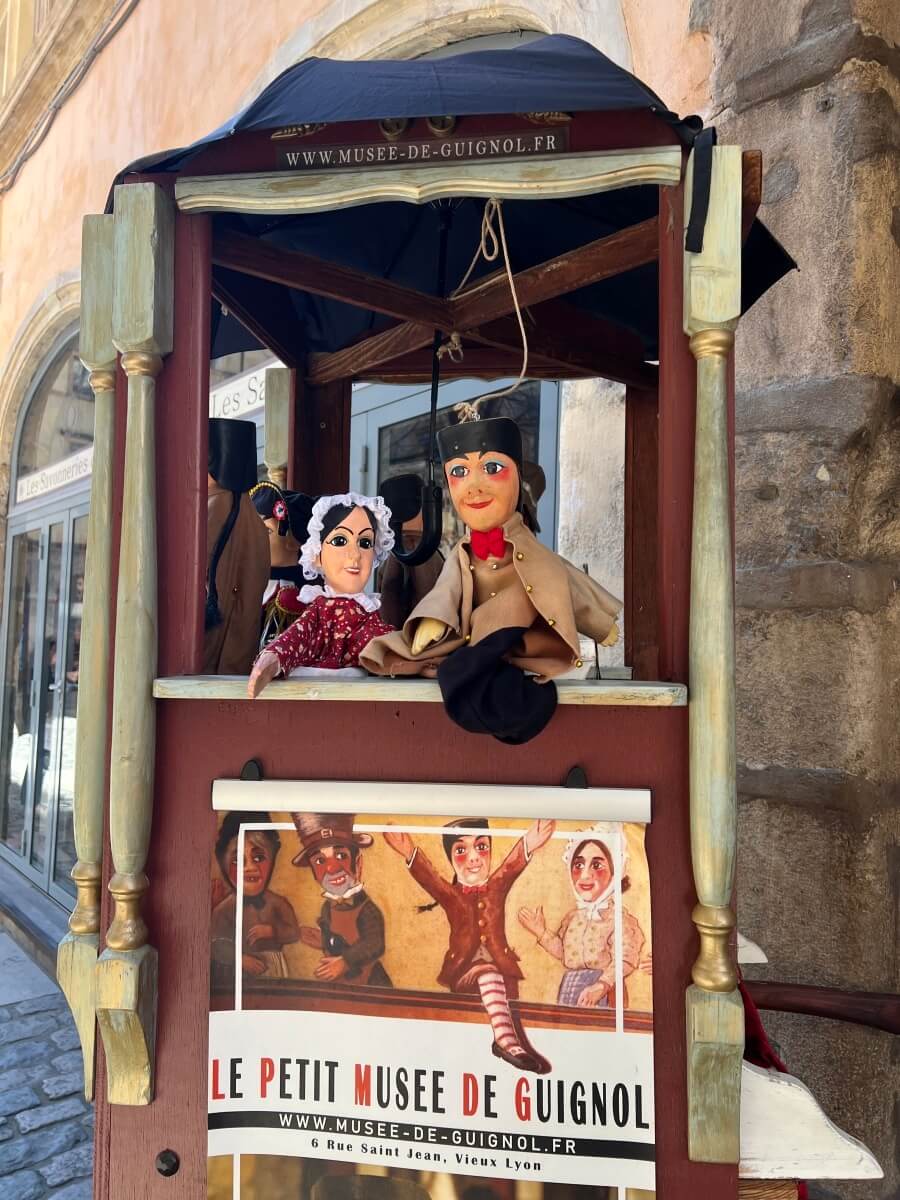
These characters reflect everyday Lyon life—the artisan class, family dynamics, neighborhood gossip, and social justice themes. Guignol gave ordinary Lyonnais a safe way to laugh at power. The also famous wooden “le bâton” (baton) Guignol uses wasn’t random—it symbolized resistance.
The tradition is still alive in Lyon, especially at La Maison de Guignol and the Théâtre Guignol du Vieux Lyon. On rue Saint-Jean steps from one of the apartments we visited, is Le Petit Musée de Guignol. Guignol belongs to a larger European puppet tradition (like Italy’s Pulcinella or England’s Punch), but Lyon’s version is distinctly local—rooted in silk workers, social unrest, and practical humor. He isn’t polished. He isn’t aristocratic. He’s resourceful, skeptical, and fiercely independent. Very Lyon.
In fact, Guignol could easily represent the people of Lyon, even today. We discovered a couple of fiercely independent Lyonnais during our filming. The owner of a bakery shooed us off her outdoor table that we used to hold some of our equipment while filming outside, even though we had patronized her bakery. She was not very nice about it. Then, there was a gentleman living in one of the buildings where we were filming that in spite of our having a key to the door and explaining that we had a right to be there, slammed the big heavy door on us, banging into our fixer’s knee. He wasn’t very nice about it, either.
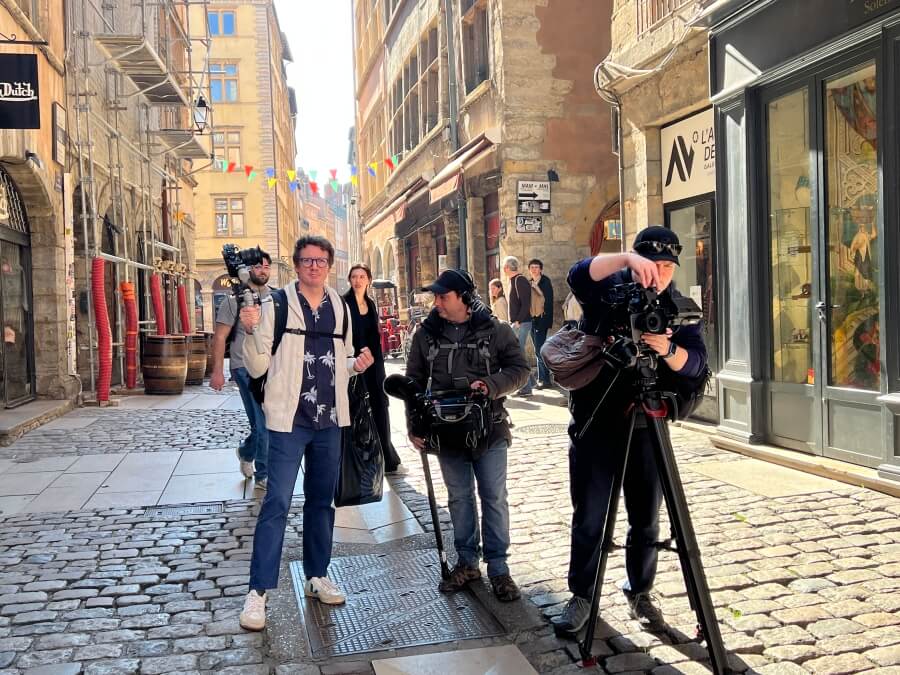
The Lyonnais have a reputation—and it’s quite different from Parisians, Marseillais, or Niçois. They won’t overwhelm you with charm at first meeting. But once you’re “in,” loyalty runs deep. The Lyonnais are known for being practical, financially savvy, hard-working and strategic. They’re not dreamers in the Provençal sense—they’re builders. They tend to believe—quietly but firmly—that Lyon is the real cultural capital of France. There’s a saying that Lyon has “la tête froide et le cœur chaud”—a cool head and a warm heart. I wasn’t there long enough to fully grasp this, but those two altercations did make me take notice.
As you already know, Lyon is known as the Capital of Gastronomy, so we were determined to dine in a few “buchons.” A bouchon is a traditional Lyonnais restaurant serving hearty, old-fashioned local cuisine—the kind of place where you loosen your belt and order wine by the pitcher. In many circumstances, they’re small, convivial, often family-run eateries with red-and-white checkered tablecloths, closely spaced tables, walls decorated with photos, wine bottles, and Lyon memorabilia with a lively, unpretentious atmosphere.
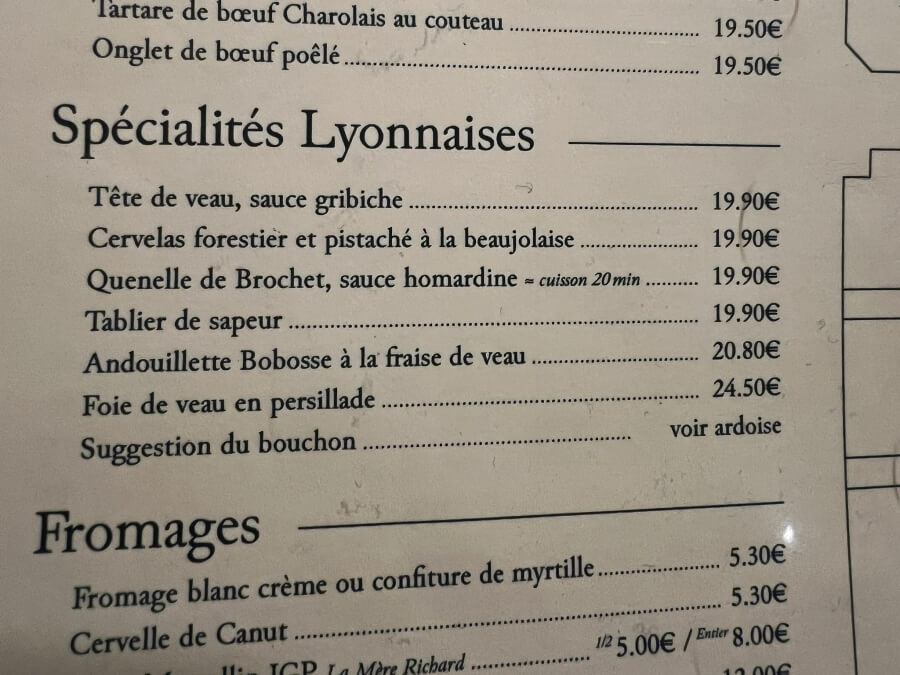
Classic Lyonnais bouchon comfort food includes such dishes as Quenelles de Brochet (pike dumplings in cream sauce), Andouillette (a strong-flavored sausage made from pork tripe), Tablier de Sapeur (breaded tripe), Salade Lyonnaise (frisée, bacon lardons, poached egg) and Cervelle de Canut (herbed fresh cheese spread). Our director is a huge fan of andouillette and ordered it whenever he could—with us having to hold our noses from the putrid odor. (It’s an acquired taste!)
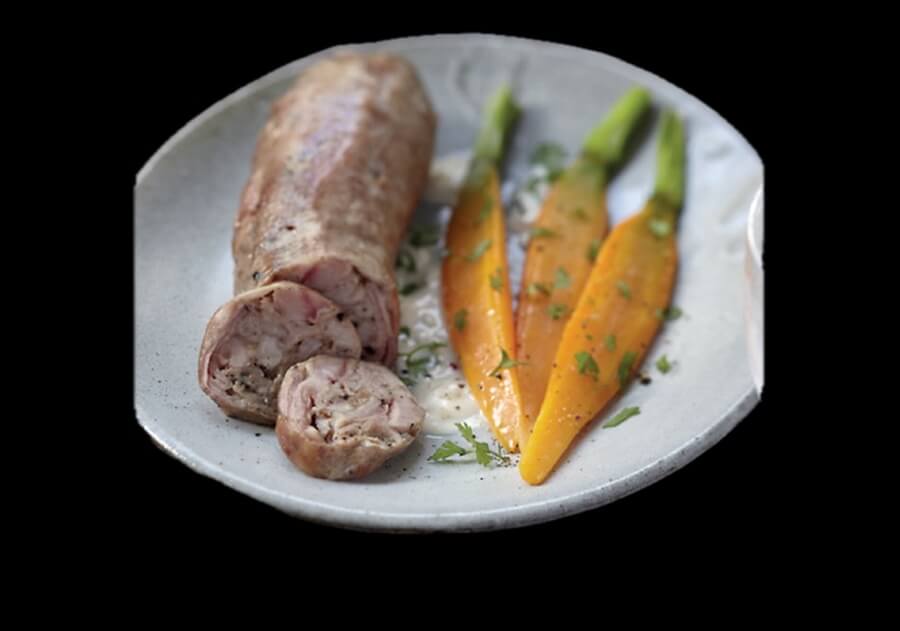
Andouillette, a Lyonnais specialty
Lyonnais cuisine was not my favorite. It’s “honest, indulgent, deeply traditional food that celebrates craftsmanship over showmanship,” however it’s full of cream, butter, and sauces, is rich, rustic, deeply rooted, and unapologetically satisfying…and not so great for your weight or your arteries. Give me the Mediterranean diet anytime!
We dined in several bouchons over the course of three days, which were quite good, but our favorite meal, believe it or not, was in a Chinese restaurant, where we least expected it…Engimono.
Would I recommend Lyon as a place to live in France? It has its plusses and minuses.
The weather shares a similar continental climate with Paris, but Lyon feels more extreme. Lyon is hotter in summer. It can get very warm and sometimes humid, especially with little wind movement in the river basin. Lyon is colder in winter (we felt it!). Night temperatures drop lower than Paris. Paris is more moderated by Atlantic influence, so it’s generally milder year-round. So, if Paris weather isn’t your thing, Lyon’s won’t be an improvement.
The American community in Lyon is noticeable but relatively small compared to Paris. Several thousand Americans live in the greater Lyon metropolitan area, but by comparison, Paris has tens of thousands of Americans. Most Americans in Lyon tend to be university students and researchers , corporate professionals, entrepreneurs and tech/start-up workers, English teachers and binational families (French-American couples). It is less “retiree-heavy” than Nice and less diplomatic/corporate-heavy than Paris.
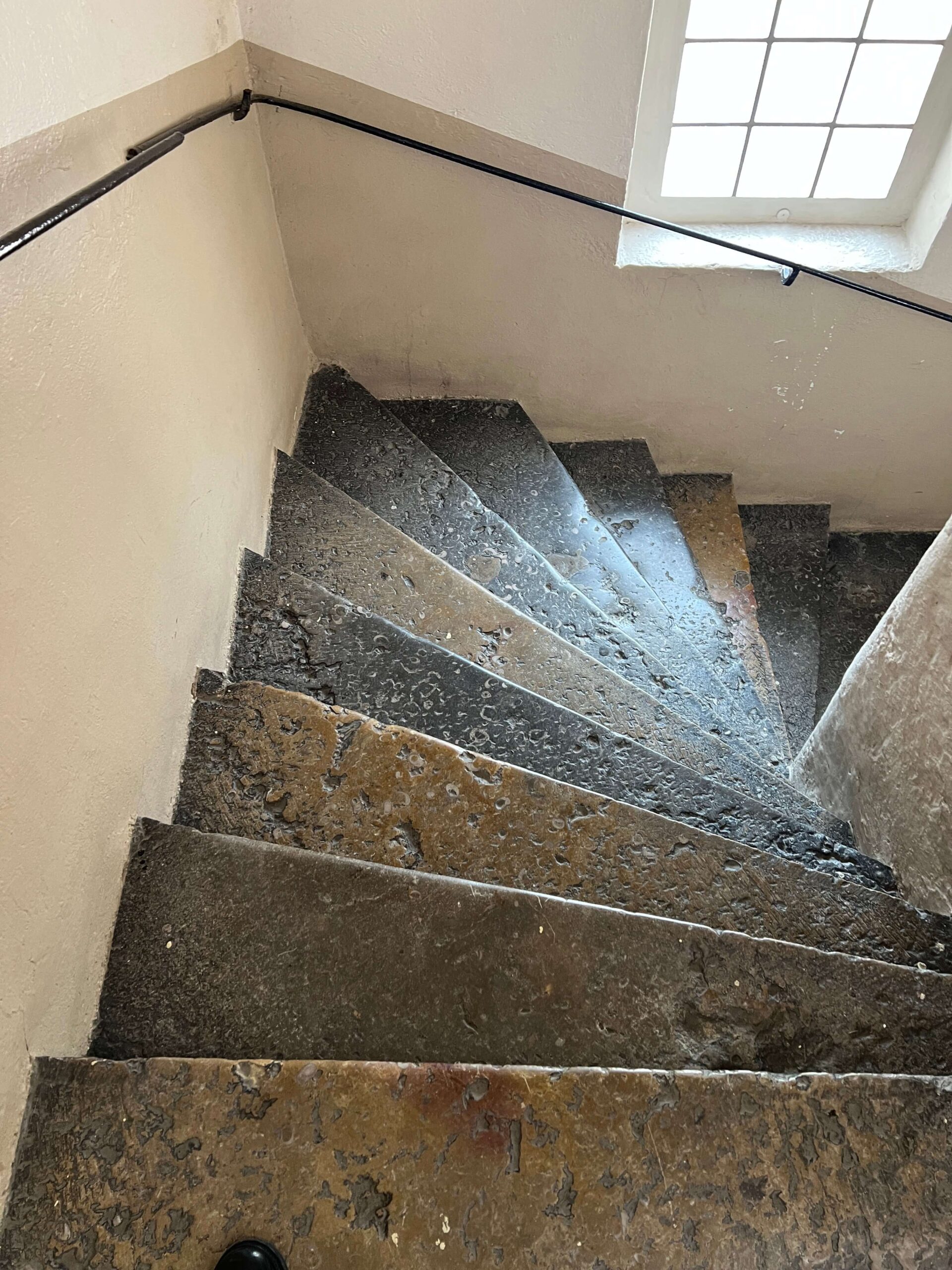
The cost of property in Lyon is about half of Paris, but so is Nice and most other major cities in France. The properties we visited as part of the episode were all rental apartments, and all very centrally located. They were also in very historic buildings with many flights of steep stone stairs spiraling up—one as high as fifth floor, and nothing like Paris’ buildings with mostly wooden staircases. I found them treacherous and unmanageable, even for a seasoned stair-climber such as myself.
The train to and from Lyon (from Nice to Lyon and Lyon to Paris) on the TGV was a piece of cake, and according to some resources, it’s one of its strongest (and most underrated) assets of the city. Lyon’s airport offers: direct flights to major European cities, some seasonal transatlantic flights (typically New York and sometimes Montreal) and strong connections through hubs. It’s smaller and easier than Paris airports—much less chaos. The airport has a TGV station built in, so you can step off a train directly into the terminal. Paris and Nice win on global flight volume, but Lyon wins on being one of the best-positioned cities in Europe for regional mobility without Paris congestion.
At the end of four days I asked myself: Would I trade Paris for Lyon? Or even Nice? Not a chance.
Would I recommend it to our clients? Only to younger clients with a limited budget.
This is not to say that you couldn’t have a great life in Lyon, but given the choice of living in Paris, the cultural Mecca of the planet, and Nice with its sunny days, aqua blue sea and Italian joie de vivre…?
For me, there is no question. What would you choose?
A la prochaine…
 Adria Leeds
The Adrian Leeds Group®
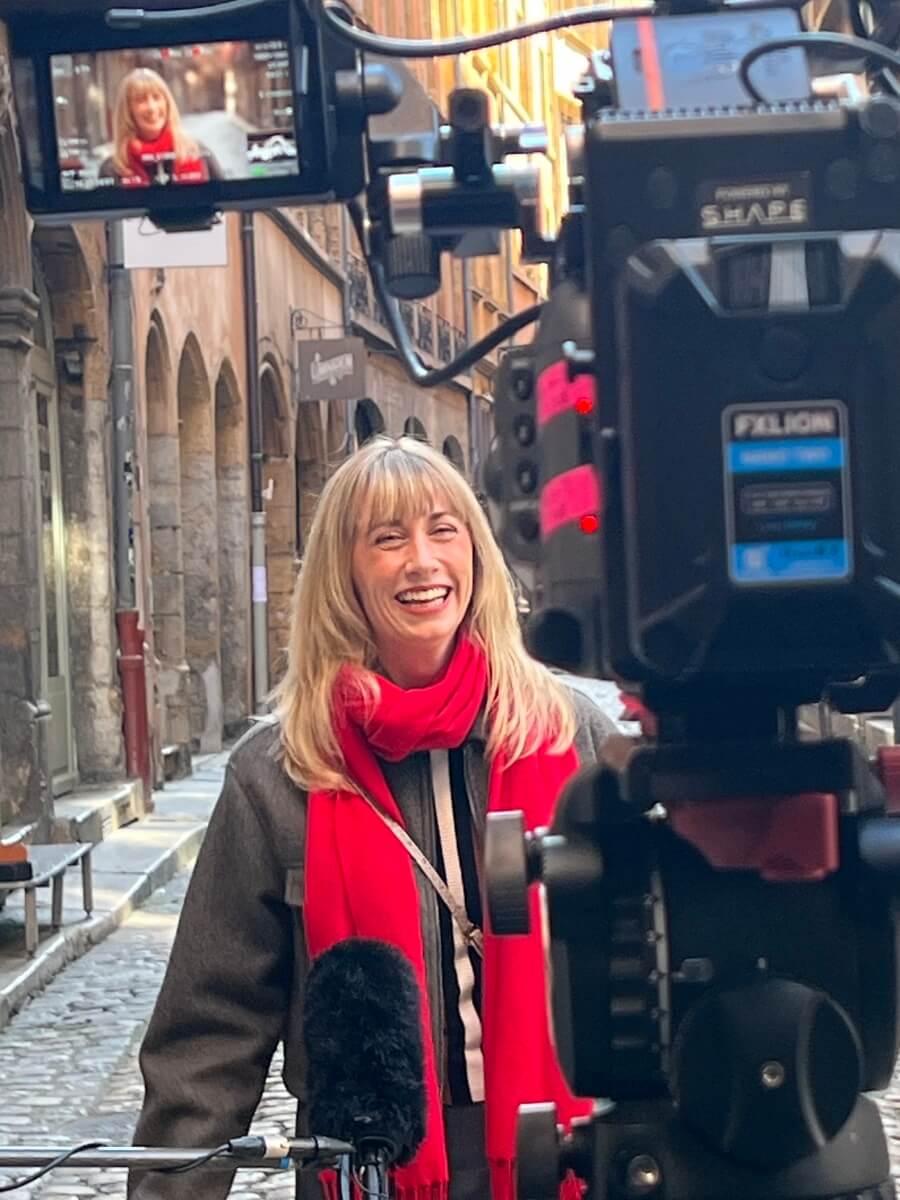
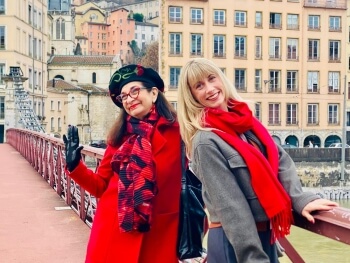
Adrian with Leah Marie Young, filming in Lyon
P.S. In addition to our property services, we also focus on living in France on a practical level—like moving, renovating, cultural acclimation, etc. Our website is the perfect place to begin your education into everyday life in France.
1 Comment
Leave a Comment

Let Us create a custom strategy for you
You can live or invest in France-now.
Join us at our monthly Après-Midi.
Become a part of the Paris community.
Property for sale
Read & Subscribe
Dive into more by reading the French Property Insider
Better yet, subscribe to both and get the updates delivered to your inbox.
Global Money Services
Our contacts will help you invest in France.


See Adrian on HHI

Join us on Youtube
Dive into more on how to live, invest & escape to France
Be sure to subscribe!
To read more, click the links below.
This was a lot of great information. I’m disappointed that it’s not really a contender for retirees. I’m going on a group tour in 3 weeks and we’ll be in Lyon for 3 days and I was hoping it might be a contender in a couple of years. Hearing about the weather was enough to change my mind – hot summers are a no-go for me. The Lyonaisse food sounded really disappointing as well. I will definitely check out the Chinese restaurant you mentioned.