

Adrian Leeds Nouvellettre®
Your taste of life in France!
Subscribe and don't miss an issue!
The Electric Cabbage Patch…and Whatever
PARIS ATLAS
Clients-turned-friends (which happens very often) presented me with the gift of the Paris Atlas—a paperback book filled with maps of Paris. It treats Paris like an onion—the more you peel, the more layers you find, and the more likely you are to cry (tears of joy, of course).
The book is one of those rare gems that makes you feel like you’re peeking behind the city’s velvet curtain. It’s not just a collection of maps—it’s Paris laid bare, from her cobblestone veins to her Haussmannian heart.

Page by page, the Atlas charts out the familiar (arrondissements, Métro lines, those perfectly gridded Haussmann boulevards) and the unexpected—forgotten rivers, medieval remnants hiding under your favorite café, and the tangled roots of the city’s history. You can discover why the Left Bank feels like a village, how the Right Bank became a stage for grand boulevards, and why Parisians are so particular about which bridge they cross.
It’s not a book you read once and shelve. It’s a guide, a confidant, a “let me show you something special” from the city itself. Whether you’re new to Paris or you’ve been here long enough to know your “carrefours” from your “impasses,” this atlas doesn’t just help you find your way, it helps you understand why Paris is the way she is.
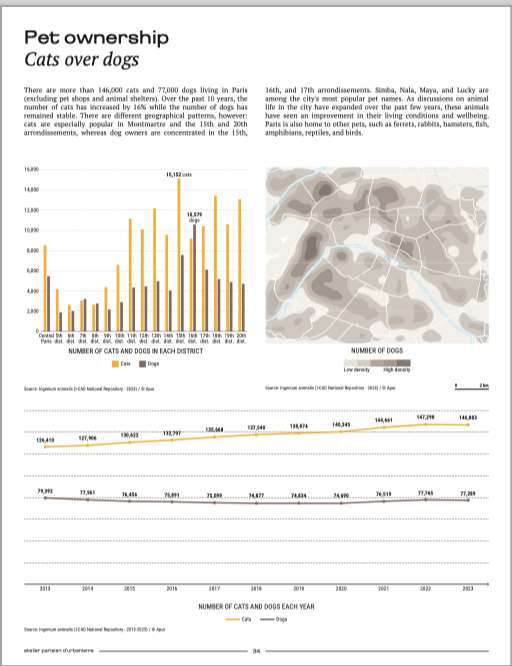
In other words, if you want to fall in love with Paris all over again, this is your ticket. Be prepared to spend hours perusing every map and digging deeper into the City of Light than you ever imagined.
Note: The bad new is that the French and English editions of Paris Atlas are permanently out of stock (guess we were really lucky to score a copy), however, believe it or not, it’s downloadable!!!
Do it, print it, love it.
THE BRIDGE TO THE CABBAGE PATCH
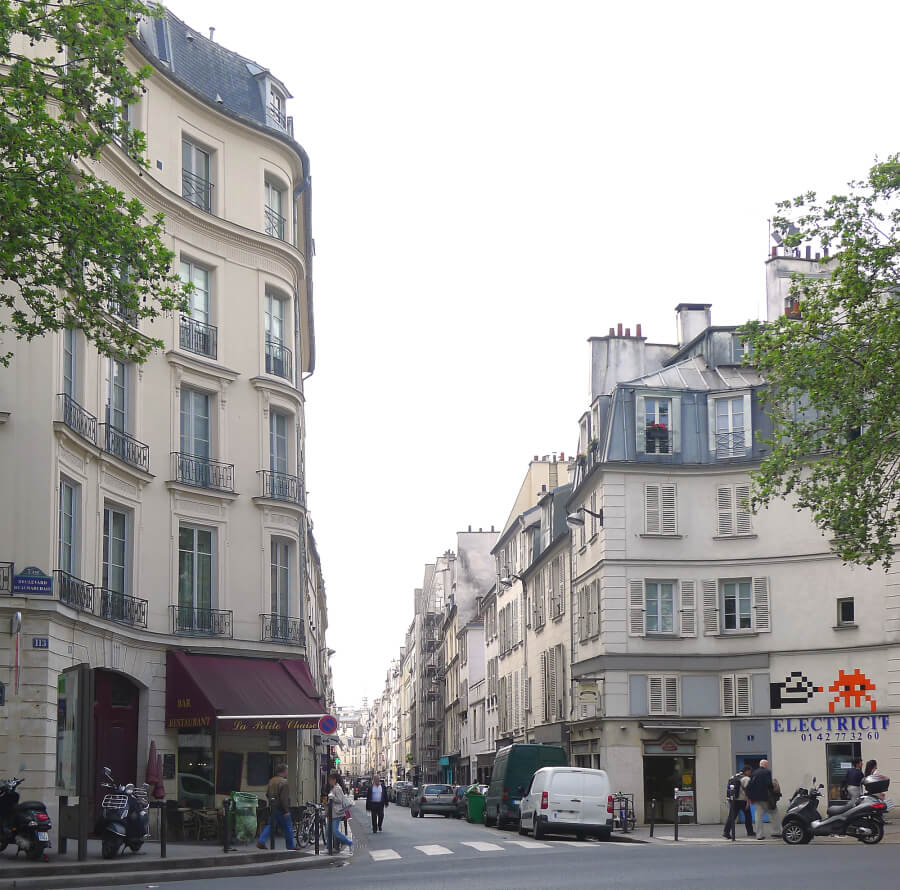
Back at the end of the 16th-century, rue du Pont-aux-Choux wasn’t the charming Marais street we stroll today. It was little more than a path leading from a modest postern gate in Charles V’s city walls straight out to the marshes where cabbages and other vegetables grew. (Yes, that’s how it earned its name — “Bridge of the Cabbages.”)
That humble gate was replaced in 1674 by the Porte Saint-Louis, part of an ambitious reconstruction. Even more fascinating? This spot had been earmarked for Henri IV’s grand project, the Place de France—a monumental square that was sadly abandoned after his assassination in 1610. Still, the plans left their mark: the area began to urbanize, with new streets filling in what was meant to be this regal public space. This is the “quartier” that by chance became my home in Paris.
At the very start of rue du Pont-aux-Choux, there was once a culvert—a small bridge crossing over an open sewer (the same one that now runs invisibly beneath rue de Turenne, that I never knew about until now). And by 1624, according to a survey report dated January 2nd of that year, the street was already almost completely built up.
The first time I walked the street was in 1995, when I visited a friend living there—who I had met in our French-English conversation group at WICE (Where Internationals Connect in English). This same friend was with me the first time I visited the apartment on rue de Saintonge that became my home in 1997…and is the apartment under renovation now that we’ll move back into at the end of this month.
At one end of rue Pont-aux-Choux, as it meets boulevard Beaumarchais, there used to be a shop specializing in electrical products. It had a sign on it that made us chuckle every time we passed it. It said “ELECTRICITe”—the last letter…,the E, had obviously been forgotten when planning or positioning the sign, then added and fit in as best as possible. It was like those “Plan Ahead” signs you see with the D trailing behind.


It’s gone now, but rue Pont-aux-Choux has always tugged lightly at my heart strings for these reasons. And now, it will become even more important in our lives as my daughter’s future home in Paris. Thanks to one of my wonderful team of search consultants—who has kept their eyes wide open for the perfect apartment…so that my daughter and grandson will have an apartment in which to live when they move back to France. It appeared in a flash…at the most unlikely time of year—the summer when everyone is gone on vacation and many businesses are closed.
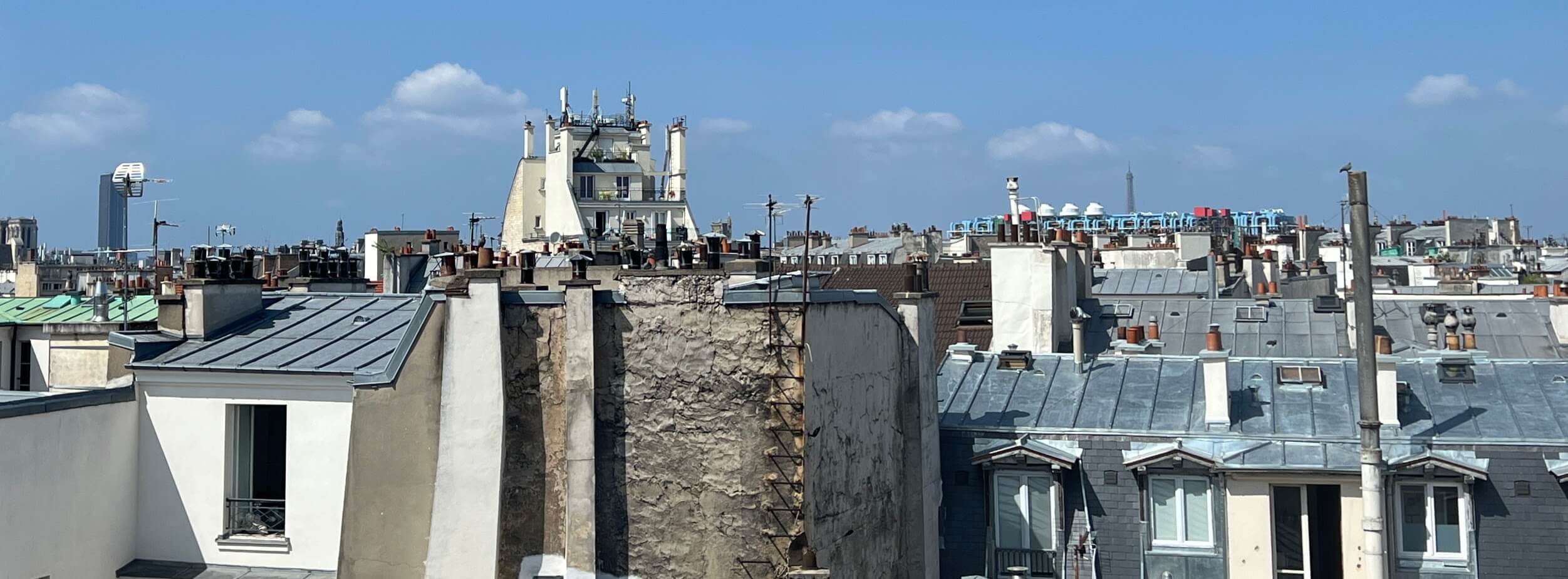
We made one visit to the apartment, fell in love, made an offer and after a bit of negotiation with the seller, came to an agreement. It’s on the top floor of a beautiful 18th-century building facing north overlooking the street, with an elevator (and a big one!). There are four windows with rooftop and sky views. In the distance is Sacre Coeur. From the windows in the entry hall, you can see many major monuments—the Centre Pompidou, Eiffel Tower, Notre Dame and the Tour Montparnasse, among others…not bad!
What I like most of all about the apartment is that the heart is a large living room/dining room/kitchen sandwiched by a bedroom on either side. It’s the perfect layout, even if quirky with, lots of angles and slanted roof lines. The floor plan is a complete triangle. In fact, it’s one of the things we like so much about it.
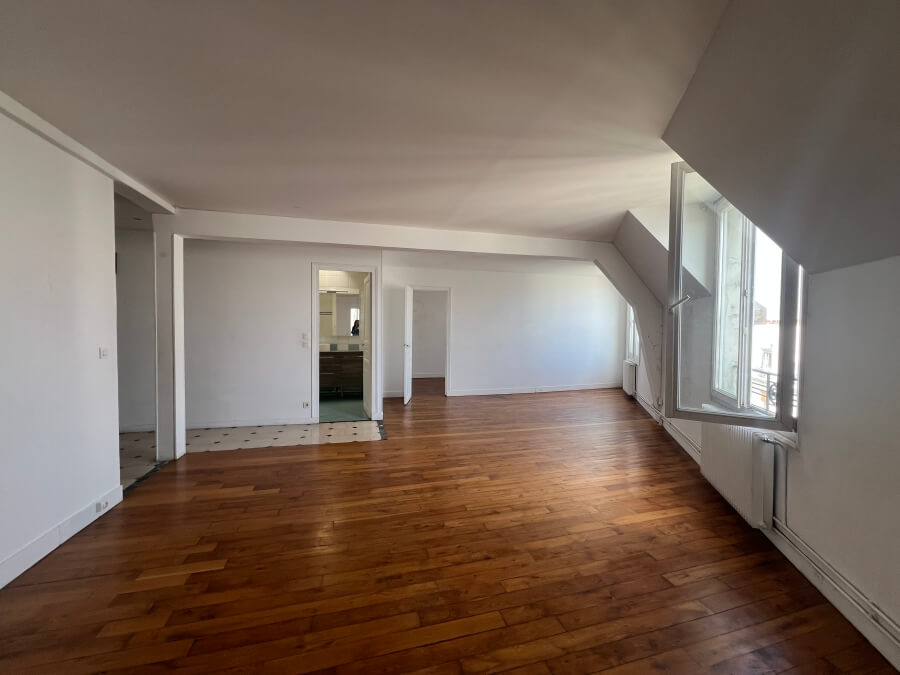
When I walked in, it felt very much like the Saintonge apartment for this reason. It’s larger than Saintonge by about eight square meters. That’s one reason we can create one bathroom “ensuite” to the main bedroom, and another independent one, both with toilets (real ones!).
The apartment is a clean slate and needs complete renovation. (What else is new?) We’re planning on creating two bathrooms within the space that is now the kitchen. We’ll turn the bathroom into an open corner kitchen and we’ll change one wall of the second bedroom to half glass, atelier-style, and of course, build in tons of storage. Designer Martine (Martine di Mattéo), will be busy with another one of our projects—she’s already knee deep in the muck and mire of rue de Saintonge, that must be ready by the end of the month, and the new apartment in Nice that is at the mercy of the Syndic to fix the leaky terrace! We are all covered in construction dust! Ha!…but happily.
The sellers are prepared to go straight to closing, rather than go through the long formal process of signing a pre-sale agreement and then the final deed. It could be ours as soon as early September.
I say “ours,” but in truth it will be my daughter’s. We are paying for it with joint funds and loans, but it will be in her name to avoid future inheritance taxes. This is a great way for me to move assets to her while I am still alive to reduce the inheritance tax burden upon my passing. (I joked with her that she was “one lucky rich bitch” now that she has all these French properties in her portfolio!)
And I can’t wait till it’s ready for Erica and Little Leeds to move in and be back in Paris…just steps away so that I can fully enjoy being “Glamma.”
GETTING OLD SUCKS
For about a month, I’ve suffered with sciatica pain down one side of the body, going from the lower back to the foot. The pain got worse and worse as I began a series of remedies, including visits with generalists, osteopaths, physical therapists, chiropractors, and neurologists, massage specialists, accompanied by X-rays, bone density tests and an MRI, that without that, no one could diagnose any treatment. Meanwhile, they prescribed anti-inflammatories, muscle relaxers, pain-killers (with codeine), special exercises, a heating pad, wearing of a lumbar belt, and advised against bending over or twisting, lifting anything heavy, etc. I even purchased a new desk chair with lumbar support. Daily I watch videos and do exercises to reduce the pain and fix the problem. In other words, I am trying EVERYTHING.

There were a number of possible causes, but until having the MRI, no one was sure how to treat the symptoms best. I know now that the cause is a herniated disc that will correct itself over time, with care. And I know how to fix this in the long run, which will include exercise (such as Pilates) that will improve posture and strengthen the spine.
The reason I am telling you all this is not because I want sympathy or recommendations for cures, but because the cost, by comparison to U.S. medical costs, is a joke that you should know about it. Not one practitioner I visited cost more than 80€ (except the massage was 100€), and it’s all covered by Social Security or my “mutuelle” insurance policy (except the massage!). The osteopath I see in Nice charges 30€ for a 30-45 minute session using a special stretching technique. The most expensive test of all was the MRI—a whopping 160€! Happily I turned over my credit card, chuckled to my assistant, Diane, and then asked Chat GPT what the average cost of a spinal MRI in the U.S. would be.
Here’s what it said:
In the United States, MRI costs vary widely depending on the facility (hospital vs. imaging center), location, and whether contrast is used.
For a spinal MRI (cervical, thoracic, or lumbar):
• Without contrast: typically $1,000–$3,000
• With contrast: often $2,000–$5,000+
• Average self-pay (no insurance): about $1,500–$3,000
• With insurance: copays can range from $100–$500, depending on your plan and deductible
Tip: Free-standing imaging centers (not attached to hospitals) often cost 50–70% less than hospital-based MRIs.
Yep, another reason to retire and live in France! Getting old might suck, but at least it doesn’t suck the money out of savings!
Note: In France it’s called an IRM: “Imagerie par Résonance Magnétique”. “MRI” = Magnetic Resonance Imaging in English.
BECOMING FRENCH
The morning of our next Après-Midi on September 9th, I won’t be doing the usual tasks to prepare for the event. Instead, I’ll be shaking in my boots in anticipation of the interview at the Préfecture to get my French nationality.

The France Prefecture makes it easy to get up to speed. Their website is devoted to help people like me pass the test.
In between watching sciatica videos, I’m studying the Livret de Citoyen and trying to learn the Marseillaise! Trying to cram all of this knowledge into my little old brain at this age is no easy task and now I’m getting very worried not to pass the test!
HELP!!
If you or someone you know happens to be really good at tutoring for this test, please send them my way! Between now and September 9th, I need to be confident I can answer their questions…in French! Contact me.

A la prochaine…
 Adrian Leeds
The Adrian Leeds Group®
P.S. In addition to our property services, we also focus on living in France on a practial level based on our own experiences and the advice of a variety of those-in-the-know. Our website is the perfect place to begin your education into everyday life in France.
7 Comments
Leave a Comment

Let Us create a custom strategy for you
You can live or invest in France-now.
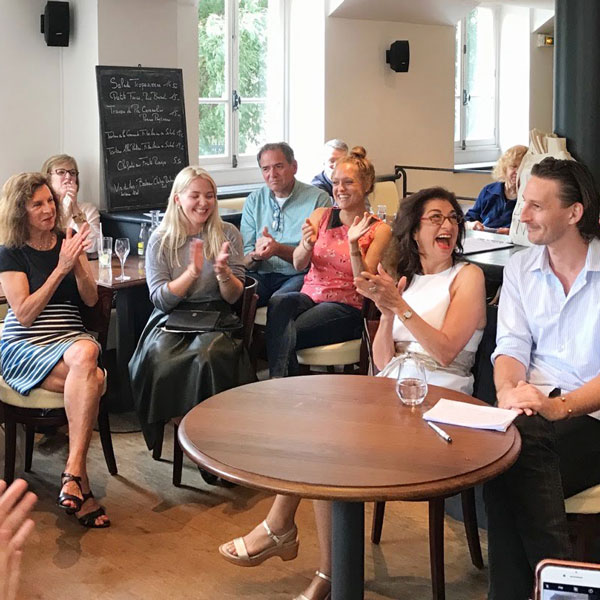
Join us at our monthly Après-Midi.
Become a part of the Paris community.
Property for sale
Read & Subscribe
Dive into more by reading the French Property Insider
Better yet, subscribe to both and get the updates delivered to your inbox.
Global Money Services
Our contacts will help you invest in France.


See Adrian on HHI

Join us on Youtube
Dive into more on how to live, invest & escape to France
Be sure to subscribe!
To read more, click the links below.
I love reading your nouvellettres and watching your videos. You have a very forthright and honest communication which is very appreciated. I also love the inheritance tip. Thank you and keep the inspiration coming, s’il vous plait! Merci beaucoup!
Hi Adrian, congratulations on finding your daughter an apartment! What is the arrangement for a quicker closing in Paris if one is paying cash? I thought no matter what it was a 3 month process? Is this something that is done frequently? Any risks to closing quickly? Maybe a subject for another newsletter? Thanks!
A quicker process depends on the property itself as well as the seller.
Thanks for the history of Pont a Choux. I’ve a set of Gien dishes and the pattern is called Pont a Choux
Dear Adrian,
I read about your very real pain, and I had to respond! Since my 30s, I did something that herniated my back at L2 and L3. Nothing, and no doctor, could fix it. BUT, a chiropractor told me that, before there were drugs, people had to figure out what to do. He told me to buy three gel packs to freeze and apply one every hour on the hour for no more than 20 minutes. Remove, refreeze by alternating the packs. At the top of the hour, repeat the treatment. I immediately discovered that I needed to wrap the pack in a cotton hand towel to cut the intense cold… but I needed no meds! I am now 71. This has always worked for me. If I needed to walk around the house with a walker, I know that it will take a week of rotations. Usually, it only takes a day or two to reach barely-there pain if I “tweak” my lower back. The objectives are to immediately relieve the pain by numbing, and very slowly reduce the swelling between disks, so everything slips back into place asap. And then? Nothing for a year if I am careful!! Lastly, I asked the chiropractor where he learned about this, and he said skeletal bones showed a natural fusing from ice treatments…long before there were medical schools. I am not a doctor, so you decide if it’s worth a try. Feel better, sooner!
Brava for the link to download the Paris Atlas. I’ve downloaded it to read myself and forwarded the download to a couple of new Paris residents. Also the great hint that getting your own IRM costs much less if you go to a free-standing magnetic resonance imaging facility instead of a hospital. Brava in general for being so helpful in these blogs.
Great read. Do not know how anyone could “live” in the us empire especially having no universal health care yet endless billions for endless wars.