

Adrian Leeds Nouvellettre®
Your taste of life in France!
Subscribe and don't miss an issue!
Two Days in Strasbourg
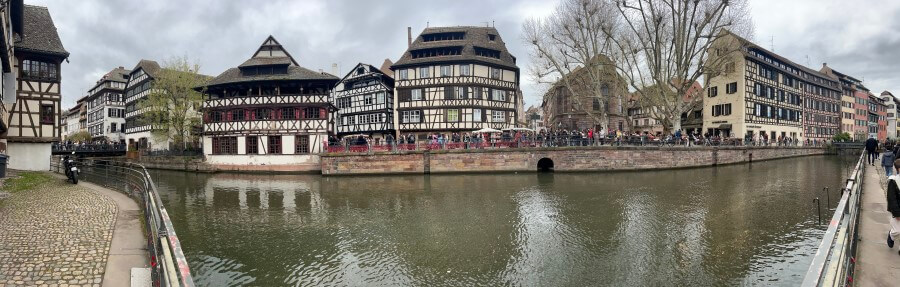
Believe it or not, there are 15 to 20 direct TGV trains a day to Strasbourg from Paris. It’s very good, but not the busiest corridor. Paris to Lyon is one of the busiest in Europe with 25–35+ trains/day. This is France’s backbone route—business-heavy, extremely frequent. Paris to Lille isn’t far behind with 20–30 trains/day, making that feel almost like a commuter route. Paris to Nice has many fewer trains due to the longer distance and the slower final segment along the coast on slower tracks.
If you’re thinking about this from a relocation or lifestyle standpoint, this matters more than you realize—and something I am constantly preaching to our clients who want to travel in their retirement years.
Let me frame it the way I do with clients: “Connected” vs. “Reachable” in France. It’s not about whether a train exists. It’s about whether the city feels like an extension of Paris…or a separate destination you plan around. The cities that make the most sense to me are the ones that are “Connected,” where Paris can feel “next door.” And these are the cities I’m making a point of visiting so that we can know as much as possible when advising our clients. Strasbourg is one of them, and that’s the biggest reason for this weekend in the Alsatian town.
It has been many years since I visited Strasbourg. The last time was at Christmas-time, with my daughter. It was icy cold. We drove the 500 kilometers, about five hours from Paris. We had high hopes for the famous Christmas market, but found it disappointing…what were two Jewish girls doing perusing the Christmas decorations anyway? We didn’t buy anything. So, I wanted a new experience.
When I told old, close friends living in Bonn, Germany, Christa and Dirk, that we would be “not so far away,” they made plans to come for the weekend and spend some time with us. How perfect! And an American couple I met in Lyon, Anne and Johnny, but who now live in Strasbourg, invited us to join them for dinner Saturday night. How perfect!
Easter is supposed to be almost as special as Christmas in Strasbourg. I was hoping the Easter market would be more interesting, but I went with no expectations (it is the way I live as a general rule, with hopes, not expectations, so as to never be disappointed).
We made our plans to dine in local Alsatian restaurants, visit the Cathedral (of course), take tours of the best museums, meet up with friends and invite you readers to meet up for an “apéro,” so I can learn more about what those who live in Strasbourg both like, and dislike about it.
Who needs Rick Steves anymore when AI can make sense of all of it in seconds? So, I asked ChatGPT to propose an itinerary for our weekend in Strasbourg. My friend, “Chat,” said our timing was perfect because the city will feel festive, floral, and just beginning to bloom—without the intensity of Christmas market crowds.
Here’s how ChatGPT designed our two days:
Day 1 – Saturday: Storybook Strasbourg
Wander the Grande Île, visit the Strasbourg Cathedral and check out the Maison Kammerzell— one of the most photographed buildings in town. Have a coffee outside if the weather cooperates. Explore La Petite France postcard zone—canals, timbered houses, flower boxes. Walk to Ponts Couverts, the Barrage Vauban. For dinner, book a “winstub” (Alsatian tavern) and order a Choucroute, or a “Baeckeoffe” (a traditional slow-cooked casserole) and a Tarte Flambée, topped off with a glass of Riesling or Pinot Gris.
Day 2 – Sunday: Easter Atmosphere and Local Life
Morning: Easter Market on Place du Château, visit the decorated “Osterbrunnen” fountains (Ostern = Easter, Brunnen = fountain), and check out the handmade eggs and spring crafts. Chat suggested we head toward the European district and stroll through Parc de l’Orangerie, where we can spot stork nests (a regional symbol), and where families will be out for Easter walks. Nearby we’ll see the modern contrast of the European Parliament—an interesting juxtaposition to medieval Strasbourg. In the afternoon, Chat suggested we settle into a café in Krutenau (a neighborhood in the southeastern part of the historic center), or go back near the Cathedral for classic ambiance. While we’re there, order a Kougelhopf (a yeasted cake baked in a distinctive fluted, ring-shaped mold often dusted with powdered sugar) or a Black Forest gâteau, or simply espresso and people-watch (more my speed).
The train arrived about noon on Saturday, and our return was scheduled early evening on Monday, so in essence, we had a bit more than two days. We used ChatGPT as a guide, but not our master, and created our own itinerary. By the time you read this, we will still be in Strasbourg doing some of the things we missed over the weekend, but for now, here’s how it played out:
The Gare de Strasbourg-Ville was as busy as a hive when we got off the train. The back looks just the way it should—a 19th-century stone facade much like other stations around France, but exiting tells a different story. Its historic façade is now encased in a sweeping, transparent glass shell that feels futuristic. The result is both protective and theatrical: a grand railway station preserved like a jewel inside a luminous, modern bubble. Personally, I prefer the original structure.
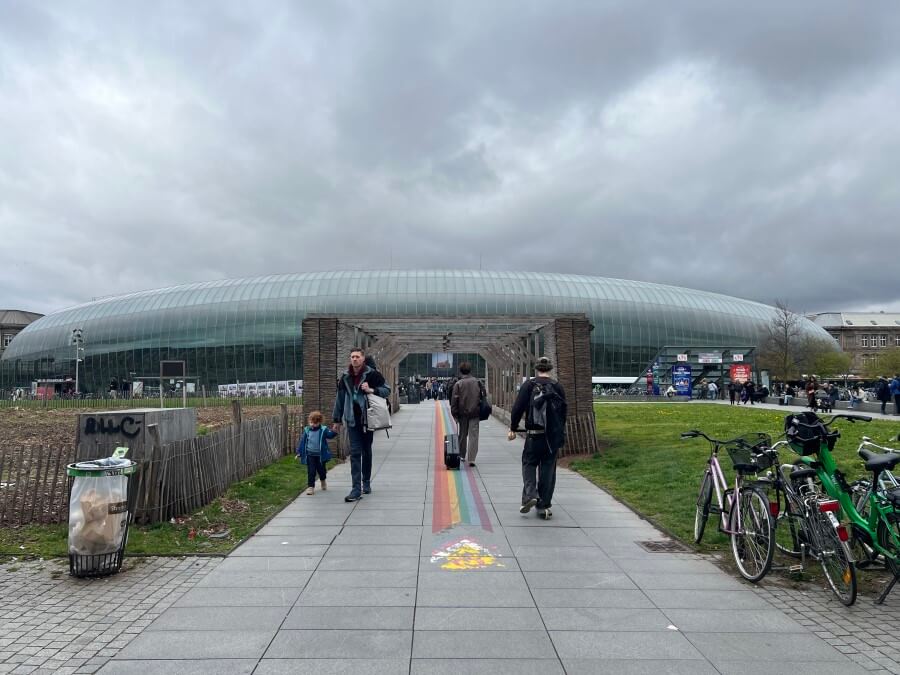
There were no taxis. We waited so long that we resorted to calling an Uber. It took 45 minutes to arrive near the hotel, which would have been a 20-minute walk. I say “near” because the pedestrian streets didn’t allow us to get closer than a few blocks away.
We booked, what looked like a very nice hotel in the city center, Hotel Rohan Strasbourg. The hotel was indeed quite nice and the location was ideal, steps from the cathedral and literally next door to the restaurant/cafe where our meet-up on Sunday was planned, Le Gruber. We had a view of the cathedral from our room…if we stuck out heads out the windows. The windows were doubled so that not a single peep could be heard from inside the room.
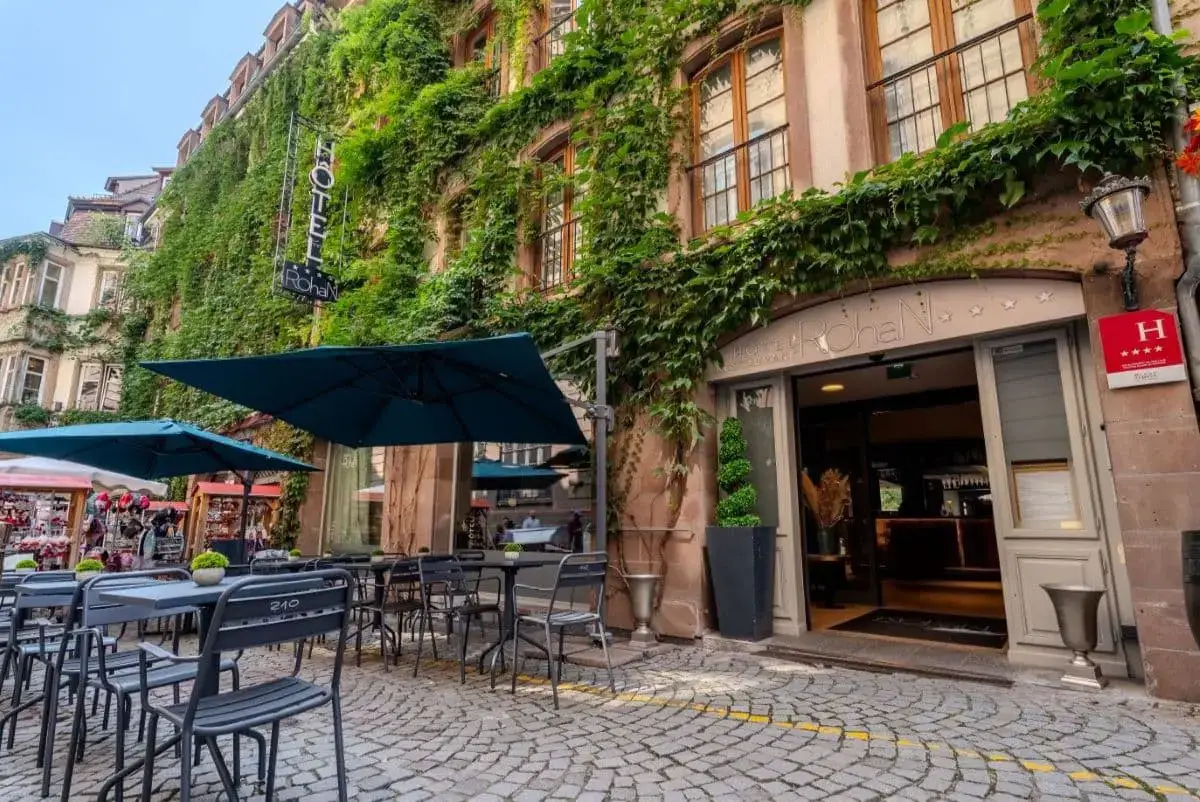
The Hotel Rohan in Strasbourg
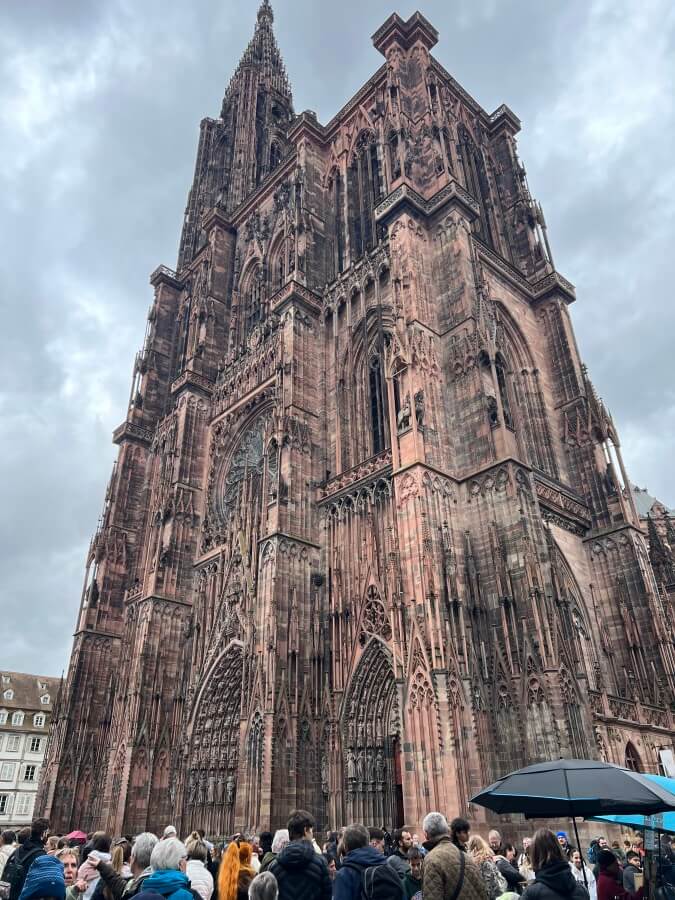
The cathedral is the anchor of the city. It’s impossible to miss, both physically and historically. Built between 1015 and 1439, it’s made of distinctive pink Vosges sandstone and is famous for its single soaring spire (142 meters). For over 200 years, it was the tallest building in the world. It has an asymmetrical design—only one tower was ever completed, with a very intricate facade covered in thousands of sculpted figures. It’s particularly proud of its astronomical clock, a Renaissance masterpiece that still functions. (We weren’t able to visit it because of the Easter holiday closures.)
Stand in front of it, and you don’t just see architecture—you feel the weight of a city that has lived many lives and kept them all. You can see the spire from just about any point of the city, which makes it easy to always find your way back to center.
 At ChatGPT’s suggestion, I booked lunch at Chez Yvonne, Strasbourg’s most famous “winstub” (Alsatian bistro). It was founded in the late 19th century and originally called “S’Burjerstuewel” (Alsatian dialect for “the citizens’ room”). Yvonne, however, was a woman who helped make it famous and has long been a gathering place for locals, politicians, and visitors alike.
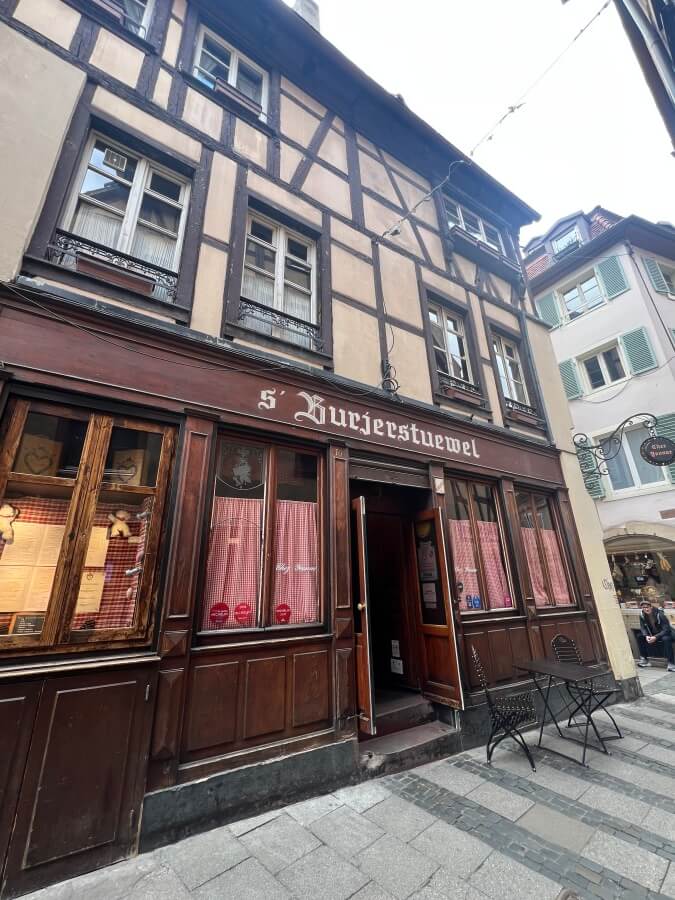
Chez Yvonne in Strasbourg
A winstub is a cozy, wood-paneled Alsatian tavern focused on wine and hearty regional dishes, normally informal, convivial, and deeply rooted in local culture. This was that. On the menu are all the classic Alsatian specialties such as “choucroute garnie” (sauerkraut with sausages and meats), “baeckeoffe,” and foie gras, served with local wines from Alsace. Jacques Chirac and Bill Clinton have dined here, as did Clista and I.
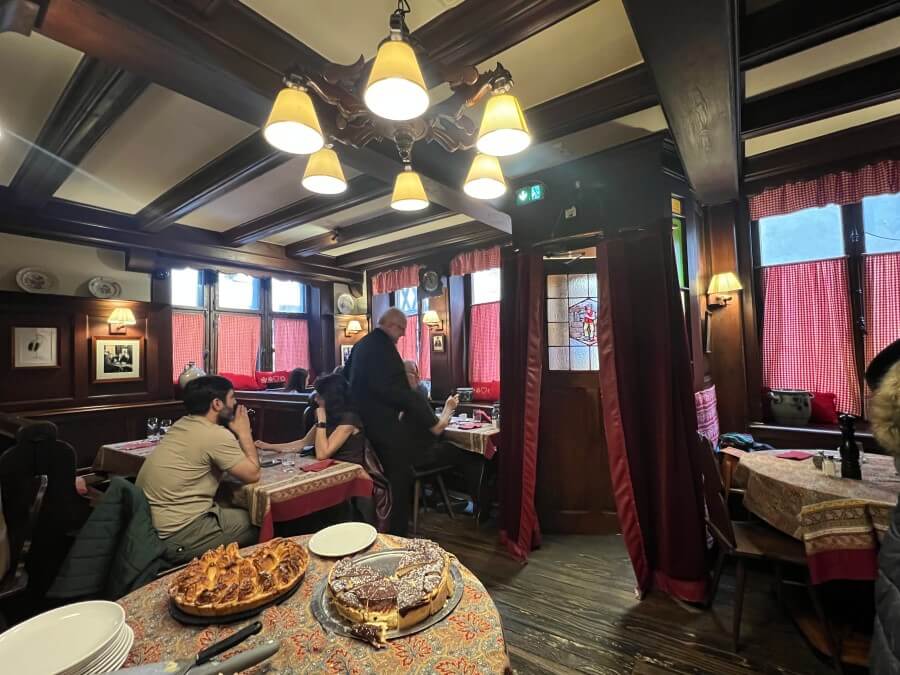
The cozy interior of Chez Yvonne
It was a four-minute walk from the hotel, so a perfect start to get a taste of true Alsatian flavor. And while the charm of the restaurant didn’t elude us, on a scale of one to five, we gave the food a 3.5 rating. You don’t go there for innovation…you go there to taste the city’s memory.
We had all those lofty plans to visit a museum after lunch, but that was the last thing we wanted to do until getting to know the city better. Visiting Le Petit France was top of the list, the storybook quarter being just a short walk away from the cathedral.
It may be the city’s most most picturesque part, but its origins are far more gritty than its postcard beauty suggests. In the Middle Ages, this area was the home to tanners, millers, and fishermen, located along the canals for easy access to the water. The half-timbered houses you see today were actually workshops, especially for leather tanning. But the gritty part comes from the hospital, after which the district is named, “Petite France,” that treated soldiers suffering from syphilis (nicknamed “the French disease”).
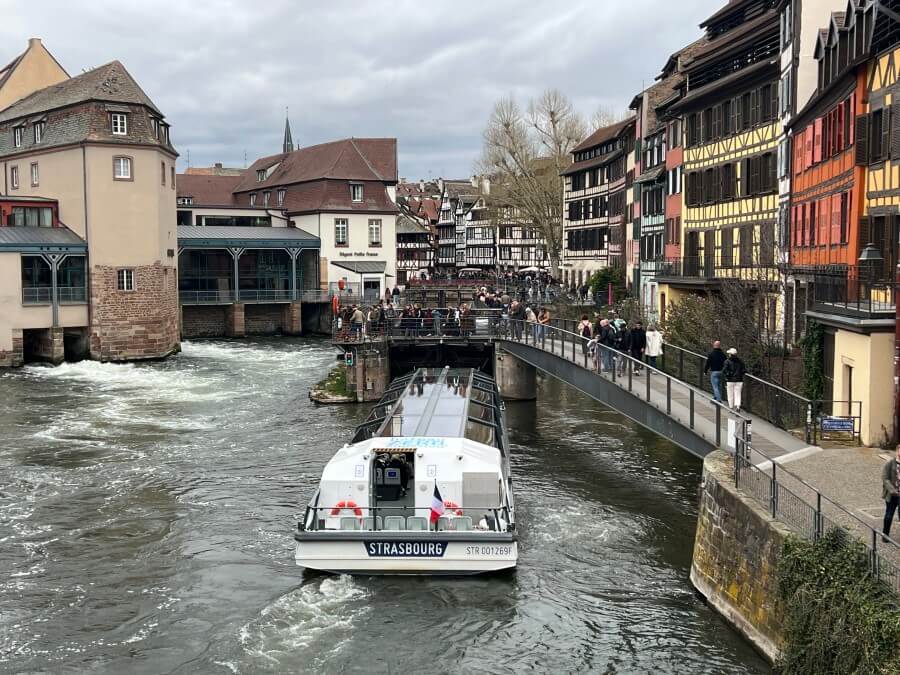
The Batorama boat tour through Le Petit France
It’s residential now, and beautifully preserved, except for a few unsightly contemporary buildings that remind us how unthinking we humans can be. And while it seems very romantic and exciting to have a home there, I left thinking it’s best left for the tourists as it would be isolating and lacking the amenities of a real neighborhood…plus having the manage the wall-to-wall tourists at any given moment.
Saturday dinner was planned by Anne and Johnny, at Chere Amie, a modern, design-forward restaurant in the Krutenau neighborhood. About a 10-minute walk from center, the contrast in the neighborhoods was as acute as is the atmosphere in Chere Amie. Anne and Johnny were kind enough to include my friends from Germany, which unknowingly became a highlight of the whole adventure—as Johnny, being of German descent and now speaking German on a daily basis in Strasbourg, had an immediate connection with Christa and Dirk. (I understood nothing of their conversations!) They hit it off as if they had known each other for decades and spoke German most of the evening.
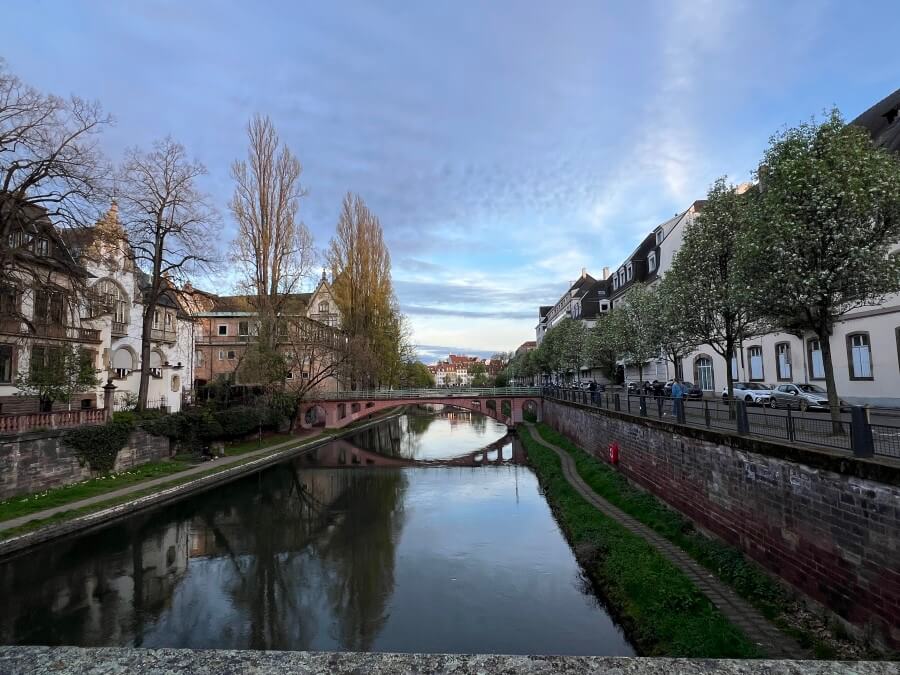
The Krutenau quarter in Strasbourg
The space that now houses Chere Amie was at one time an old post office, and they have made an effort to preserve its prior identity. Krutenau and the center have seen many buildings shift from administrative or commercial uses (including postal services, small offices, etc.) into restaurants and other establishments. We might have been the oldest diners there (it’s clearly most appealing to the young), but no matter…it was the perfect setting for the six of us and the contemporary French cuisine was perfect for our first night in Strasbourg. It’s the kind of place you go when you want a break from choucroute and baeckeoffe!
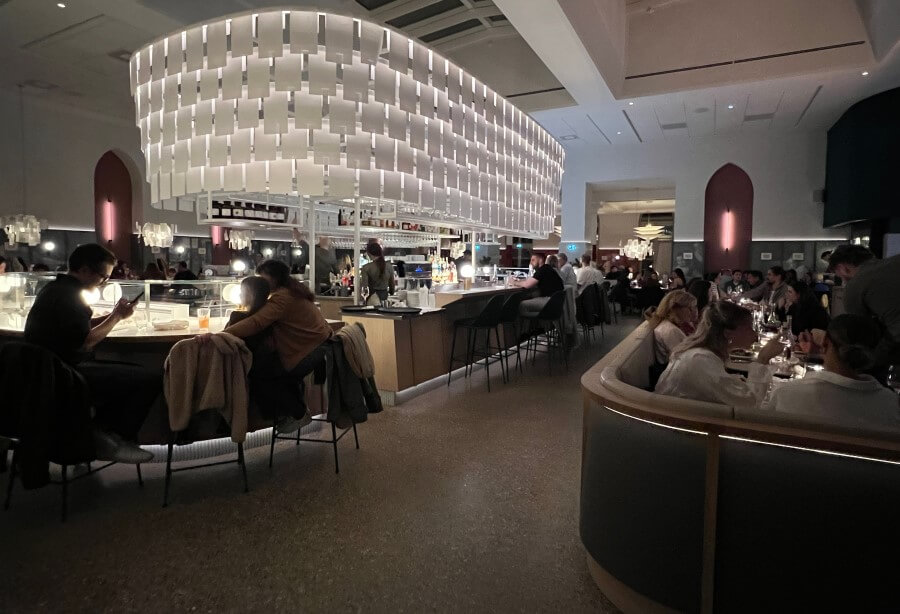
The interior of Chere Amie in Strasbourg
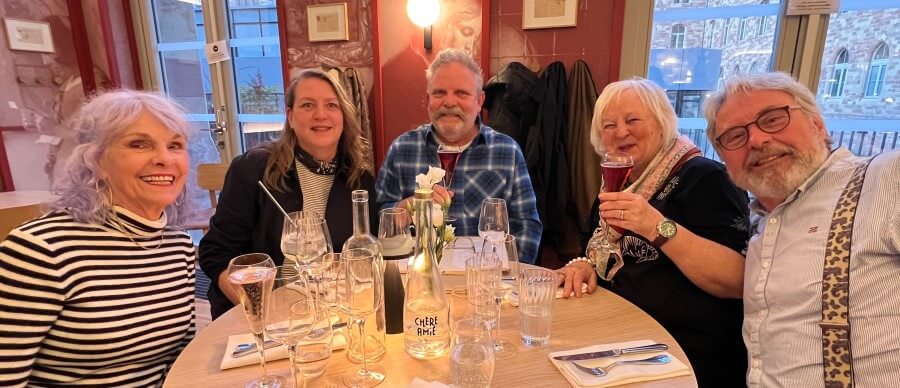
Clista, Anne, Johnny, Christa, and Dirk at Chere Amie
Sunday morning was the perfect moment to visit the Musée de l’Œuvre Notre-Dame, considered one of Strasbourg’s true treasures—quiet, profound, and often overshadowed by the cathedral next door. The museum is built around the Fondation de l’Œuvre Notre-Dame, founded in the 13th-century, and over centuries, it kept everything: plans, sculptures, fragments, and even quite a bit of stained glass. Eventually, all of this was brought together into the museum in 1931, creating a single place that tells the story of Strasbourg’s medieval artistic power.
As you wander through the rooms, up the stairs and around the ancient building, you find the real statues from the cathedral that originally stood on the façade of the cathedral were removed for preservation and replaced with copies. The museum spans from Romanesque times, through Gothic and into the Renaissance period (up to 1681) .
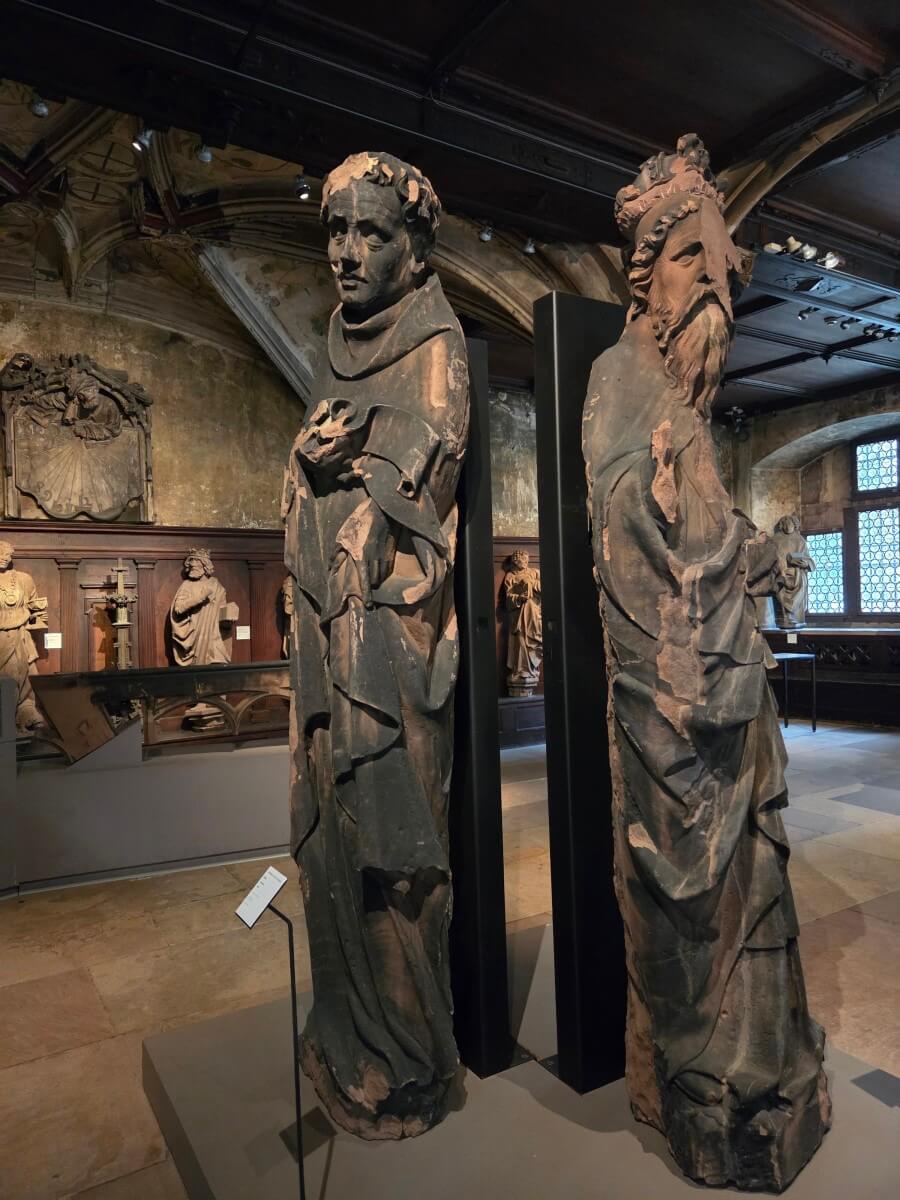
We were the first in and likely the first out, although about 1.5 hours later. For those who are fascinated by these historical periods, you will likely love it. For me personally, all I saw was a lot of very sad faces on the statues and in the paintings that reminded me how life must have been very miserable during those centuries, and how religion must have been very oppressive to the people. The cathedral itself dominates the Strasbourg landscape, much more so than Nôtre Dame does in Paris, to the point of being overwhelming—as I said…from my personal point of view.
Easter Sunday lunch was at the Maison Kammerzell, that iconic building next to the cathedral that is famous for not only being the most photographed building in the city, but the possible inventor of the three-fish version of choucroute (sauerkraut)—”choucroute de la mer.”
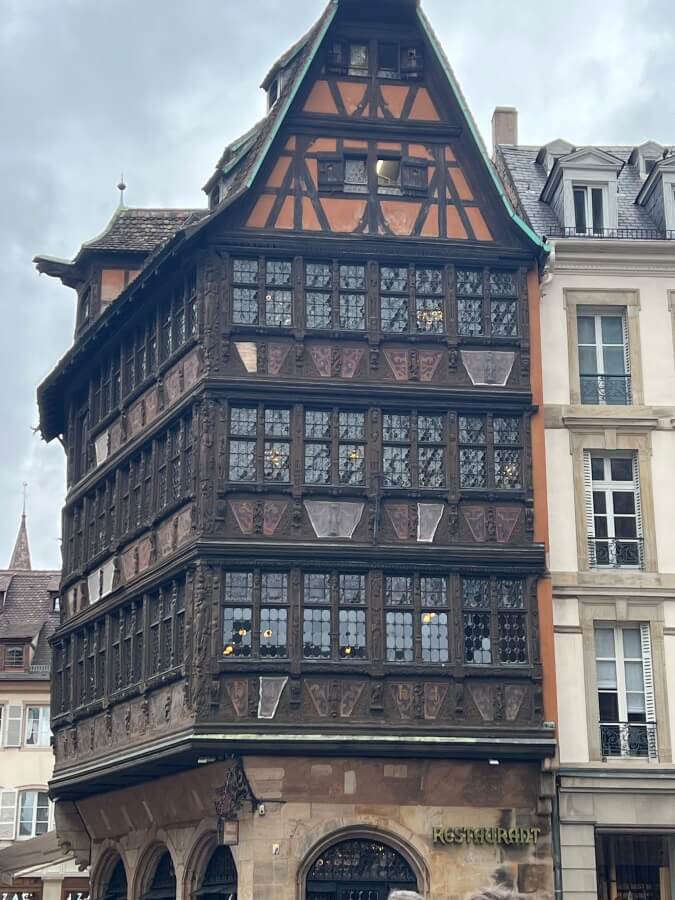
Maison Kammerzell in Strasbourg
Alsace, despite its Germanic culinary roots, is not landlocked in spirit—thanks to the nearby Rhine River, it has always been connected to major trade routes. Fish—fresh and smoked, made their way inland regularly. At some point in the late 20th-century, chefs began asking: “What if we kept the tangy, wine-braised cabbage, but replaced the heavy pork with something lighter?”
The answer became choucroute de la mer. There’s no single rigid rule, but the traditional trio usually includes salmon, smoked haddock and white fish of some kind. No one restaurant can definitively claim to have invented, but the name most often associated with it was none other than Maison Kammerzell.
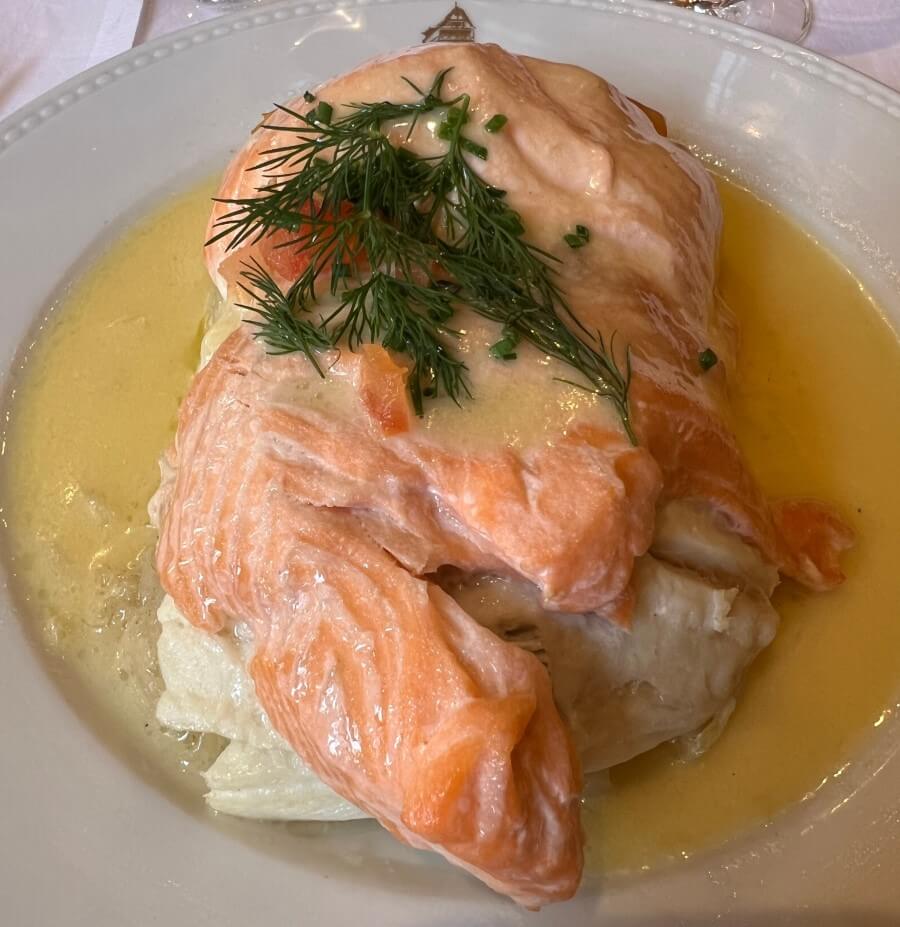
Choucroute de la mer
I had to have it. Not just to taste it, but to be able to tell you all about it in this Nouvellettre®. We met our German friends there to fully experience Strasbourg. Christa ordered the traditional choucroute with four or five different pork meats piled on top. The quantity bordered on absurd, and in all honesty, none of it was appealing. At that moment I realized that Strasbourg’s culinary specialties would never be on my diet and living there would forever frustrate me. (I spent quite a bit of time talking about how much I miss New Orleans cooking and fresh boiled seafood!)
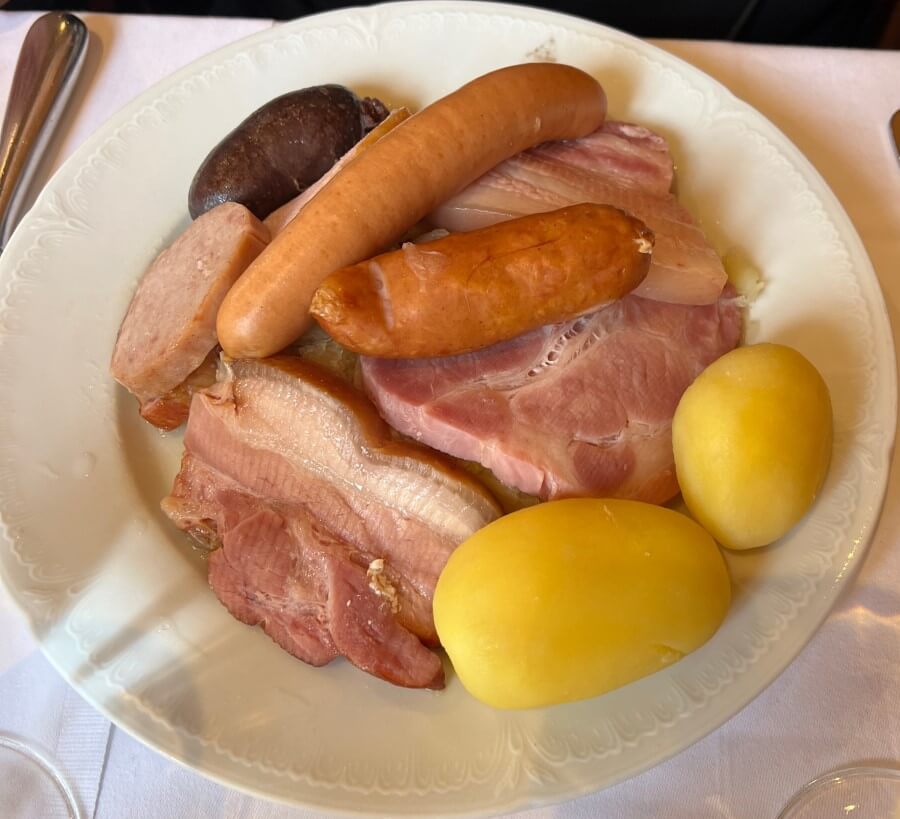
A traditional meat Choucroute
We had booked a boat tour on the Ill River by Batorama that boards on the river very near the cathedral. It takes you, along with about 125 passengers, from downtown to the European Parliament, through the imperial district of Neustadt, discover Strasbourg from a unique perspective—like a walk along the waterfront! With earbuds they distribute plugged in alongside your seat, you hear in your language all about every aspect of what you’re seeing.
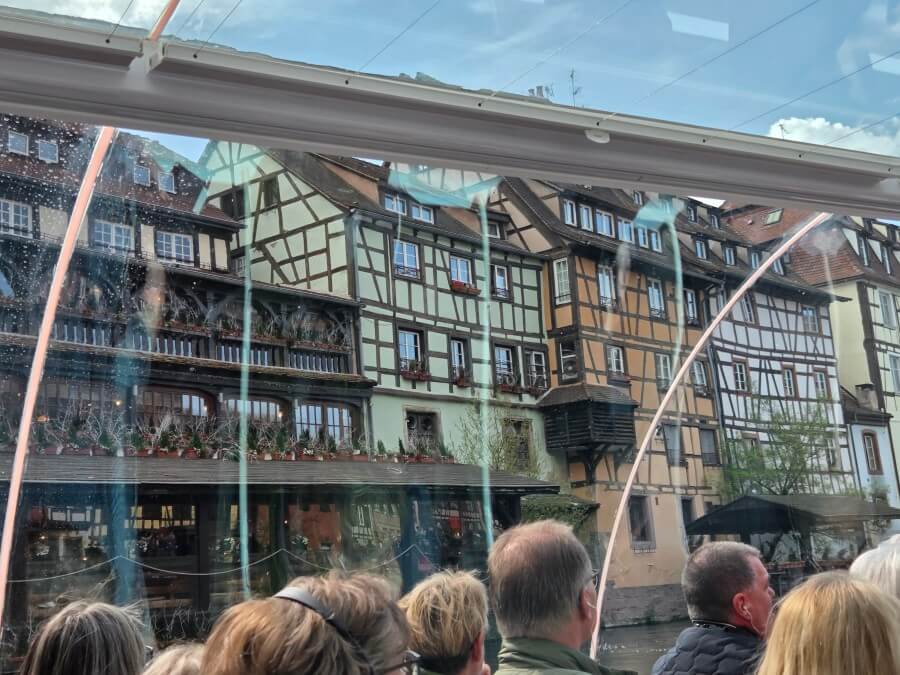
On the Batorama boat tour in Strasbourg
A group of Italians surrounding us were so loud and talking non-stop that we could barely hear the recording. It was a perfect moment for me to nap, so I sadly missed quite a bit of it, but perhaps I needed the break. I’ll have to go back and try again.
Our weekend in Strasbourg topped off with the “apéro” at Le Gruber. The restaurant had kindly set up a long table for a dozen people and that’s how many showed up. Everyone were my readers, except for one couple Anne and Johnny had invited. Another couple were our clients from Nice who decided Nice wasn’t their cup of tea and moved to Strasbourg. The group was congenial and informative.
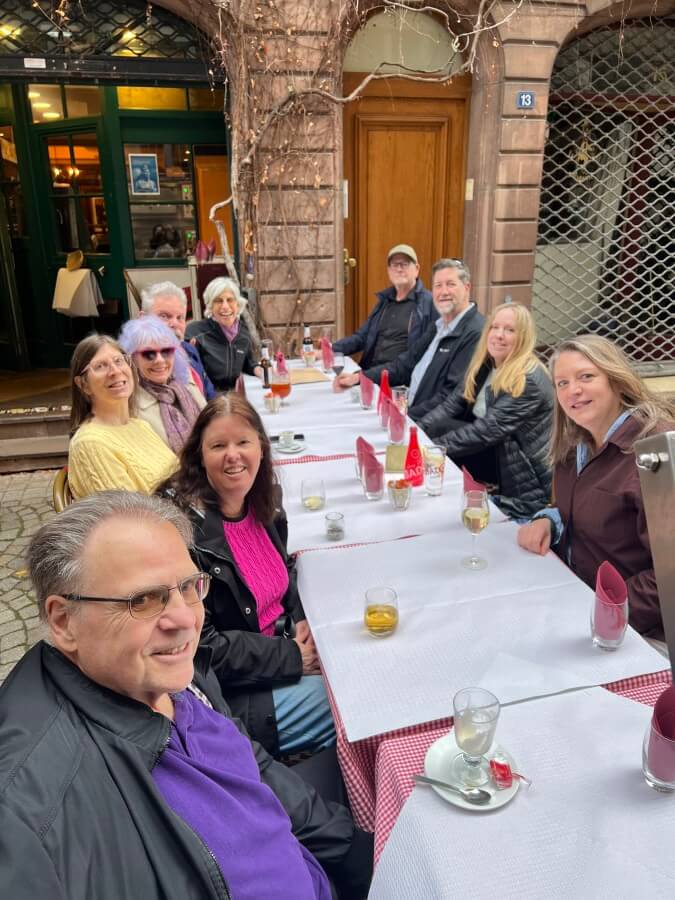
Afternoon Apéro with Adrian and the group of locals
Everyone loved living in Strasbourg and had nothing, but good things to say about it. They reiterated the things that I deem important for a great place to live in France:
• It has a good strong American community and a couple of organizations where one can easily and quickly make friends. (Americans in Alsace and ESC English-Speaking Community of Alsace,and Democrats Abroad. It also has a good-sized and well-established Jewish community, that has an important history.
• Getting around is easy because the local transportation system is excellent. (Strasbourg was one of the first cities in France to install a tramway.)
• The health care system actually pays more than in other cities. Thanks to a historical holdover from when the region was under German rule, social security offers more generous reimbursements than the rest of France. (Doctor visits and other services pay 90% compared to the 60–70% standard reimbursement.)
• Because of the international community, there is broad range of different ethnic restaurants, so you’re not stuck eating heavy Alsatian food all the time. (This turned out to be great for us having discovered a really good Tibetan restaurant last night, that was also ridiculously inexpensive!)
• Even though I’ve always thought the weather was very cold, it’s tempered the last few years with global warming and isn’t as cold as one might think. Paris is milder but gloomier. Strasbourg is sharper, more defined.
I learned so much from the group—which translates to doing a better job consulting with clients about where to live in France. Learning what makes a city a great place to live is essential in helping our clients make this very important decision. (And you will hear from us soon about our expansion into other parts of France so that we can be absolutely full-service.)
Incredulously, Anne and Johnny moved to Strasbourg without ever having visited it! His German roots made the decision a “no brainer,” although it was a big leap to take without knowing what they would find. For them, it’s been the perfect adventure and claim it as home, already doubtful they will ever return to the U.S. to live.
I asked them what they thought about the best neighborhoods in Strasbourg to live, depending on how you want to balance investment value, livability, and long-term appeal and I did my own research. Everyone seems to agree that the Orangerie/Conseil des XV is the most prestigious residential area with elegant buildings, embassies, international institutions, just steps from the Parc de l’Orangerie—it’s quiet, green, and very safe. These properties have the highest values in the city.
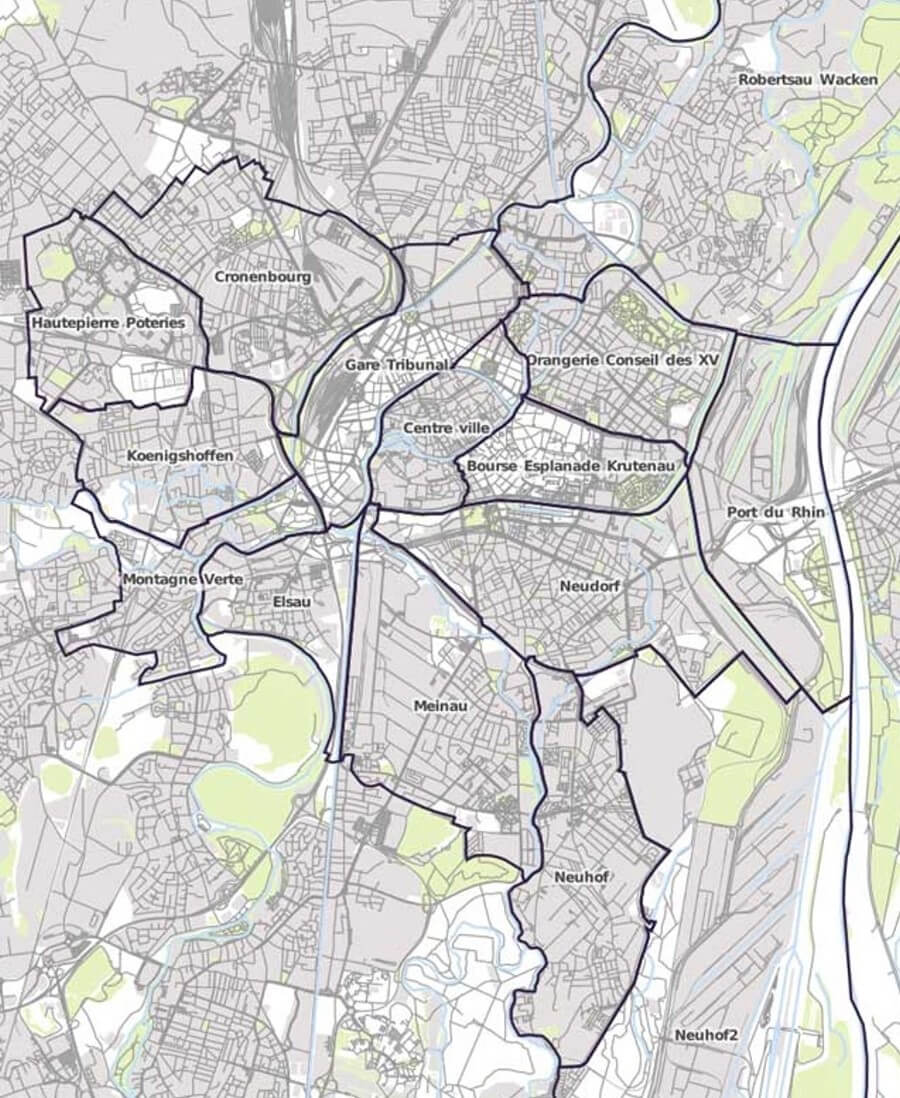
Map of the quartiers in Strasbourg
Neustadt (German Imperial District) gets the second runner-up. A UNESCO-listed district with grand architecture, wide boulevards, high ceilings, beautiful façades, the values are strong and stable. It’s central, but residential and elegant—perfect for buyers wanting space, character, and good proximity to the city center.
The Krutenau is where they are living. It’s trendy, youthful, near the universities and has lots of cafés, restaurants, and nightlife. The values are rising quickly and has a dynamic lifestyle, but can be noisy. For investors, rentals, and younger buyers, it’s ideal.
The Robertsau district has more of a village feel, is inside the city, but close to European institutions. The property values are strong, especially for houses, as it’s quiet, suburban and nature-oriented. For families wanting space and calm, this might be ideal.
The Grande Île (historic center) is actually a bit further down on the list, even though it might be postcard picture perfect. We searched for grocery stores and found very few—and in fact were more like small incidental markets than “supermarchés.” Perhaps a pied-à-terre here for occasional use or short-term rental, but not for daily life.
It reminded me of how I feel about living in Old Town in Nice. I set out for years to find an apartment there thinking it was the only place to be, when in fact, it was not that at all, but would be great as a pied-à-terre for occasional use or short-term rental, but not for daily life.
So if you’re thinking of moving to Strasbourg, consider this: if your priority is:
• Prestige & stability: Orangerie/Conseil des XV
• Character + central living: Neustadt
• Rental yield & energy: Krutenau
• Peace & greenery: Robertsau
• Charm (but compromise): Grande Île
Strasbourg is small enough that everything is accessible, but the feel of each neighborhood is completely different. This is not Paris—you’re not choosing between arrondissements. You’re choosing between ways of living.
Put Strasbourg high on your list, for both a great city to visit and a great city to live.
A la prochaine…
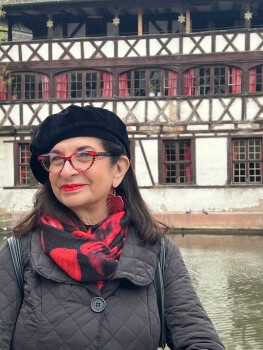 Adrian Leeds
The Adrian Leeds Group
Adrian in Strasbourg
P.S. In addition to our property services, we also focus on living in France on a practical level—like moving, renovating, and finding the perfect location for you to put down your roots in France. Our website is the perfect place to begin your education into everyday life in France.
2 Comments
Leave a Comment

Let Us create a custom strategy for you
You can live or invest in France-now.
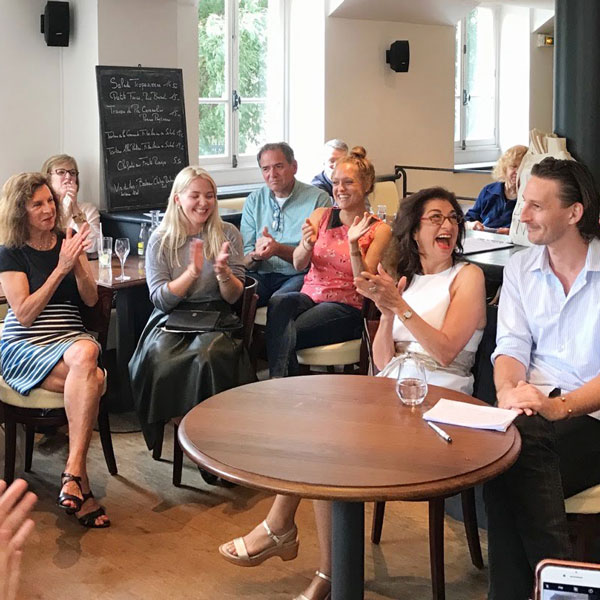
Join us at our monthly Après-Midi.
Become a part of the Paris community.
Property for sale
Read & Subscribe
Dive into more by reading the French Property Insider
Better yet, subscribe to both and get the updates delivered to your inbox.
Global Money Services
Our contacts will help you invest in France.


See Adrian on HHI

Join us on Youtube
Dive into more on how to live, invest & escape to France
Be sure to subscribe!
To read more, click the links below.
Great article, thanks. I liked the summary about the best neighborhoods in Strasbourg to live. Do you have something similar (or are planning to have) for Bordeaux?
Stay tuned!